GoDataAnalytics @GoDataAnalytic
#DataScientist #Machine_Learning #AI #Robotics #BigData #NLP #Data_Mining #Dtata_Analytics #blockchain #Artificial_Intelligence #Neural_Networks #Deep_Learning Stanford, CA Joined March 2018-
Tweets3K
-
Followers411
-
Following4K
-
Likes1K

I just open-sourced my /learn skill. Learn anything with agents and HTML artifacts. I have been learning about all kinds of topics with it. Install the skill and interact with any agent to help you through any topic. Ask it to generate visual and interactive artifacts and help you go deeper or generate knowledge checks (e.g., quizzes). Upskilling myself on any topic is one of the most impactful ways I have been able to use AI agents. If you are a DAIR Academy pro member, you can use it with our AI Builder. Skill: github.com/dair-ai/dair-a… Try now: academy.dair.ai
My new favorite skill is /learn. I built it to learn any topic at whatever level you like. It combines two of my passions: artifacts and learning. Coming soon to the @dair_ai academy.
// Self-Harness: Harnesses That Improve Themselves // (bookmark this one) Most of the agent scaffolds we rely on today are built once and remain frozen or mostly unchanged. The harness, like the skills, needs to evolve with new models. What if the scaffold rewrites itself? This new work treats the harness, the prompts, tools, and control flow around the model as a learnable artifact that improves from its own runs rather than staying a fixed wrapper you hand-maintain. The scaffolding becomes the part that compounds, run after run. If you run long-horizon agents, a self-modifying harness turns scaffold upkeep from manual work into something the system earns on its own. Paper: arxiv.org/abs/2606.09498 Learn to build effective AI agents in our academy: academy.dair.ai

🚨 ANTHROPIC JUST PUBLISHED A 36-PAGE SECURITY GUIDE THAT BASICALLY TELLS YOU TO STOP TRUSTING YOUR OWN AI AGENTS. If you run agents on Claude Code, MCP servers, or automation tools, pay attention. The attack timeline has collapsed. AI models compress the gap between a vulnerability and a working exploit from months to hours, for mere dollars. Agents introduce new autonomous risks, from tool poisoning to context memory manipulation. The most useful idea in the guide is Anthropic's new security test: Does a control make an attack impossible, or just tedious? Automated attackers have unlimited patience. They will grind straight through friction like rate limits and 2FA. To defend at the speed of AI, you need hard barriers and automated defensive operations. Here is how Anthropic says you should lock down agents: → Treat static API keys as compromised. Use short-lived tokens that expire in minutes. → Apply "Least Agency": explicitly limit what each tool can DO. → Sandbox agents that process untrusted inputs like emails and web pages. → Scope permissions dynamically per task, not permanently. I've added the link to the guide in the 🧵↓


Hands on AI Engineering! I open-sourced a collection of 50+ hands-on AI engineering tutorials. It features step-by-step projects and tutorials on: • AI Agents and Multi-agents • RAG (Agentic, Vision, and Local) • MCP AI Agents • OCR Apps • Voice AI Agents • & so much more 100% free and open source. 1k+ Github stars I've shared the link in the comments!

🚨 Anthropic just dropped a FREE 23-page enterprise AI playbook, and it’s a must-read for anyone looking to scale their operations! It’s essentially a free operating manual for turning Claude into your company's core infrastructure. The main takeaway? A generic model gives you generic output. To really win, you have to teach Claude exactly how your unique business works! The results are incredible when you train AI on your company’s DNA: → L’Oréal hit 44,000 monthly users with 99.9% accuracy. → Lyft cut support resolution times by a massive 87%. → Rakuten sped up product releases from quarterly to bi-weekly! The architecture making this possible is brilliant: → MCP connects Claude to your tools. → Plugins store reusable company knowledge. → Claude Cowork provides an intuitive interface. Good AI adoption isn't buying disconnected tools. It’s making AI your actual operating system! I pasted the link to the playbook in the 🧵↓

whichllm automatically detects your hardware and ranks the best local LLMs from HuggingFace that actually run on your system. - Evidence-based ranking from merged benchmarks, not just VRAM size - Simulate any GPU before buying hardware with `--gpu "RTX 4090"` - Recency-aware scoring demotes stale leaderboard entries - Returns JSON for scripting with `--json` flag Explore it here: osp.fyi/whichllm

Anthropic engineer: "You're not supposed to watch Claude Code work. You're supposed to wake up and review what it shipped." In 22 minutes she builds the entire workflow live on camera. Most people close their terminal and everything stops. This setup keeps shipping while you sleep. Watch the video, then save the exact setup below👇
Just released my new /lesson-generator skill. Use it with your agent to learn anything: - generate lessons/courses on any topic - include nano-banana images with my /image-generator skill - present the course as an HTML artifact And it's also available to use in our academy.

🚨 لو عايز تخلص من عقدة الـ Limit في Claude وتخليه يكفيك وقت اطول.. البوست ده ليك! احفظ البوست ده عندك فوراً وشوفه عشان توفر على نفسك الـ Limit وتعرف إزاي تطلع أقصى استفادة من كل Session. كلنا بنشتكي إن الـ Limit بيخلص بسرعة، بس الحقيقة إنك بتستهلك الـ Context بتاعك غلط ببرومبتس طويلة وبتعيد فيها نفس الكلام في كل شات! صناع الموديل نفسهم (شركة Anthropic) لسه منزلين ورشة عمل مدتها 24 دقيقة، بتشرح الـ Playbook والأسلوب الرسمي الوحيد لهندسة الـ Prompts وترتيب الـ Context بشكل يخلي الـ AI يطلع لك نتايج عبقرية من أول شات وبأقل استهلاك للمصادر والـ Tokens. واللي بيشرح فيها هما نفس المهندسين اللي بنوا Claude بإيديهم. المحتوى مجاني بالكامل، من غير تسجيل، ومن غير أي اشتراكات. أنا شفت كورسات بـ فلووووووس كتير جدا مش بتغطي ربع الكنز اللي مشروح في أول 8 دقائق بس من الفيديو ده. الفرق بين اللي بيخلص الـ Limit بتاعه في دقيقتين على الفاضي، واللي بيخليه يبني له سيستم كامل بنفس الـ Limit، هو فهم التكنيكات اللي جوه الورشة دي.

LLM Wikis + HTML Artifacts are insanely powerful. You should seriously consider this in your workflows. LLM Wikis captures all the important information that lets you and your agents do meaningful work. HTML artifacts present that information in interesting ways that allow you to take important actions along with your agents. My HTML artifacts sit on top of my LLM wikis. They are dynamic and are easily extended as needs arise. I have hooked my Artifacts to talk to my agents, and similarly, the agents can talk to artifacts. This has allowed me to build powerful artifacts that reduce my inbox to zero, keep me updated on any topic of interest, fast prototyping, do deep research, design/trigger new experiments, generate figures to improve understanding, schedule research, search relevant information, discover topics, and so much more. What you see in the clip is not a website. It's a simple interactive HTML artifact. HTML artifacts are useful for designers, engineers, researchers, students, and anyone working with agents. Lastly, HTML doesn't replace Markdown. They are a much better combination working together.

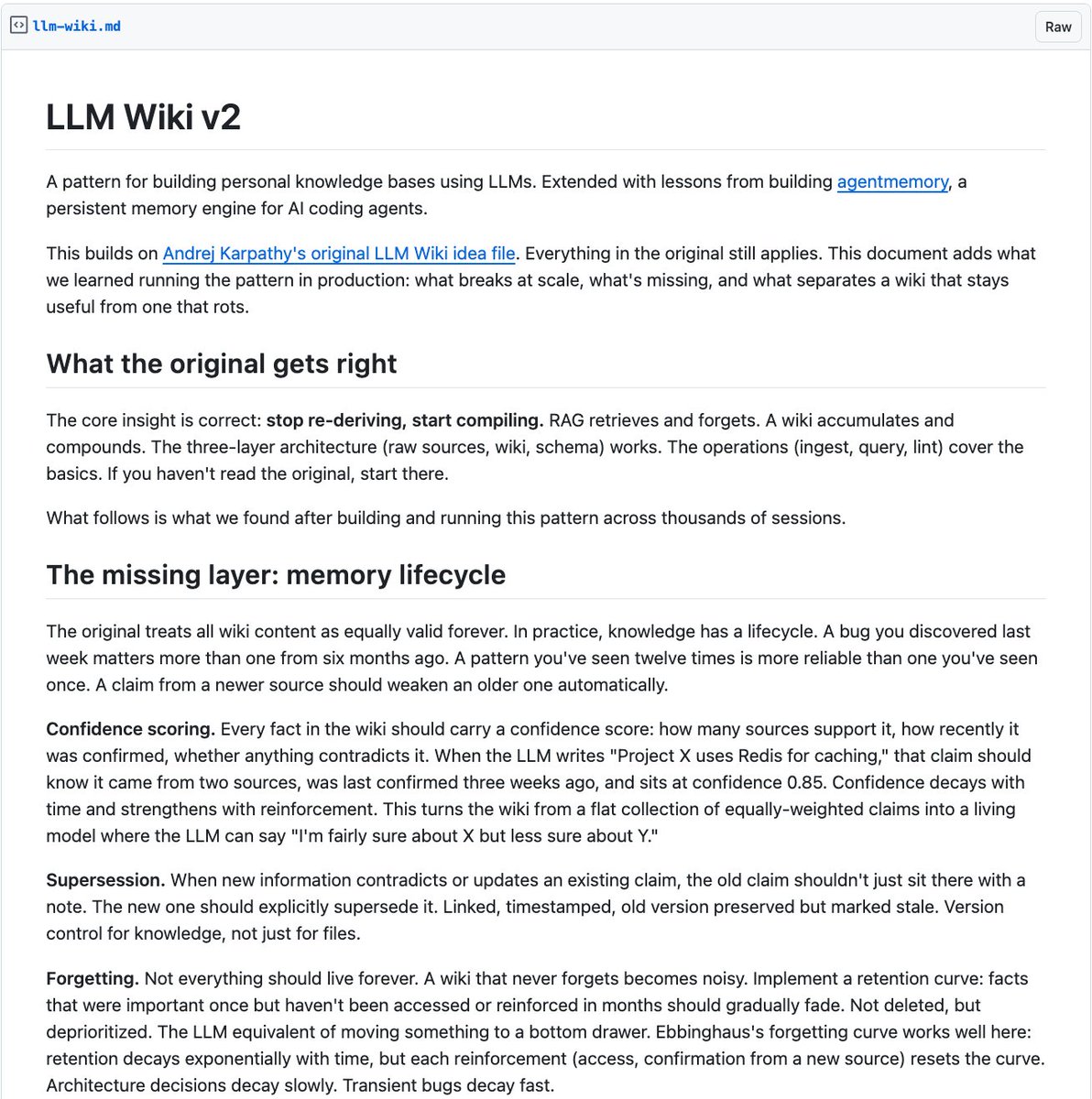
Karpathy's LLM Wiki got 5,000 stars in 48 hours. Now someone extended it with the features it was missing. Memory lifecycle. Confidence scoring. Knowledge graphs. Automated hooks. Forgetting curves. It's called LLM Wiki v2. The original pattern was brilliant. AI builds a wiki instead of re-deriving knowledge from scratch every time. But it treated all knowledge as equally valid forever. In practice, that breaks. Here's what v2 adds: → Confidence scoring. Every fact carries a score. How many sources support it. How recently confirmed. Whether anything contradicts it. Knowledge that decays over time. Not everything is equally true forever. → Memory tiers. Working memory for recent observations. Episodic memory for session summaries. Semantic memory for cross-session facts. Procedural memory for workflows. Each tier more compressed and longer-lived. → Knowledge graph. Not flat pages with links. Typed entities with typed relationships. "A caused B, confirmed by 3 sources, confidence 0.9." Graph traversal catches connections keyword search misses. → Hybrid search. BM25 for keywords. Vector search for semantics. Graph traversal for structure. Fused with reciprocal rank fusion. Replaces the index .md file that breaks past 200 pages. → Automated hooks. On new source: auto-ingest. On session end: compress and file. On schedule: lint, consolidate, decay. The bookkeeping that kills wikis is now fully automated. → Forgetting curves. Facts that haven't been accessed or reinforced in months fade. Not deleted. Deprioritized. Architecture decisions decay slowly. Transient bugs decay fast. → Contradiction resolution. AI doesn't only flag contradictions. It resolves them based on source recency, authority, and supporting evidence. Here's the wildest part: The original LLM Wiki was a flat collection of equally-weighted pages. This turns it into a living system with memory that strengthens, weakens, consolidates, and forgets. Like a real brain. "The Memex is finally buildable. Not because we have better documents or better search, but because we have librarians that actually do the work." Built on lessons from agentmemory, a persistent memory engine for AI agents. Extends Karpathy's original. Open Source.

What does every big company think about the agent harness? Anthropic, OpenAI, CrewAI, LangChain. They all build agents. They all wrap their models in infrastructure to make them useful. They each call it the harness. But they agree on one thing. And disagree on everything else. The agreement: the model is not the product. The infrastructure around the model is. The disagreement: how much of that infrastructure should exist. This is the most important architectural bet in AI right now. And each company is placing a different one. 𝗔𝗻𝘁𝗵𝗿𝗼𝗽𝗶𝗰 bets on the model. Their harness is deliberately thin. A "dumb loop" that assembles the prompt, calls the model, executes tool calls, and repeats. The model makes all the decisions. The harness just manages turns. Their bet: as models get smarter, you need less infrastructure, not more. 𝗢𝗽𝗲𝗻𝗔𝗜 takes a similar but slightly thicker approach. Their Agents SDK is "code-first," meaning workflow logic lives in native Python, not in some graph DSL. But they add more structure: strict priority stacks for instructions, multiple orchestration modes, and explicit agent handoff patterns. 𝗖𝗿𝗲𝘄𝗔𝗜 adds a deterministic backbone. Their Flows layer handles routing and validation with hard-coded logic, while their Crews handle the autonomous parts. Intelligence where it matters, control everywhere else. 𝗟𝗮𝗻𝗴𝗚𝗿𝗮𝗽𝗵 bets on explicit control. The harness encodes the logic. Every decision point is a node in a graph. Every transition is a defined edge. Planning steps, routing strategies, multi-step workflows are all spelled out in the harness, not left to the model. Notice the spectrum. On one end: trust the model, keep the harness thin. On the other: encode the logic, make the harness thick. And here's where it gets interesting. The scaffolding metaphor makes this concrete. Construction scaffolding is temporary infrastructure that lets workers reach floors they couldn't access otherwise. It doesn't do the building. But without it, workers can't reach the upper floors. The key word is temporary. As the building goes up, scaffolding comes down. Manus demonstrated this perfectly. They rebuilt their agent five times in six months. Each rewrite removed complexity. Complex tool definitions became simple shell commands. "Management agents" became basic handoffs. The scaffolding did its job. So they removed it. This is also why Anthropic regularly deletes planning steps from Claude Code's harness. Every time a new model version ships that can handle something internally, the corresponding harness logic gets stripped out. But there's a catch. Models are now trained with specific harnesses in the loop. Claude Code's model learned to use the exact scaffolding it was built with. Change the scaffolding, and performance drops. The worker trained on THIS scaffolding. Swap it out, and they stumble. So the field is converging on a principle: Build scaffolding that's designed to be removed. But remove it carefully, because the model learned to lean on it. The "future-proofing test" for any agent system: if dropping in a more powerful model improves performance without adding harness complexity, the design is sound. Two products using the exact same model can perform completely differently based on this one decision: how thick is the harness? LangChain changed only the infrastructure (same model, same weights) and jumped from outside the top 30 to rank 5 on TerminalBench 2.0. The model didn't improve. The scaffolding around it did. The article below is a deep dive on agent harness engineering, covering the orchestration loop, tools, memory, context management, and everything else that transforms a stateless LLM into a capable agent.

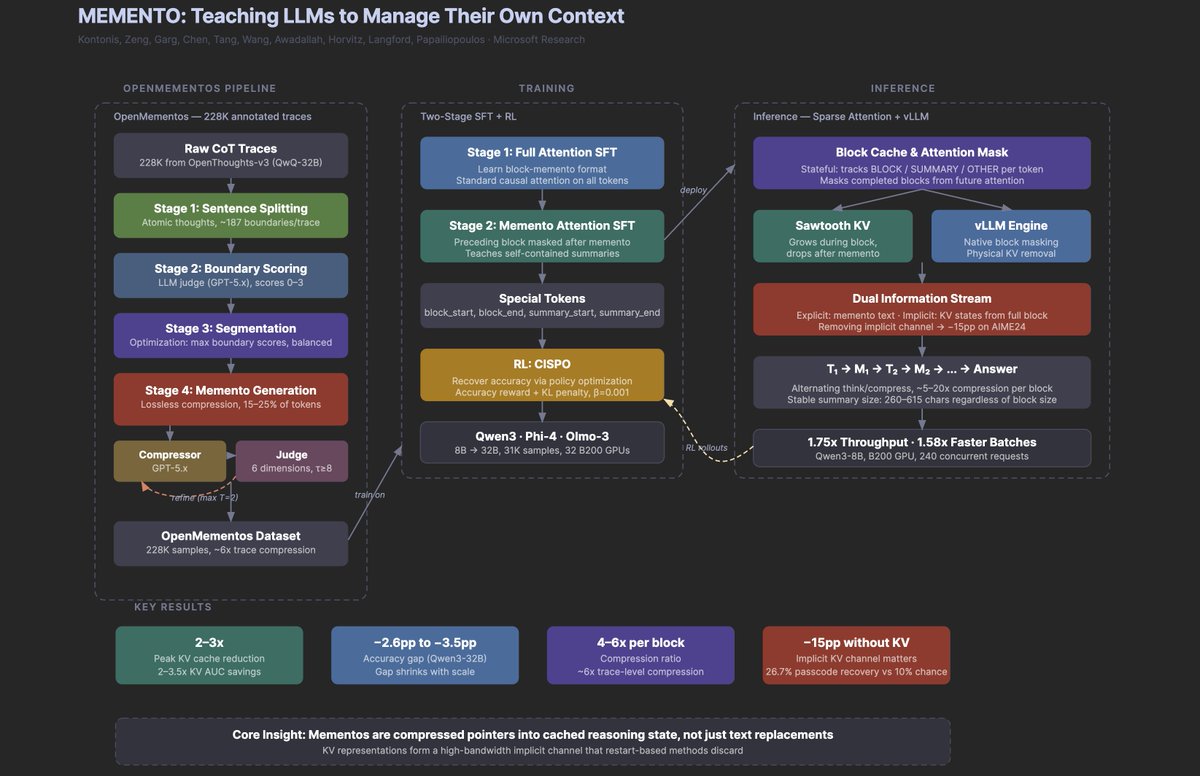
Another banger paper from Microsoft. Why it's a big deal: It teaches reasoning models to compress their own chain-of-thought mid-generation. The most interesting finding isn't the 2-3x memory savings or the doubled throughput. It's that when the model erases a reasoning block after summarizing it, the deleted information keeps leaking forward through the KV cache representations, forming an implicit second channel that accounts for 15 pp of accuracy. The model is, in some meaningful sense, remembering things it can no longer see. If context management turns out to be a teachable skill (and 30K training examples seem to be enough), then the bottleneck for long-horizon agents may be less about architecture and more about the right training data, which is a very different kind of problem than most people are working on. If it helps, below is my research agent's visual summary of the paper (at least highlighting the key parts).

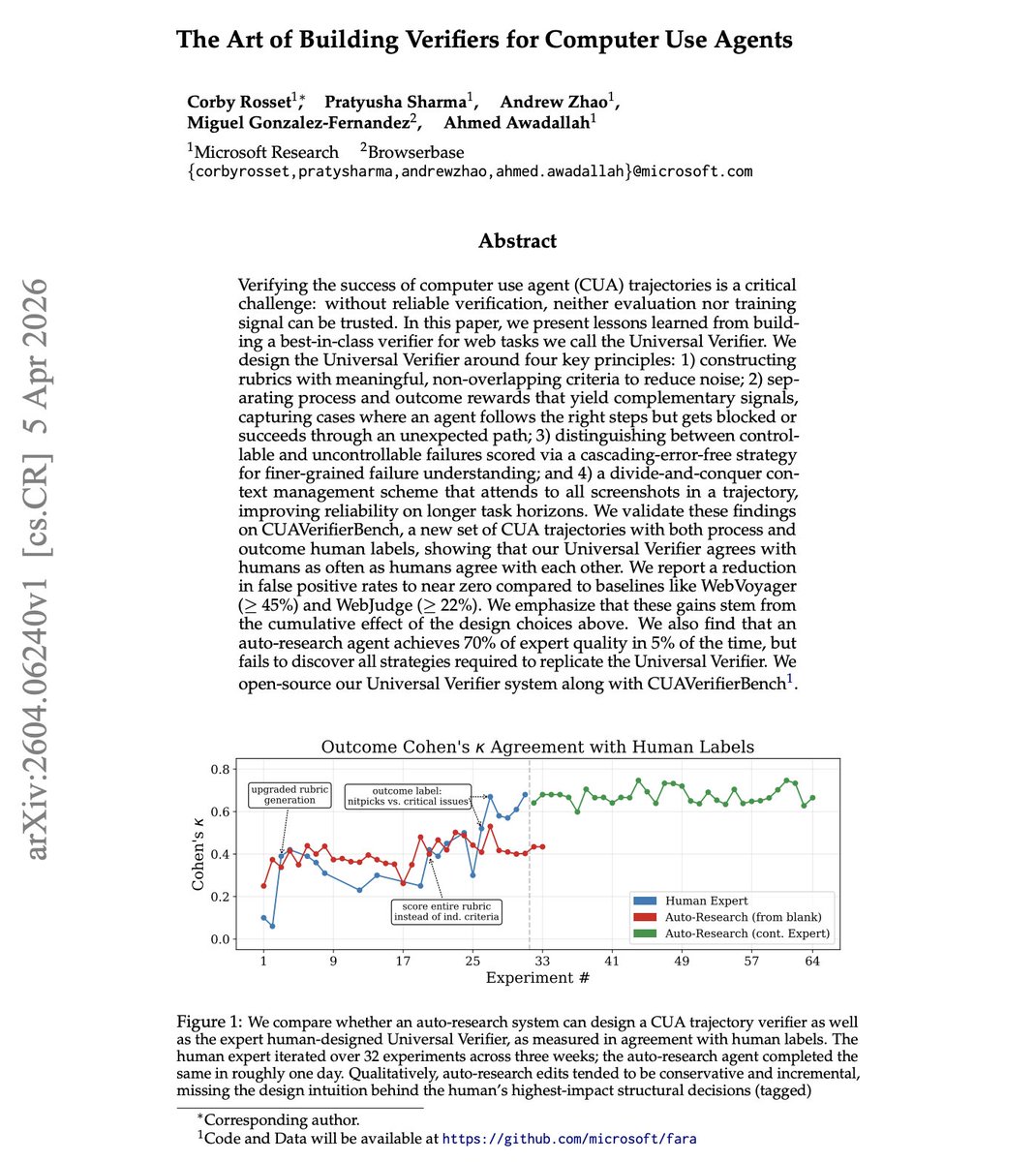
NEW paper from Microsoft Every agent benchmark has the same hidden problem: how do you know the agent actually succeeded? Microsoft researchers introduce the Universal Verifier, which discusses lessons learned from building best-in-class verifiers for web tasks. It's built on four principles: non-overlapping rubrics, separate process vs. outcome rewards, distinguishing controllable from uncontrollable failures, and divide-and-conquer context management across full screenshot trajectories. It reduces false positive rates to near zero, down from 45%+ (WebVoyager) and 22%+ (WebJudge). Without reliable verifiers, both benchmarks and training data are corrupted. One interesting finding is that an auto-research agent reached 70% of expert verifier quality in 5% of the time, but couldn't discover the structural design decisions that drove the biggest gains. Human expertise and automated optimization play complementary roles. Paper: arxiv.org/abs/2604.06240 Learn to build effective AI agents in our academy: academy.dair.ai

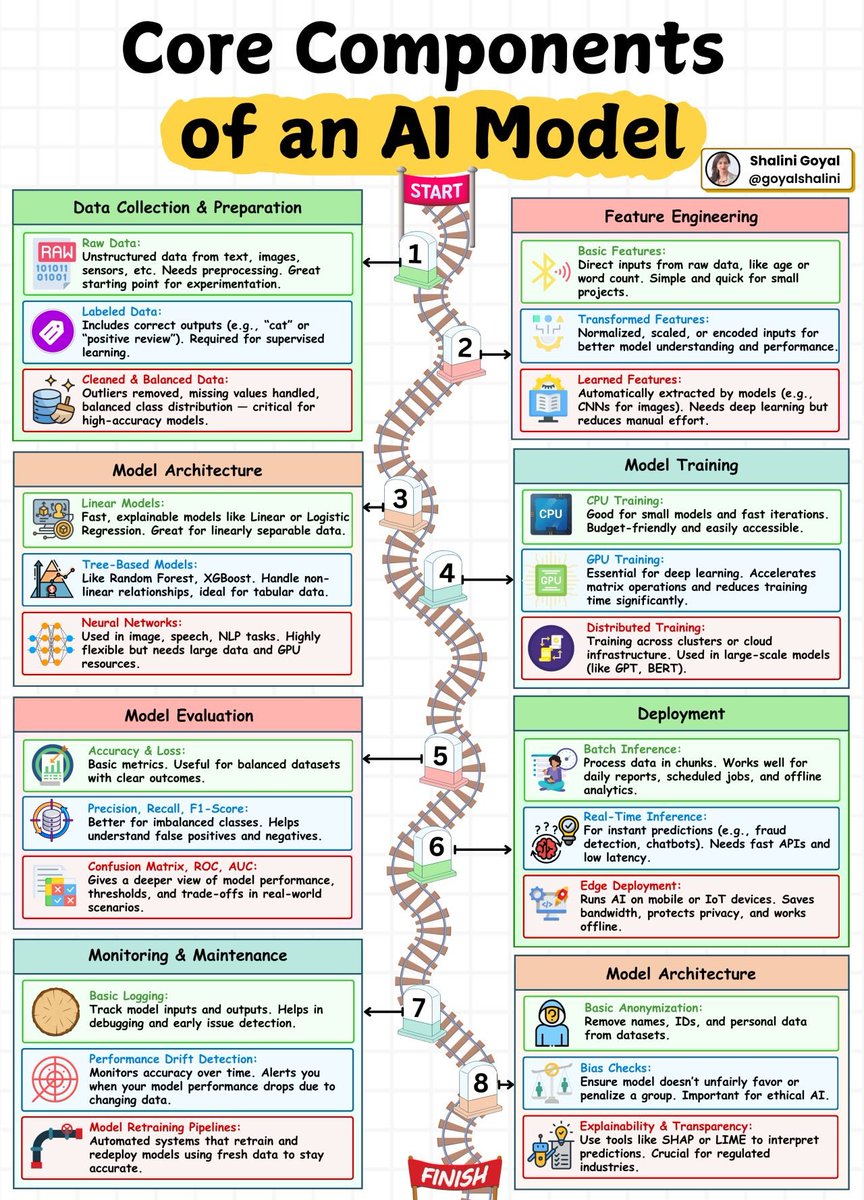
Building an AI model isn’t just about training a neural network - it’s a full journey with 8 critical stages. From data collection to model monitoring, here’s how AI systems are built and maintained today: 1. Data Collection & Preparation Everything starts with data. Raw input like text, images, or sensor readings is collected, labeled with correct outputs, and cleaned for quality. This foundation is vital for training high-performing models. 2. Feature Engineering Raw data is refined into useful inputs. Basic features are used for simple models, while advanced tasks rely on transformed or learned features from neural networks. 3. Model Architecture Here you choose the model type — linear models for simplicity, tree-based for tabular data, and neural networks for complex tasks like vision and NLP. 4. Model Training You train the model using CPUs for small workloads, GPUs for deep learning, or distributed systems for massive models like GPTs. 5. Model Evaluation After training, you evaluate performance using metrics like accuracy, F1-score, and confusion matrices. These metrics show how well the model is doing - especially on real-world data. 6. Deployment Once ready, the model is deployed. You can serve predictions in real-time (like chatbots), in batches (like analytics reports), or on edge devices (like mobile apps). 7. Monitoring & Maintenance AI doesn’t stop at launch. Logs are tracked, performance is monitored for drifts, and retraining pipelines ensure the model stays accurate as data evolves. 8. Model Architecture (Trust & Ethics) To keep models fair and explainable, anonymization, bias checks, and transparency tools like SHAP or LIME are implemented — especially important in regulated industries. From raw data to real-world impact - this is the full roadmap of an AI model. Save this guide as your go-to reference if you're building or working with AI systems in 2026!
🚨 @karpathy literally ditched traditional RAG for an autonomous Obsidian file system. Instead of writing code, he dumps raw AI research into a local folder and lets an LLM convert it into an interconnected markdown wiki. He rarely edits the text manually. By relying purely on dynamically updated index files, the system navigates the exact context it needs natively without relying on flawed vector embeddings. Because the LLM fully understands the file structure, it executes advanced autonomous workflows: → Operates a custom vibe-coded local search engine → Renders complex charts and formatted markdown slides → Continuously compounds a 400,000-word knowledge base The most fascinating mechanic is the self-healing loop. He triggers background health checks where the LLM natively spots structural gaps, scrapes the internet for missing data, and cleans the articles perfectly. This feels the absolute blueprint for managing complex technical data 🔥 btw, he also plans to fine-tune a local model directly on the wiki so the research is baked into the neural weights rather than relying on limited context windows 👀


5 LLM fine-tuning techniques, explained visually:


30 AI algorithms that power modern AI 👇 📊 Linear & Logistic Regression 🌲 Random Forest ⚡ XGBoost 🎯 SVM 🔍 k-Means / DBSCAN 📉 PCA / t-SNE 🎮 Q-Learning / DQN 🧠 ANN / CNN / RNN / LSTM 🔁 Transformers 🧬 Genetic Algorithms Master the foundations → master AI.


What is RAG? What is Agentic RAG? > Retrieval-Augmented Generation (RAG) < ---------------------------------------------- Retrieval-Augmented Generation (RAG) is an architecture that enhances a language model’s outputs by grounding them in external knowledge sources at inference time. Instead of relying solely on parameters learned during training, RAG systems dynamically retrieve relevant information and inject it into the model’s context before generation. => Canonical RAG workflow > A user submits a query. > The query is embedded and matched against a pre-indexed corpus (commonly stored in a vector database). > The top-K most relevant document chunks are retrieved. > Retrieved context is appended to the original query. A language model generates a response conditioned on this augmented input. => Primary objective To reduce hallucinations and improve factual accuracy by grounding generation in verifiable, external context. => Key limitation > Traditional RAG is a single-shot pipeline: > No explicit reasoning or planning > No validation of retrieved evidence No iterative refinement if retrieval or generation is suboptimal The system assumes the first retrieval and generation pass is sufficient, which often breaks down for complex, ambiguous, or multi-hop queries. > Agentic RAG < ------------------ Agentic RAG extends standard RAG by introducing autonomous decision-making agents that can reason, plan, evaluate, and adapt across multiple steps. Rather than a static retrieval → generation flow, Agentic RAG operates as a closed-loop, goal-driven system. => Core idea Retrieval and generation are no longer treated as isolated steps, they become actions taken by agents in pursuit of a higher-level objective: producing a correct, complete, and useful answer. => Typical Agentic RAG Architecture 1./ Planning Agent > Interprets the user’s intent > Decomposes complex queries into sub-tasks > Determines what information is required and from which sources 2./ Retrieval Agent > Dynamically reformulates search queries > Retrieves information from: - Vector databases - Structured databases - APIs - Tools or live data sources > Can perform multi-hop retrieval when needed 3./ Generation Agent > Synthesizes retrieved evidence into a coherent response > Reasons across multiple sources > Maintains traceability between claims and evidence 4./ Evaluation (Judge) Agent > Critically reviews the generated output > Checks for completeness, correctness, and alignment with the original query > Decides whether to: - Accept the answer - Refine retrieval - Re-plan and regenerate This feedback loop can repeat until predefined quality criteria are met.


Ronald van Loon @Ronald_vanLoon
353K Followers 163K Following Helping AI driven companies generate value•Top10Influencer #AI #BigData #DataScience #IoT #MachineLearning #Analytics #Cloud
J @iemma4142
47 Followers 1K Following
Hailey Morales @haileymoraa9o
5 Followers 331 Following 💕 Hailey ✶ Aries energy ✶ golden hour mood ✶ pastel thoughts 🩷

Kal Vepuri @kalvepuri
17K Followers 7K Following Building a healthspan system @HeroHealth. (Pre)seed angel investor. 18 unicorns.
Manish Singhee @SingheeManish
1 Followers 131 Following
Lillian @BoehmVaugh17735
251 Followers 7K Following
Iliana @KennethBar44647
223 Followers 7K Following
Evelina @Eakuqrul485359
177 Followers 7K Following Keep shining, beautiful one. The world needs your light.
Manda NicheSite Build... @NicheSite_Manda
643 Followers 4K Following Building #NicheSites & Testing #NoCode Tools
Andrea Iorio @Aioriobr
244 Followers 821 Following Keynote Speaker (+100/year) on AI, Leadership, Innovation & CX | USA Today Best-Selling Author of “Between You and AI” (Wiley) | host of NVIDIA Brazil’s podcast
C-Suite Tech Point @CsuiteTechPoint
39K Followers 40K Following Fresh Tech News for Executives. #AI #Blockchain #Digital and much more.
Xawko @Xawko9455653
12 Followers 512 Following
Octavia Lombardi @ykuiaumau73060
17 Followers 998 Following I don’t need permission to exist loudly.
AdaWolf @01ipp0XFEhM7J10
46 Followers 2K Following
MaggiePope @77pqsHoft3j5IC
19 Followers 501 Following
Ooboeejiem @Ooboeejiem4456
20 Followers 2K Following
Rhouqauj @Rhouqauj626921
78 Followers 3K Following
Skylar @Jalcau681
37 Followers 2K Following
PreMarketGains🇺�... @Abivax248324
72 Followers 2K Following 15-30% Monthly | 2 High-Conviction Stocks.Short-Term Gains: 15-20% in Days/Weeks.DM "JOIN" for WhatsApp Alerts. Live Trade Signals • Market Analysis
Ali @ayoub_009
24 Followers 207 Following


Talnar @Talnar813
43 Followers 1K Following
Yvaine Morgan @YvaineMorgan
319 Followers 6K Following Designer 🌟 Making Your Personal Brand Look as Good as You Actually Are

Dnoslar @DnoslarvM1
11 Followers 434 Following
rina hart @rina_hart74
5 Followers 105 Following
Rewsouez @Rewsouez1nq0
15 Followers 436 Following
Teighsl @teighsl20112
11 Followers 230 Following
Tertto @TerttoCnKG
47 Followers 4K Following
All You Can Learn Dig... @AYCLearnDigital
38K Followers 38K Following All you can learn from the Digital world. Update, insight and new tech. #Digital #Business
Theallat @TheallatjPURye
36 Followers 4K Following
Wroughd @WroughdCPE
42 Followers 4K Following

Engineer John @TheDXEngineer
38K Followers 38K Following Hi, I'm an engineer sharing content in the digital field. #DigitalTransformation #Robotics #Industry40
Giorgio Robino @solyarisoftware
3K Followers 4K Following Conversational LLM-based Applications Specialist @ Almaviva | Former ITD-CNR Researcher | Soundscapes (Orchestral) Composer.
SharonChilde @5ZL83jIzlDxmOHn
63 Followers 7K Following
Baunea @BauneaoiR
31 Followers 1K Following
Jad F. Assaf @AssafJad
1K Followers 2K Following Post-Doctoral Scholar @CaseyEye | Medicine @AUB_Lebanon | AI in Cornea Imaging.
Hadiza Salihu @HadizaSali45345
12 Followers 278 Following
Thynough @ThynoughA66w
45 Followers 908 Following
Alejandro Ruíz Sánc... @RuzSnch
45 Followers 291 Following Biólogo, Maestro y Doctor en Ciencias Quimicobiologicas, me gusta la difusión de la ciencia y soy responsable de mis ideas y opiniones.
Fitairn @FitairniiJ
9 Followers 616 Following
Tasleausn @Tasleausn7izW9
39 Followers 4K Following
Scasu @Scasu9Ny914
13 Followers 596 Following

LenaWaters @h4t2ba5wF1EAJZ3
67 Followers 7K Following
Teauto @TeautolQLUj
59 Followers 4K Following
Sebastian Raschka @rasbt
465K Followers 1K Following ML/AI research engineer. Ex stats professor. Author of "Build a Large Language Model From Scratch" (https://t.co/O8LAAMRzzW) & reasoning (https://t.co/5TueQKx2Fk)
Ronald van Loon @Ronald_vanLoon
353K Followers 163K Following Helping AI driven companies generate value•Top10Influencer #AI #BigData #DataScience #IoT #MachineLearning #Analytics #Cloud
Kirk Borne @KirkDBorne
485K Followers 3K Following Advisor to startups. Freelancer. @LeadershipData founder. Global Speaker. Top #B2B influencer & social promoter #DataScience #AI #ML. PhD Astrophysics @Caltech
Data Science Dojo @DataScienceDojo
227K Followers 940 Following We make learning data science and LLMs easy! Join the community of 10,000+ professionals. #DSDojo
UNSW Medicine & Healt... @UNSWMedicine
5K Followers 980 Following This account is currently not actively managed. You can find us on other platforms @unswmedicine. CRICOS no. 00098G
SwissCognitive, AI Ve... @SwissCognitive
145K Followers 99K Following We are committed to unleashing the power of AI in the business world. With our AI research, advisory, and ventures, we bring a blend of expertise to the Table.
Khoon Lim @Khoonono
5K Followers 2K Following Prof @Sydney_uni / ARC Future Fellow / Group Leader @CPC_usyd/ 3DBioprinting / Biofabrication / Past President @asbte1
Prof Caroline Ford @DrCFord
4K Followers 3K Following Cancer Researcher, Advocate for #diversityinSTEMM Founder @stemminist #ovariancancer #endometrialcancer #endometriosis Views own. She/her
Jim Fan @DrJimFan
460K Followers 3K Following NVIDIA Director of Robotics & Distinguished Scientist. Co-Lead of GEAR lab. Solving Physical AGI, one motor at a time. Stanford Ph.D. OpenAI's 1st intern.
Towards Data Science @TDataScience
250K Followers 2K Following The world's leading publication for data science and artificial intelligence professionals. Submit an Article ✍️ https://t.co/57pIMegK1o
Mike Driscoll @driscollis
135K Followers 971 Following Python Book author, blogger, and more @ThePSF #Python
Charly Wargnier @DataChaz
174K Followers 49K Following Ex @Streamlit @Snowflake Maestro • I write about AI agents, LLMs and automation • My ❤️ is open source • DM for collabs 📩
UNSW @UNSW
68K Followers 1K Following This account is currently not actively managed. You can find us on other platforms @unsw. CRICOS Provider no.00098G
Dr. Deepak L. Bhatt @DLBHATTMD
42K Followers 839 Following Dr. Deepak L. Bhatt is Director of Mount Sinai Heart and the Dr. Valentin Fuster Professor of Cardiovascular Medicine. Bio and COI: https://t.co/ngtk4hxfDG.
Turing Post @TheTuringPost
86K Followers 9K Following On X we surface the AI research that matters and explain the ideas behind it. In the newsletter, we connect the dots between AI’s past, present, and future ⬇️
Ardem Patapoutian @ardemp
51K Followers 263 Following @scrippsresearch Professor. @HHMINEWS Investigator. @NobelPrize 2021. Research: touch & other forms of pressure sensing. Find me at @ardemp.bskyverified.social
Science Magazine @ScienceMagazine
4.7M Followers 458 Following Cutting-edge research, news, commentary, and visuals from the Science family of journals. Follow @NewsfromScience for stories from our News team.
Jelena Rnjak-Kovačin... @JelenaRnjak
2K Followers 976 Following Scientia Associate Professor | ARC Future Fellow | UNSW Sydney | Biomaterials | Tissue engineering | Silk | Cardiovascular disease
Prof Emma L Johnston ... @DrEmmaLJohnston
26K Followers 7K Following Prof of Marine Ecology & Ecotoxicology. Director on the board of CSIRO and IPF.
Peter Steinberger �... @steipete
548K Followers 2K Following Polyagentmorous ClawFather. Came back from retirement to mess with AI and help a lobster take over the world. @OpenClaw🦞 + @OpenAI
Greg Hurrell @wincent
3K Followers 18 Following Staff Engineer at @datadoghq, Ex-@github, Ex-@facebook

Hila Shmuel @HilaShmuel
3K Followers 202 Following builder of Cabinet, LLM+KB 🗄️https://t.co/xmSBr2eADB Ex-Software Engineering Manager at @Apple 🍏👠 https://t.co/Q8HiAVrCbJ
ClaudeDevs @ClaudeDevs
518K Followers 2 Following Official updates for developers building with @ClaudeAI
Mark Chen @markchen90
74K Followers 353 Following Chief Research Officer at @OpenAI. Coach for the USA IOI Team.
Peter Gostev (SF: 22-... @petergostev
13K Followers 888 Following London 🇬🇧 AI Capability @ https://t.co/Y4VEGWoNFG https://t.co/bkfw1nxLch
Matt Pocock @mattpocockuk
292K Followers 784 Following I teach devs for a living. Author of Total TypeScript and AI Hero. Ex-@vercel. Used to be a voice coach.
Mark Cuban @mcuban
8.5M Followers 2K Following Dunking on the pharma industry with @costplusdrugs.com, the lowest prices on meds anywhere. check it out !
Denis Wirtz @deniswirtz
47K Followers 8K Following VP for Research @JohnsHopkins, T.H. Smoot Professor @HopkinsEngineer & @HopkinsMedicine, Co-founder @INBT_JHU, Lab: https://t.co/9OtmgB6InU Tweets are my own.

AI Security Institute @AISecurityInst
16K Followers 30 Following We conduct scientific research to understand AI’s most serious risks and develop and test mitigations.

Ineffable Intelligenc... @IneffableLabs
7K Followers 0 Following Making first contact with superintelligence.

Cong Lu @cong_ml
5K Followers 2K Following Founding Member @Recursive_SI. Prev: @GoogleDeepMind | @UBC_CS | @UniofOxford | @SakanaAILabs | @Waymo | @MSFTResearch. The AI Scientist | Genie 3 | SIMA
Recursive @Recursive_SI
7K Followers 0 Following Recursive self-improving superintelligence to automate knowledge discovery.
Mingchen Zhuge @MingchenZhuge
2K Followers 873 Following Founding member @recursive_si; PhD of @SchmidhuberAI; Ex @Meta @Microsoft; Build @MetaGPT_, https://t.co/wnoau7ZPeE, https://t.co/OufDJP5DTO, https://t.co/tWu64hYA3T, ICLR RSI 2026, etc.

adaption @adaption_ai
9K Followers 5 Following Building extremely efficient intelligence that evolves with our world.
Kevin Rose @kevinrose
1.5M Followers 2K Following building at @basic_in (@digg) | Podcasts: The Kevin Rose Show, Random Show w/ @tferriss. | Ex: @google, Board of Directors: @ouraring, @hodinkee
Chris Hayduk @ChrisHayduk
8K Followers 3K Following FDE, Life Sciences @OpenAI | Cross-disciplinary writing on AI & where we're going at https://t.co/gmBIh9hlZI | ex MLE @Meta, Drug Discovery Lead @Deloitte
Florian Brand @xeophon
14K Followers 743 Following evals @PrimeIntellect | open models @interconnectsai
Sebastian Siemiatkows... @klarnaseb
48K Followers 432 Following Co-founder & CEO @Klarna. Building the world's most consumer-obsessed bank, 100M+ active customers, soon 1M+ merchants, smarter credit, lower cost.

Vincent Koc @vincent_koc
23K Followers 7K Following Futurist 🦄 Chief Architect @openclaw 🦞 Writer @forbes Tech Council Adjunct @MIT Ex @Microsoft @Qantas


Farza 🇵🇰🇺�... @FarzaTV
116K Followers 2K Following hi. i make things. hacking on @heyclicky. prev founder @_buildspace.


Microsoft AI @MicrosoftAI
16K Followers 19 Following Building a new class of safer, more capable AI systems we call Humanist Superintelligence: AI that is always aligned, controllable, and in service of humanity.

ClawNow.AI @ClawNowAI
399 Followers 5 Following Deploy your own AI assistant on Telegram in under 1 minute — or get hands-on help in Zurich & London. Powered by OpenClaw. $0/mo.
Supabase @supabase
201K Followers 99 Following The Postgres development platform. 🌐 https://t.co/kHsst88XA1 ⭐️ https://t.co/txGagqok1i 🎥 https://t.co/6eTjCTIrzK 💬 https://t.co/ikFm89oPVI


Quincy Larson @ossia
296K Followers 853 Following Founder @freecodecamp. 🏕️ Teach yourself math, programming, and computer science for free. A 501(c)(3) public charity.
Hussein Nasser @hnasr
89K Followers 640 Following Backend and Database Courses https://t.co/Qonec4YftL YouTube https://t.co/FfDg8cnVCI Author of Root Cause https://t.co/x5hQ6JCIcw Engineer @esri
George Moller @_georgemoller
119K Followers 852 Following Staff Front End Engineer @shopify. Learning, building, and sharing my journey.
Oliver Jumpertz @oliverjumpertz
118K Followers 472 Following The Educated Software Engineer | Writing over @ https://t.co/EVIvqJCm8q | YouTube @ https://t.co/Wucct0uW1H
Florin Pop 👨🏻�... @FlorinPop17
204K Followers 3K Following Documenting my business adventures. Currently growing https://t.co/RnTIUOM1j8
Ankur💻🎧💪 @TheAnkurTyagi
72K Followers 2K Following Fractional growth consultant for ai startups. Fixing developer marketing and distribution for founders. Let’s talk https://t.co/gbNYYnBBFU
Francesco Ciulla @FrancescoCiull4
210K Followers 486 Following - Head of DevRel Engineer at https://t.co/t5PMw0nLYM - Software Developer - Rust, Docker, Web Dev - Docker Captain - Keynote Speaker - Building a 1M community...66%
GitHub Projects Commu... @GithubProjects
325K Followers 64 Following We're sharing/showcasing best of @github projects/repos. Follow to stay in loop. Promoting Open-Source Contributions. UNOFFICIAL, but followed by github
Ajala Victor 👑 | V... @avstudiosng
12K Followers 884 Following Strategy led designer | AI Consultant & Coach helping brands stand out & designers go pro | 5x award winner | 800+ mentee Co-founder: @indices_studios
Deník N @enkocz
138K Followers 80 Following Nezávislý Deník N s placeným obsahem vychází na webu https://t.co/H2XfZyvv2D a nabízí zpravodajství, reportáže, rozhovory a komentáře.
Michal Bláha @michalblaha
36K Followers 3K Following Propagátor chytrého státu (👉 https://t.co/DVCX42JCOa) #ProEuro 🇪🇺. 🏍🏎🏁. Ředitel @HlidacStatu, spoluzakladatel top video investigace @past_vinaTrends for United States
You might like