Exploit-Forge @ExploitforgeLTD
Industry-leading penetration testing and offensive security services to protect your digital assets and ensure your business stays secure. exploit-forge.com Global 🌍🌎🌏 Joined March 2025-
Tweets505
-
Followers2K
-
Following0
-
Likes116
@cyber_razz "That is not a password reset flow. That is an account takeover endpoint." Said everything. This is why we review code the way an attacker reads it, not the way a developer wrote it.
@cyber_rekk Attack paths are rarely created by attackers. They're created internally over months or years and simply discovered by attackers first. That should be in every security briefing to a board. The attacker didn't build the path. Your environment did. They just found it.
How many vulnerabilities can you spot in this code?

Exposed internal endpoints assumed to be unreachable…a scanner finds them in eleven minutes. Authentication that breaks the moment a request looks slightly different from what the developer expected. Third-party integrations where nobody has ever reviewed what each one can actually reach. Valid credentials from someone who left. Account disabled. Service account they used was not. None of these require a sophisticated attacker. Just someone actually trying. #infosec

A pattern across engagements we've run over the last twelve months…four findings that show up in almost every engagement we run. #cyberawareness #cybersecurity


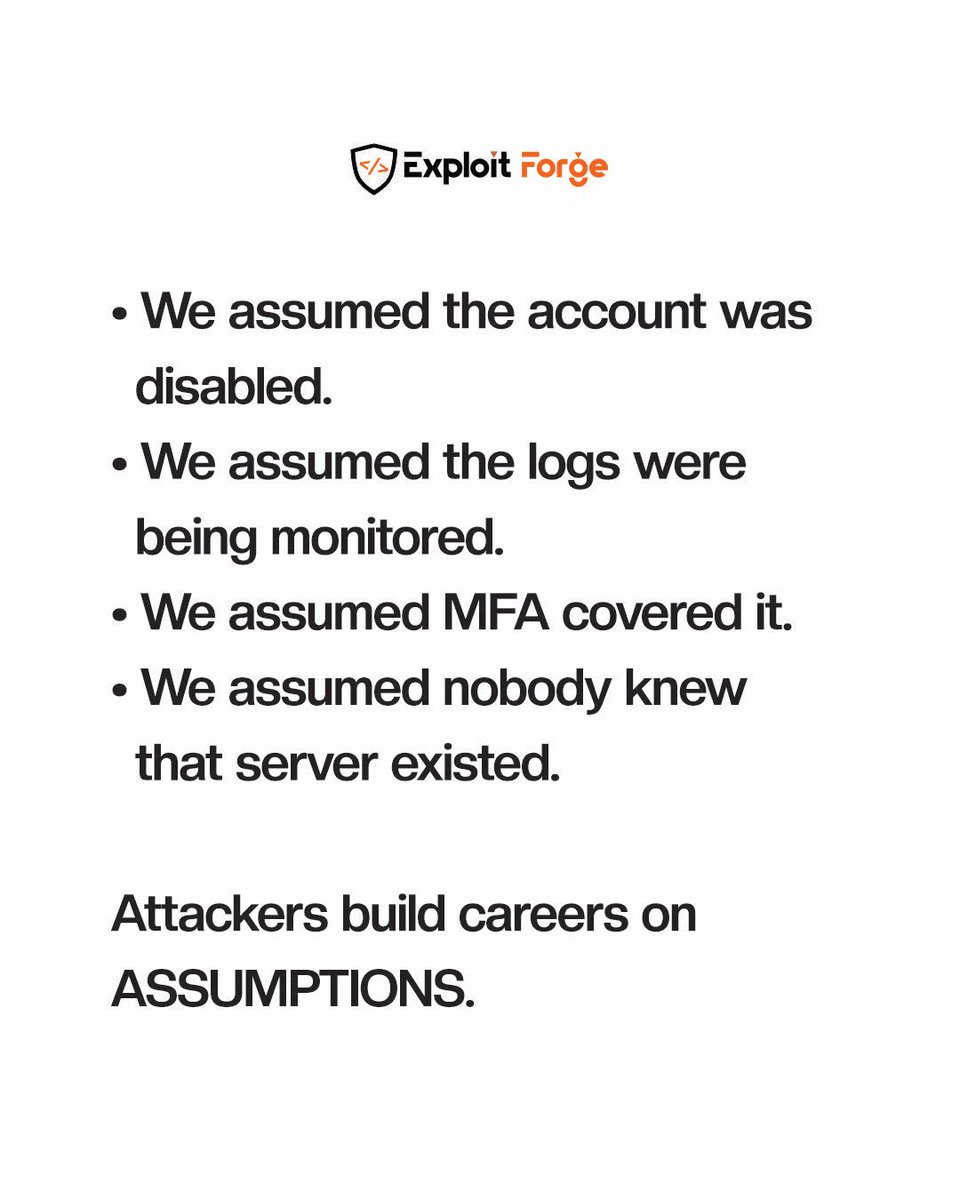
@cyber_razz This is exactly it. The most dangerous word in any security review isn't "vulnerable", it's "assumed." Assumed disabled. Assumed monitored. Assumed covered. Assumed harmless. Attackers don't need sophistication. They just need one assumption nobody thought to verify.
@T3chFalcon We appreciate this mention. The standard we hold ourselves to is exactly what you've described…engagements where someone actually did the work, thought about the environment, and wrote something that means something to the people reading it. Thank you for noticing.
@gabbytech01 That's something we can definitely explore…watch this space.👀
Over the last few years, we've noticed something. Breaches rarely begin with a sophisticated exploit. They begin with an assumption. #cybersecurity #infosec

How many vulnerabilities can you spot in this code?

@gabbytech01 Correct on both🎯…There's more in there though, want to keep looking?
Vulnerabilities don't expire. They sit quietly, compounding risk, until someone finds them and that someone is either you or an attacker. The difference is who you invite in first. ExploitForge comes in without the emotions, without the history, and without any reason to look the other way. Just an honest, adversarial assessment of what's actually there.
The client had done pen testing before. Clean history. Sensible scope for what they knew about. That's the problem. Scope is always defined by what you know. The most dangerous risks are usually the ones that weren't on anyone's list. A threat model changes the question from "what's wrong with what we have?" to "what are we missing?" Those are different questions. They produce different findings. DM "THREATMODEL" to run one before your next engagement. #pentest #threatmodel


The breach didn't happen. That's the point. Most security stories are about what went wrong. This one is about what a threat model caught before it became a story at all. #threatmodel #cybersecurity


A penetration test operates against what exists. It is bounded by scope, driven by technical validation, and produces findings tied to specific systems and vulnerabilities. Done well, it tells you exactly where your defenses can be broken. A threat model operates before and above that. It maps who your adversaries are, what they want, and what attack paths exist against your environment…. including paths that don't involve any of the systems you've decided to test. It is the exercise that defines whether your pentest scope actually covers what matters. We've seen well-executed pen tests come back clean while the real risk sat in an integration nobody thought to include in scope. The pentest wasn't wrong. The scope was. That's a threat modelling problem. Save this for later. #security


Penetration testing and threat modelling are not the same thing. A pen test validates what exists. A threat model defines whether you're testing the right things in the first place. #pentest #cybersecurity


This isn't paranoia. It's an accurate reflection of how modern attacks work. Credentials get phished. Devices get compromised. Insiders pose risks. The idea that being "inside" the network equals being safe has been disproven too many times. Zero Trust shifts the question from "is this coming from inside?" to "should this be trusted at all?" At Exploit Forge, our assessments test whether your environment is built to answer that second question correctly.
“We're on the internal network" used to mean something. It doesn't anymore. Zero Trust is built on a simple principle: trust nothing by default. Not the user. Not the device. Not the network segment. Every access request is verified regardless of where it originates. #zerotrust #cybersecurity

Hello @konvashon, we keep pricing off the website intentionally…every engagement is scoped to the specific environment, objectives, and threat profile of the organisation. A fixed price list would mean a fixed scope, and that's not how meaningful security testing works. Send us a DM and we'll have a proper conversation about what the right engagement looks like for you.

Kiing Vamp @kiing_vamp
9 Followers 77 Following Cybersecurity Researcher | Ethical Hacking Enthusiast
Paul Samuel Danyaro @PaulSamuel2p
11 Followers 76 Following
Nandan | ನಂದನ... @lgnandan
268 Followers 2K Following

G I D E O N O N O R I... @Vaallourr
37 Followers 235 Following Detail-oriented, highly analytical with methodical approach, natural researcher, problem solver, and pattern recognizer.

Lo Neey @Looneey16
1 Followers 79 Following
glocklove @glocklove19
73 Followers 5K Following
Enoch Oluwayomi @enoch_oluwayomi
343 Followers 744 Following Lover of God | GenAi Expert | Researcher | Jazz Music Lover.

wisdom Kingsley @wisdom_kizzy
498 Followers 606 Following don't allow Ur failures to hold back Ur success | cybersecurity |chelseafc
Silver @Dasilvercass
10 Followers 115 Following

𝚁𝚎𝚐𝚃𝚎�... @Sapienspen15
240 Followers 439 Following Unapologetically Igbo| Biafran| Biomedical Engineer (B.Eng, GMNSE, P.Coren, GECHSE) | Igbo Traditionalist| irreligious| Realist| Cybersecurity Beginner 🔰
Casey Quaife @quaife12
177 Followers 247 Following


༒Da Guy 👑💡༒ @contacteyes1
148 Followers 981 Following Life is 🅰️rt🎬 $hØt the 🅱️ëst Memøry to rËmËmbËr📌
Babu @babu_arumu7100
2 Followers 228 Following
Marc Piñol Piqué @pin_piq
2 Followers 106 Following
Brian @dailyrev
378 Followers 278 Following Don't trust the government Don't trust Big Corp (Pharma, MIC, Wall St. Tech) Don't trust their paid media Trust in your true and non-institutionalized self.
DayTrade_Cory @DayTrade_Cory
76 Followers 408 Following Day/Swing Trader '16 | DeFi Tactician | Setups w/ Risk Mgmt 📈 Copy Trading | Weekly Lives 👥 Join Traders Free → https://t.co/cq0XLVUmjG
ᐯ+ᖇᗩᒪ @0x13370x
201 Followers 1K Following Security Researcher| Prevented data breaches affecting 135M+ individuals | Engineer| Featured in @techcrunch @indiatoday @boomlive_in & many others| 3+ CVEs
Malus Hardy @malus88561
23 Followers 86 Following

s.m.p.l @smpl_AT
1 Followers 418 Following
Nemo Jones @NemoJones4
3 Followers 164 Following
ZeroParadox @ZeroParadoxx
27 Followers 190 Following
RobSmith @WietRob
34 Followers 257 Following
Ariel Anonic @ArielAnonic
17 Followers 415 Following GWCrew, Anti-Advertising, Pro- Gun, Pro-Baby Killing and Pro Guillotine
Κλαρκ @ClarkGBeul
3K Followers 2K Following Δανία του Νότου | Ασχημονώ, άρα υπάρχω / Ego viriliter improprie, ergo sum
Mwaigitau @Sculine1
8 Followers 57 Following
Martin Francis @NitramFrancis
102 Followers 2K Following Bot,idiot or troll. Sadly that's most of the Internet now.
🍕Post Woke Wizard ... @gregbarris
2K Followers 3K Following American Comedy Scene Darling. DEEP HEALINGS is out now wherever you listen or watch things
Guillermo Zaandam �... @besodemieterd
7 Followers 112 Following Computers Posts don't represent my employer(s).
ErifKard @ErifKard
102 Followers 998 Following Humans are weird. Like troubleshooting with no logs, only symptoms, Technology security consultant, nursing student
Conor Winkle 🇺🇦... @conorwinkle
3K Followers 6K Following IT Consultant, Bookseller, Newsagent. Mad Scientist. Beer Aficionado. He/him. Often found @winklesbooks @conorwinkle In most of the better places.


PetePete_Repeat 👑 @PetePeteRepeat_
38 Followers 794 Following G'day! I'm Pete! I love tech of all kinds :)
MSKR.me @MSKRme
8 Followers 33 Following Privacy-first mobile security for high-stakes work. Hardened phones with encrypted messaging, VPN & remote wipe. Protection to go anywhere.
Dagger🇰🇪 @TheLongDagger
257 Followers 2K Following The weirdest, strangest people are the SI unit of normal to themselves and their circle. There's entire legions of what you'd call Lunatics who find you..Odd.
DataRelic @DataRelic
196 Followers 1K Following Tinkerer, builder and breaker of things, here for all things ML/AI
j lr @jlr970748384580
16 Followers 132 Following
Ghosty @BlackNoirGhost
162 Followers 575 Following Don’t fall for the truncated gospel. Jesus is the only way.
Pankaj Parmar 🇮�... @pankajparmaar
77 Followers 650 Following Parmara Tani Prithvi Prithvi Tana Parmar
Nicolas Arias @ariasnico
221 Followers 2K Following
Colin @retr0panda
3 Followers 101 Following
Vaclav Soucek @soucek_vaclav
69 Followers 244 Following Obyvatel zeměkoule. Soukromé názory. Život čím dal tím víc v románu 1984. Retweety neznamenají automaticky souhlas.You might like