-
Tweets645
-
Followers4K
-
Following37
-
Likes1K
Introducing EpiBench, an agentic benchmark for practical epigenomics analysis. 106 evaluations span CUT&Tag/CUT&RUN, ATAC-seq, ChIP-seq, and DNA methylation workflows. The best agent–harness pair passes 45.0% of evaluations. Evaluations reflect the assay outputs scientists use in practice. A task may depend on alignment files, peak calls, methylation tables, QC metrics, sample metadata, genomic annotations, or downstream summaries. Solving them requires a mix of coding, data analysis, and scientific judgment. Ground truth is hard to define even for short-horizon scientific tasks. Alternative task interpretations can produce multiple plausible answers. Candidate tasks are hardened through manual quality control. We remove prompts that over-specify the method, answers that can be solved with general literature knowledge, and ground truths that fail to reproduce under peer reproduction. Short-horizon tasks are the current frontier for scientific agents in epigenomics. Before models can own deeper biological reasoning, they need to become reliable at local assay-specific decisions.

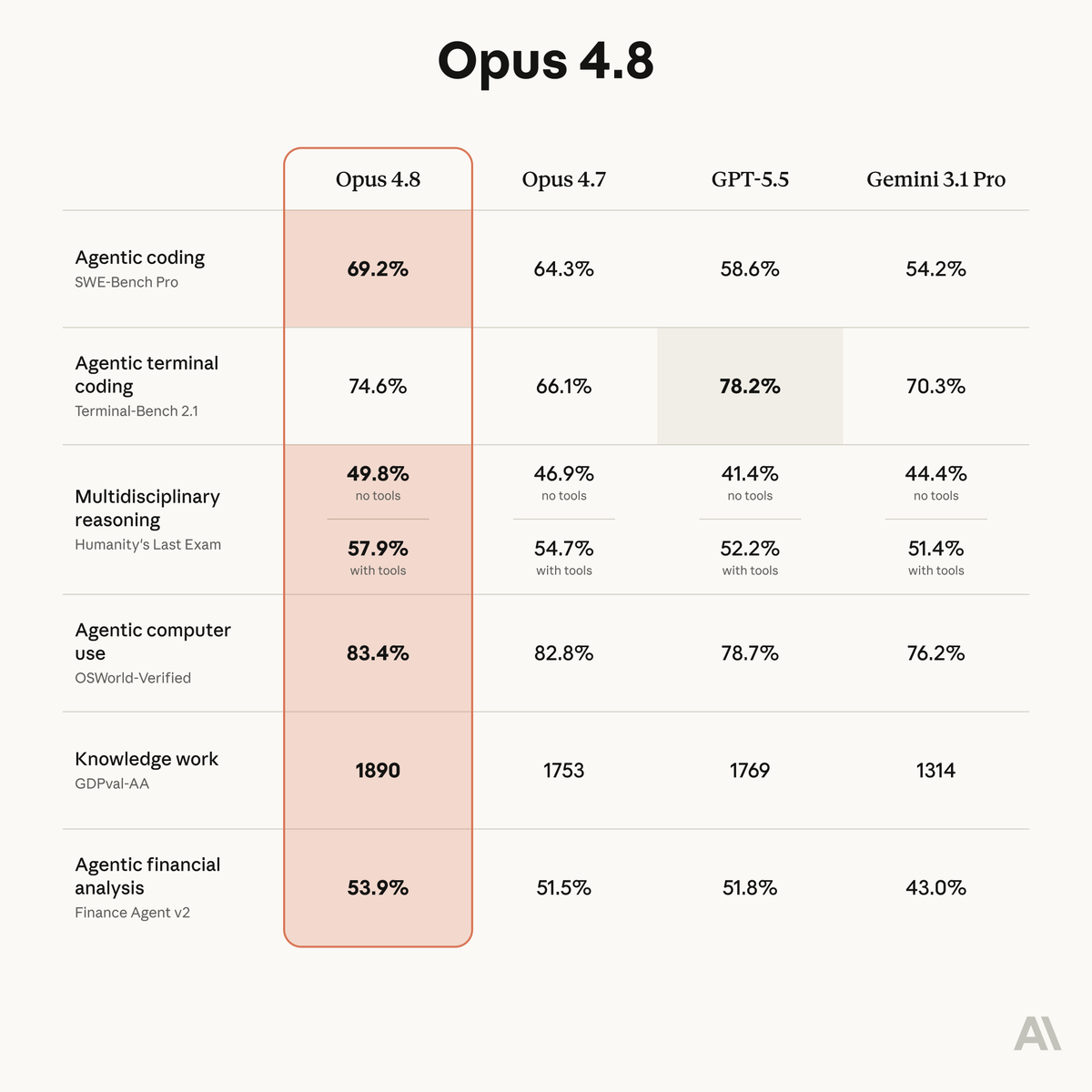
Biology is the next agentic frontier after coding. Anthropic is aggressively improving their models on routine data analysis with careful attention to nuances of different assay types. Opus 4.8 is noticeably better at single cell / spatial analysis. We have already rolled it out to customers across pharma and academia. Cool to see our benchmarks on the system card.

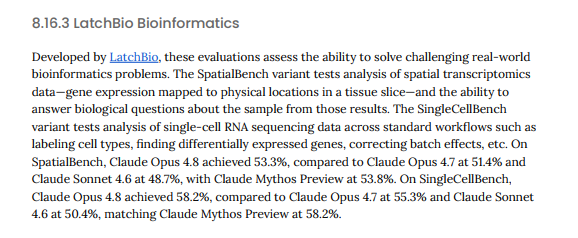

Introducing Claude Opus 4.8: it builds on Opus 4.7 with sharper judgment, more honesty about its own progress, and the ability to work independently for longer than its predecessors. Available today at the same price.
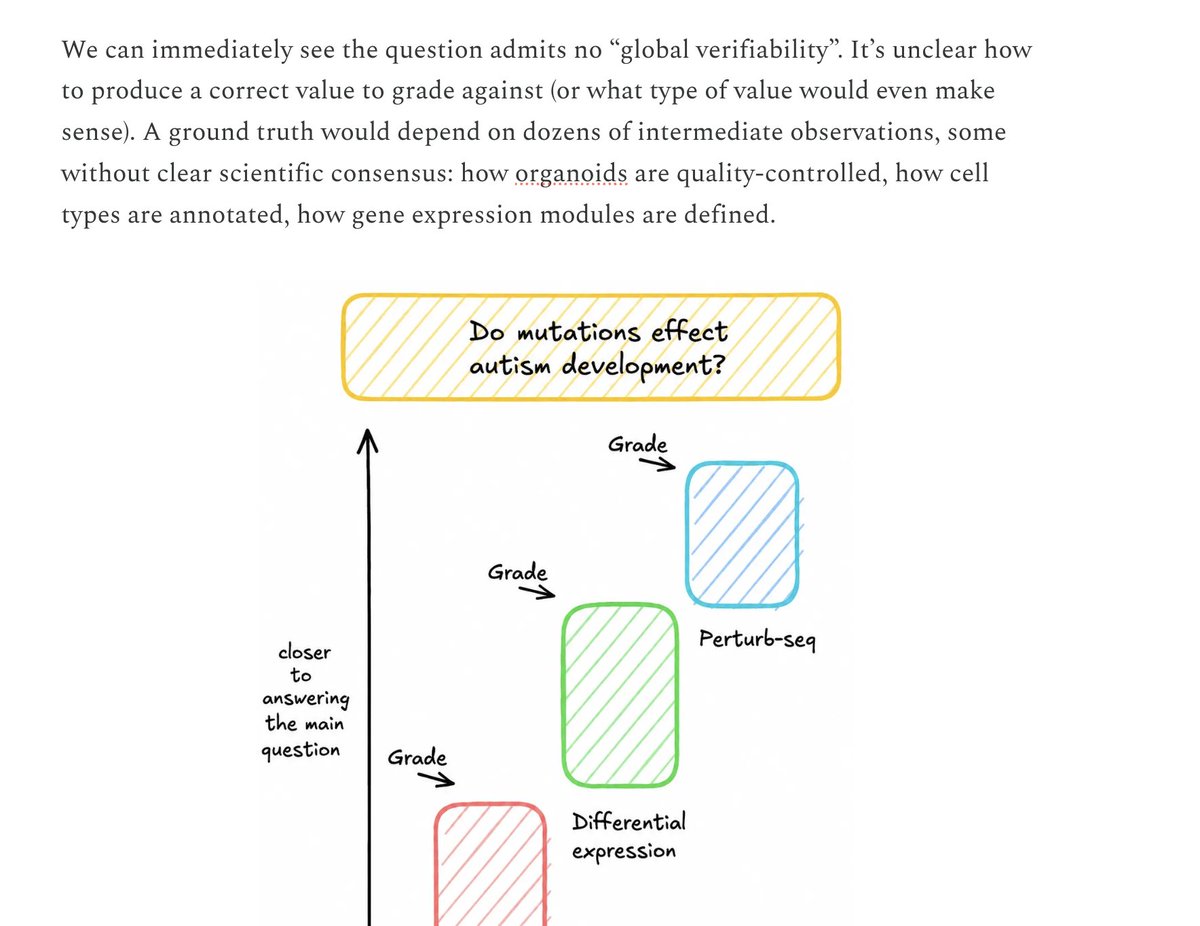
After several months of analyzing model trajectories on SpatialBench, we found issues in a subset of evals. Some tasks depended on analysis decisions not specified in the prompt. Others had grader thresholds that were too narrow, rejecting valid solution paths the original domain expert had not considered. We ran two rounds of independent expert attempts without access to solutions. This produced SpatialBench Verified: a 115-problem gold-standard subset of the original 159 evals where expected answers can be reproduced from only the prompt and associated data. Model ordering is largely preserved, but scores increase 11.6pp on average. Verifiability in biology is hard because correct answers often depend on tacit analysis choices. Our results suggest independent human verification should be a core part of benchmark construction.

Gave a talk to Machine Learning @ Berkeley on benchmarking frontier models on spatial biology. Why understanding how assays work is important, what verifiability might look like with messy biology + infrastructure challenges running agentic evals at scale.
Technical talks on engineering challenges with AI and single-cell data in Mission Bay, SF, next Thursday. Material covering emerging analysis methods for new kits, benchmarks and evaluations for frontier models, and practical AI for drug screening. Harihara Muralidharan — Technical Staff @ LatchBio Valentine Svensson — Principal Computational Biology Scientist @ Tahoe Therapeutics Mikaela Koutrouli — Core Developer @ scverse Zhen Yang — Technical Staff @ LatchBio Link below:
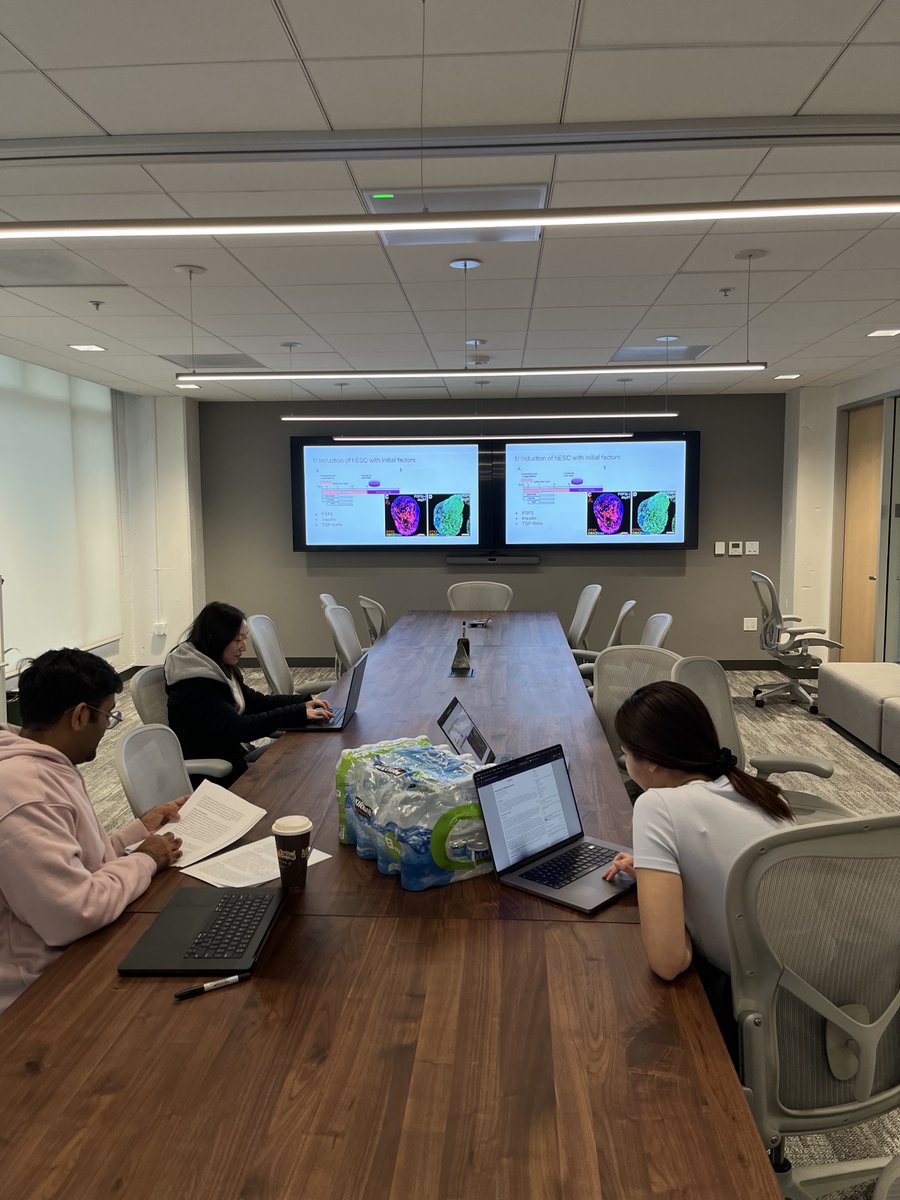
Have learned a lot building and deploying frontier agents into pharma over the past few months. Believe progress in biotech will be faster than many anticipate, and we can learn a lot from how software is unfolding. It’s unlikely biology will jump straight to fully autonomous AI scientists. Like software, agents first get useful where work is executable, feedback-rich, and economically bottlenecked. In software, that substrate is code. In biology, it is measurement-grounded data analysis. As agents reliably turn raw molecular data into trusted scientific outputs, they become the interface through which AI starts to understand biology. Essay below:
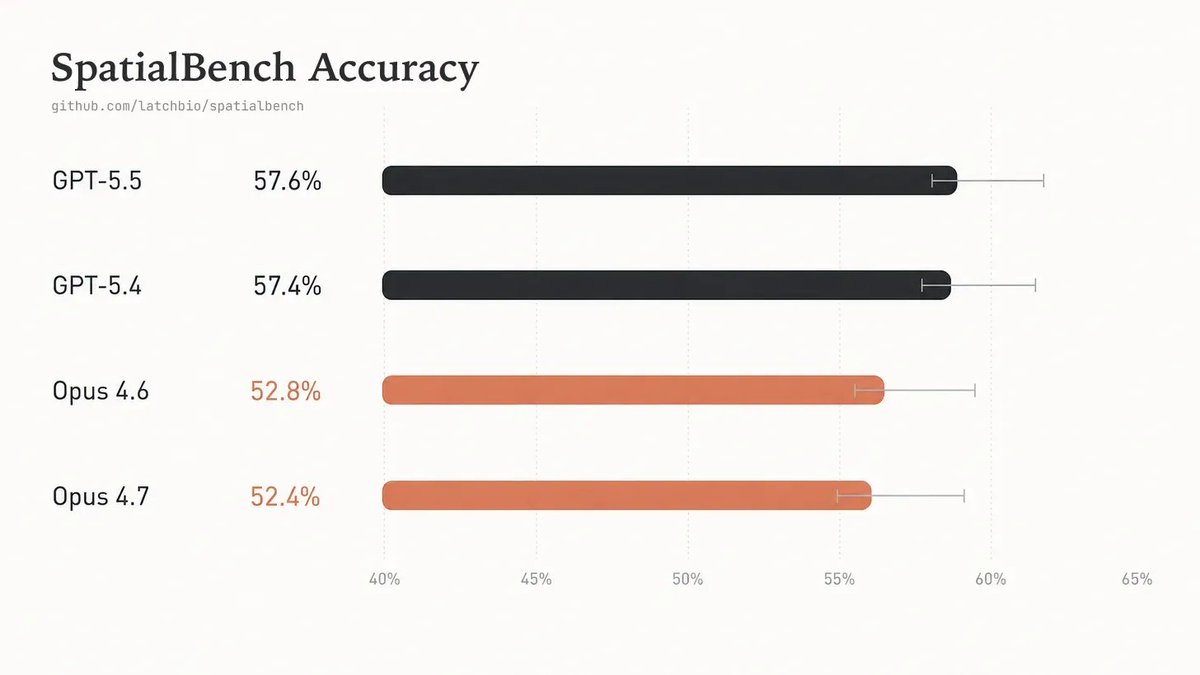
New frontier models are not meaningfully improving at spatial biology. Overall accuracy for GPT-5.5 and Opus 4.7 remains flat on SpatialBench. Scientist-reviewed trajectories reveal persistent gaps in assay-aware biological judgment.
This is the year of agents in biology. What you're seeing in code is already unfolding in molecular data analysis, reorganizing workflows in basic research and drug development. Path forward is focused benchmarking + engineering scoped to specific types of assays. Just as coding agents had to reliably write JavaScript before they could build a browser, biology agents must first learn to accurately process and interpret concrete measurements, (eg. spatial assays), before they can reason about disease, drug mechanism, or patient response. Our roadmap reflects this progression: procedural skill in analysis -> emergent biological reasoning -> synthesis across data types, translational context, and realistic ambiguity. Towards systems that can eventually support expensive, high-stakes decisions in drug programs or research projects. Diffusion in biology is slower than software and needs to be thought through carefully. We work directly with the teams building measurement tech (eg. TakaraBio and Vizgen) and package assay-specific agents alongside their kits and instruments. Scientists complete sample preparation, then use these tech-specific agents to move from raw data to answers and figures. Our partners white-label our platform; we do not run a direct biotech sales motion. Now hiring rapidly across major assay categories, prioritized by which we believe will contribute most to the area under the molecular data curve over the next several years - Spatial - Single Cell - Epigenomics - Genomics - Perturbation/Screening - Diagnostics Looking for talented scientists and engineers with strong foundations in theory and deep experience in these areas to help us build scientifically accurate agents.
Talks at the intersection of systems engineering and computational biology 0:20 Why study systems x biology in "age of agents" 5:50 Forch: Building a utilitarian cloud container orchestrator (Max Smolin, LatchBio) 41:25 cyto: Ultra high-throughput processing of 10x Flex single-cell sequencing (Noam Teyssier, Arc Institute) 1:04:30 SLAF: A single-cell omics storage format for the virtual cell era (Pavan Ramkumar, SLAF Project) 1:33:30 Lessons in Perturbation Modeling: STATE, STACK, and Beyond (Dhruv Gautam, Arc Institute + UC Berkeley) 2:03:15 Leveraging Serverless Distributed Computing to Scale Computational Biology (Ben Shababo, Modal) Topics span container orchestration, single-cell infra, perturbation modeling for biology at scale.
Hosting another computing x biology reading group with Modal. Progress has really picked up the past 6 months + many interesting projects to highlight. - Max Smolin (LatchBio): Building "Forch", a Utilitarian Cloud Container Orchestrator - Noam Teyssier (Arc Institute): cyto: ultra high-throughput processing of 10x-flex single cell sequencing - Pavan Ramkumar (SLAF Project): SLAF: A single-cell omics storage format for the virtual cell era - Dhruv Gautam (Arc Institute): Lessons in Perturbation Modeling: STATE, STACK, and Beyond - Ben Shabobo (Modal): Leveraging Serverless Distributed Computing to Scale Computational Biology Come join us for pizza and good technical talks on March 4th in Mission Bay, SF. Design decisions, paper highlights + snippets of source code.

How good are frontier models at analyzing single cell data? scBench, 394 verifiable problems from real scRNA-seq workflows, shows the best model (Opus4.6) gets 53% accuracy. Better than spatial, but the best agents still fail roughly every other routine analysis task:
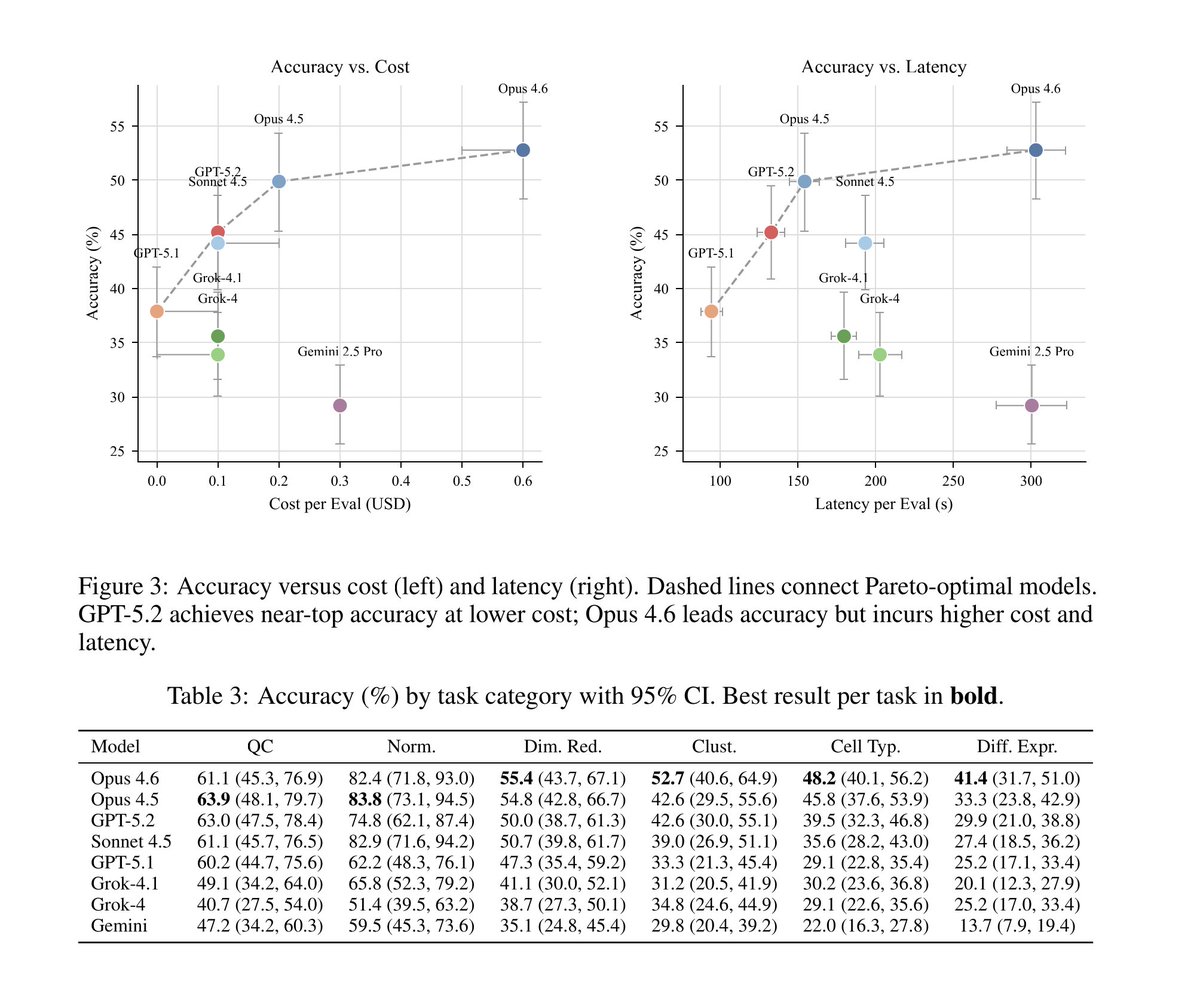
Surprising how frontier models are still pretty weak at biology! It's been fun working with Kenny, Zhen, @Harihara_subrah to build this benchmark. Below is a further breakdown of a model’s analysis journey, where it fails, plus insights that nearly 2X performance in our tests:
2026 will be the year of agents in biology. But we need better benchmarks. We worked with scientists to turn real world analysis into verifiable problems. SpatialBench stratifies frontier models, shows harnesses matter, and reveals distinct failure modes between model families:
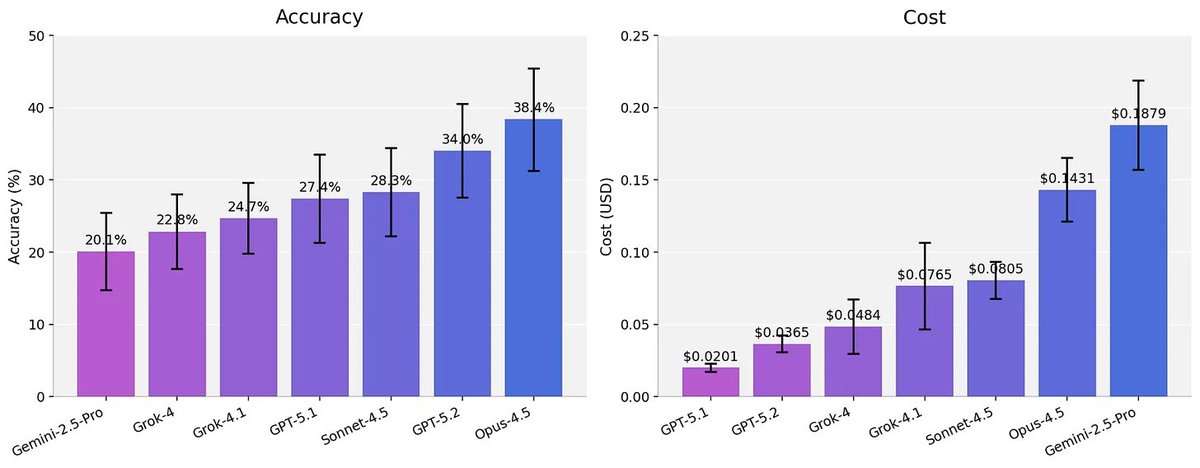
Made a website to easily visualize the results (which the team worked really hard on): benchmarks.bio We believe that making LLMs better at biological data analysis is one of the best ways to make them more useful to scientists. We will continue to expand to more types of platforms (including beyond spatial) and to more kinds of eval types.

2026 will be the year of agents in biology. But we need better benchmarks. We worked with scientists to turn real world analysis into verifiable problems. SpatialBench stratifies frontier models, shows harnesses matter, and reveals distinct failure modes between model families:
2026 will be the year of agents in biology. But we need better benchmarks. We worked with scientists to turn real world analysis into verifiable problems. SpatialBench stratifies frontier models, shows harnesses matter, and reveals distinct failure modes between model families:
Launching a public agent sandbox for spatial biology. Five demo flows tailored to specific kits/machines Try it now: agent.bio This is a shippable intermediary towards reliable and widely deployed agentic systems used to make expensive scientific decisions.

We don't know what most microbial genes do. Can genomic language models help? there's only one way to find out! this is a 1 hour and 42 minute interview with an MIT professor (the famous @Micro_Yunha) chatting about these questions, her work in solving them at @tatta_bio, and more. zoomer captions are back too Links in reply! Timestamps: 00:00:00 - Clips + sponsor roll from the wonderful @LatchBio 00:02:07 – Introduction 00:02:23 – Why do microbial genomes matter 00:04:07 – Deep learning acceptance in metagenomics 00:05:25 – The case for genomic “context” over sequence matching 00:06:43 – OMG: the only ML-ready metagenomic dataset 00:09:27 – gLM2: A multimodal genomic language model 00:11:06 – What do you do with the output of genomic language models? 00:17:41 – How will OMG evolve? 00:20:26 – Why train on only microbial genomes, as opposed to all genomes? 00:22:58 – Do we need more sequences or more annotations? 00:23:54 – Is there a conserved microbial genome ‘language’? 00:28:11 – What non-obvious things can this genomic language model tell you? 00:33:08 – Semantic deduplication and evaluation 00:37:33 – How does benchmarking work for these types of models? 00:41:31 – Gaia: A genomic search engine 00:44:18 – Even ‘well-studied’ genomes are mostly unannotated 00:50:51 – Using agents on Gaia 00:54:53 – Will genomic language models reshape the tree of life? 00:59:18 – Current limitations of genomic language models 01:08:54 – Directed evolution as training data 01:12:35 – What is Tatta Bio? 01:19:02 – Building Google for genomic sequences (SeqHub) 01:25:46 – How to create communities around scientific OSS 01:29:06 – What’s the purpose in the centralization of the software? 01:35:37 – How will the way science is done change in 10 years?

Agreed. When I first started working in genomics, I printed and read protocols for all common single-cell genomics assays— I learned a lot. #methodsmatter
If you work regularly with molecular data, but don't prep it yourself, highly recommend reading the user manual for a kit you interact with cover to cover. Every little step is there for a reason + will teach you interesting biology. Small deviations at the bench often perturb

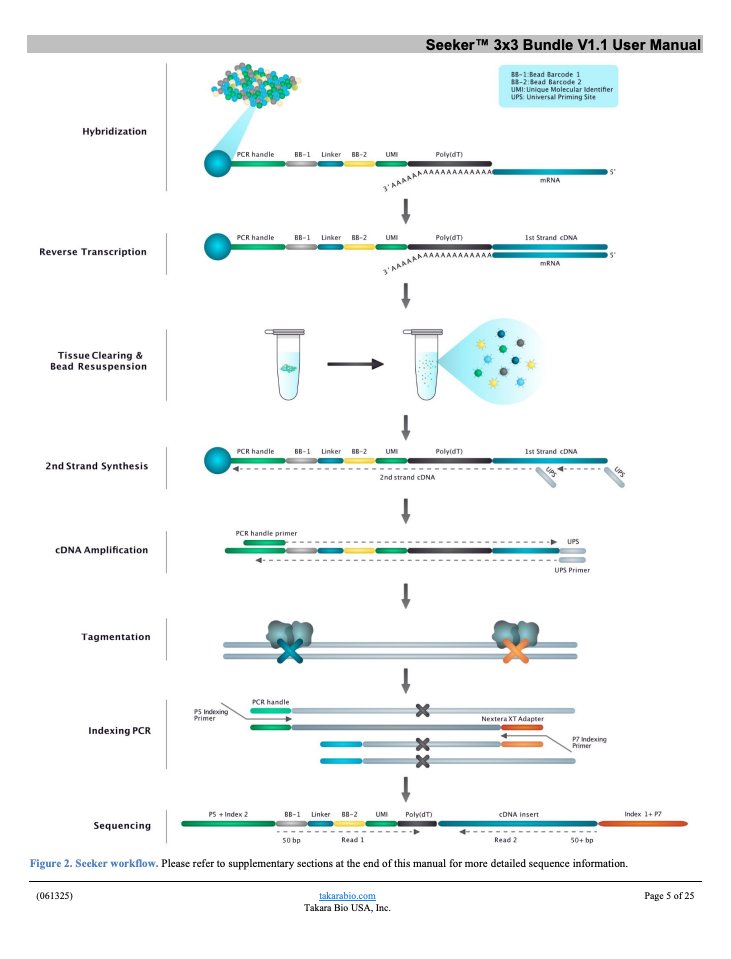
It's often unclear how to how to *measure* biology agents and rigorously compare different systems. Introducing SpatialBench, a suite of 98 dataset/eval packs with a focus on real world tasks. Constructed in collaboration with spatial vendors and scientists on tasks like cell typing, cell segmentation and spatially aware differential expression.

Today, the frontier of biology research is tacit knowledge: distributed across thousands of labs in the minds of PIs/researchers. For any given disease or tissue, there are a handful of groups that know how to select, grow and identify the important molecular signatures from the
If you read this and thought, “awesome - but I’d do X/Y/Z to make the post stronger,” consider applying to our Growth Engineer role. We focus our marketing on a handful of highly-technical prospects and reach them with value-add content: blog posts, market maps, in-person events, and product launches. The right person is able top own these end-to-end from idea → design → implementation → distribution. We want someone who empathizes with scientists and knows what’s useful to them. My assumption is they'll need prior computational biology context to do this well (happy to be proven wrong though). If this sounds like you or someone you know, reach out.
Agents are finally starting to work in biology. We’ve partnered with Anthropic and major biotech vendors - Vizgen, AtlasXOmics, Takara, 10x Genomics - to build a tool that allows scientists to steer their own analysis with natural language. Raw spatial data to publication

Alfredo Andere @AlfredoAndere
5K Followers 1K Following Co-Founder and CEO @LatchBio — Intelligence Infra for Biology
Ming "Tommy" Tang @tangming2005
46K Followers 3K Following Director of bioinformatics at AstraZeneca. YouTube at chatomics. On my way to helping 1 million people learn bioinformatics. Also talks about leadership.
Josh Wolfe @wolfejosh
228K Followers 8K Following co-founder + partner @ Lux Capital | Trustee @SfiScience Santa Fe Inst | Founding Chair @CiPrep (Brooklyn) | Co-Founder of Carson, Quinn & Bodhi w/ @ltwolfe
Jason Kelly @jrkelly
33K Followers 3K Following Co-founder and CEO at Ginkgo Bioworks ($DNA)🧬 Former Chair of US National Security Commission on Emerging Biotechnology 🇺🇸
Erik Bernhardsson @bernhardsson
55K Followers 4K Following Building everyone's favorite AI infrastructure platform @modal
Alec Nielsen @alectricity
4K Followers 2K Following Multicellular in Boston, Co-founder & CEO @AsimovBio
🧬Jacob L Steenwyk @jlsteenwyk
5K Followers 2K Following UC-Berkeley Postdoc🐻, Scientific Consultant Anthropic🏔️, Evomics Workshop Codirector🧬 prev FutureHouseu/Edison, Latch, Mantle (acquired), Vanderbilt PhD

Anshul Kundaje @anshulkundaje
31K Followers 3K Following Federally funded academic research is the innovation engine of the US economy. Reform is welcome. Destruction will have long term consequences.
John Cumbers @johncumbers
19K Followers 2K Following The room where bio partnerships get made. F500 BD, VCs, and 2,000 founders — all in San Jose, May 4–7. https://t.co/wdTABwo6of
Gleb Kuznetsov @glebkuz
2K Followers 463 Following Co-Founder and CEO @ManifoldBio // massively multiplexed AI drug design
Veera Rajagopal @doctorveera
21K Followers 5K Following 🇮🇳 MBBS, MD, 🇩🇰 PhD | 🧬 Co-founder & CSO @wellytics Building genetics-driven drug discovery in India Thoughts: https://t.co/QKUXWuTGfr
Vijay Pande @vijaypande
34K Followers 1K Following Co-Founder at @VZVCfund. Investing in companies solving humanity’s biggest problems, led by founders hell bent on bending the curve.
Jonathan Jacobs 🧬�... @bioinformer
10K Followers 3K Following Authenticity in #genomics #bioinformatics. #scicom, @officialATCC #gaming #DnD #EDM #punk @ Home ♟👾🎮 🎸he/him // I may unfollow you if you post dumb politics
Alishba Imran @alishbaimran_
8K Followers 2K Following
Tyler Zhu @tyleryzhu
2K Followers 863 Following PhD in seeing things @Princeton | MSL intern, prev SR @GoogleDeepMind, @berkeley_ai | @SFGiants @warriors guy
Daniel Liu @daniel_c0deb0t
4K Followers 2K Following
Ashton C Trotman-Gran... @ATrotmanGrant
3K Followers 2K Following Designing biology @Biohub / @EvoscaleAI Prev: Karyo Studios, @FiftyYears, @UofT (PhD Immunology). Co-founder, Notch Tx. Stay curious.
GI114100000000 @GI114100000000
2 Followers 436 Following I am matter that arranged itself into something that can ask what matter is
Tim Ang @ang_seng_chai
1 Followers 64 Following @cohere | technology × science x nature 🖥️ llms | search | multimodal 🧬 multiomics | ngs | glms prev @Cambridge_Uni, @UniofOxford
A 👻 @AddisonKasper
2K Followers 2K Following

Brian Lai @brianclai
13 Followers 707 Following

Jeannie She @jeannieshe_
29 Followers 309 Following {RL, ML} x {biology, healthcare}, and then some. Currently @arcinstitute @MIT
Hatsby @Hatsbylin
24 Followers 649 Following
Vasileios Eftychidis @V_Eftychidis
95 Followers 2K Following
Mathurin Dorel @MathSRIsh
369 Followers 2K Following Bioinformatician, Cellular Biologist, CSO @tychobio_ai @[email protected] @mathsrish.bsky.social

Robin WU @RobinAIagent
15 Followers 291 Following AI thinker, Bioenginner, Researcher in Oxford University
أسامة الغام... @DrAlMoalla
777 Followers 6K Following طبيب عناية حرجة أطفال | Pediatric ICU Fellow | (فما ظنكم برب العالمين)
MOSSE. @iam_mosse
86 Followers 391 Following Loving Life | Tech | Machines | Building nextgen hardware garage.

Yasin Polat @iamyasinpolat
2K Followers 6K Following Founder & CEO @SolvienGlobal | @CrossfieldOrg | Machine Learning & Bioengineering & Bioinformatics
Urvashi Singh @urvashi__s
160 Followers 406 Following PhD student in statistical genetics @McGillU. Previously @5PrimeSciences. Sometimes I make art.

Fanying Tang @FanyingTang
261 Followers 1K Following
alienintelligence @sam147597212925
35 Followers 3K Following
Saidhbh O’Callaghan @saidhbhoc
7 Followers 212 Following
Krinza @krinza
8K Followers 949 Following ai, compute & modern finance | prev. @zksync, @fluentxyz, @ankr
Wang Liang @maris205
209 Followers 2K Following nlper , hust, tencent, github: https://t.co/EhXGTaddjp
Rajashree Chakraborty @rajoshree__
122 Followers 766 Following PhD Bioinformatics | University of Nebraska Medical Center | Interested in Bio x AI domain |
Ronan @Ronangmi
2K Followers 4K Following investing @Collab_Currency / @Dorm_DAO τ reply guy, dreamer
jsd @datagenproc
2K Followers 4K Following @EpochAIResearch. My DMs are open. Anonymous feedback: https://t.co/0k6Duylwqa
Lucien Hinderling @lhinderling
2K Followers 3K Following tries to make microscopes smarter · bioimage analysis, optogenetics, ml, 3d printing, open science · phd student in cellular signalling dynamics @Pertzl


James McGann @jpmcga42
1 Followers 32 Following


Joe Sanchez @JoeSanchez1213
40 Followers 5K Following
Shreyes Jaditkkar @Shreyes30X
0 Followers 13 Following
Möbius ∞ @800TUSD
135 Followers 4K Following
Kevin Hou @KevinYCHou
178 Followers 535 Following medicine/software @ USyd; neurotech for mental health @ Resonait; curious about computational psychiatry and mech interp
Alexis Molina @alexismolmr
2 Followers 187 Following PhD @ AITHYRA | AI for Bio also prev: @alexismolinamr
Jean-Baptiste Schirat... @jbschiratti
294 Followers 1K Following Lead Research Scientist @OWKINscience | GenAI, Biology, Computer Vision
Pol Castellano Escude... @polcastellano_
315 Followers 670 Following Co-Founder & CTO @Heureka_Labs_AI | Previously @DukeU
Aaron Tran @aaronbtran
0 Followers 193 Following enjoying the trial and error. writing at https://t.co/r2e8REwoM4

rushank goyal @rushank_goyal
41 Followers 150 Following cs + bio @ stanford building ai for better rna therapeutics atm: rushankg (at) stanford (dot) edu if that's up your alley

teta worshipper @rohan8r_v2
98 Followers 1K Following
Ilak Manoharan (prono... @ilakkManoharan
366 Followers 6K Following I am building ASRA, an adaptive reasoning engine; Decision Biology, its first scientific domain.
Alfredo Andere @AlfredoAndere
5K Followers 1K Following Co-Founder and CEO @LatchBio — Intelligence Infra for Biology
Josh Wolfe @wolfejosh
228K Followers 8K Following co-founder + partner @ Lux Capital | Trustee @SfiScience Santa Fe Inst | Founding Chair @CiPrep (Brooklyn) | Co-Founder of Carson, Quinn & Bodhi w/ @ltwolfe
Alec Nielsen @alectricity
4K Followers 2K Following Multicellular in Boston, Co-founder & CEO @AsimovBio
🧬Jacob L Steenwyk @jlsteenwyk
5K Followers 2K Following UC-Berkeley Postdoc🐻, Scientific Consultant Anthropic🏔️, Evomics Workshop Codirector🧬 prev FutureHouseu/Edison, Latch, Mantle (acquired), Vanderbilt PhD
Gleb Kuznetsov @glebkuz
2K Followers 463 Following Co-Founder and CEO @ManifoldBio // massively multiplexed AI drug design
Ashton C Trotman-Gran... @ATrotmanGrant
3K Followers 2K Following Designing biology @Biohub / @EvoscaleAI Prev: Karyo Studios, @FiftyYears, @UofT (PhD Immunology). Co-founder, Notch Tx. Stay curious.
Latch Curate @latchcurate
5 Followers 2 Following Public molecular datasets curated with agential tools and uploaded for industry use
Fabio Boniolo @FabioZB_I
581 Followers 2K Following Engineering human tissues https://t.co/6P7lOzXZGD Prev @broadinstitute and @DanaFarber
Harihara Muralidharan @Harihara_subrah
157 Followers 1K Following Member of Technical Staff @LatchBio. Bioinformatics & Computational Biology. CS Ph.D @UMDCS @UMDCBCB
Jake Zeller @jake_zeller
3K Followers 1K Following Founder of Powerset | Reinventing venture capital
george church @geochurch
77K Followers 22 Following Professor @Harvard @MIT @PGorg @WyssInstitute tech dev: #CRISPR #NGS #BRAINi
Jeff Dean @JeffDean
443K Followers 6K Following Chief Scientist, Google DeepMind & Google Research. Gemini Lead. Opinions stated here are my own, not those of Google. TensorFlow, MapReduce, Bigtable, ...
Vibhor Khanna @KVibhor
3K Followers 6K Following VC @coatuemgmt. Led rounds in @Notionhq @HuggingFace @runwayml @supabase @Weights_biases @normativeai @skildai + more. Former @iconiqcapital @dartmouth
Hannah Han Le @lehannahle
597 Followers 186 Following head of product @latchbio | prev comp bio research @sickkids @utoronto
Sandy Kory @sandykory
3K Followers 337 Following HorizonVC -pre-seed/seed software investing -backing technical founders w/300k-1m checks Substack: https://t.co/Ur7sPw4Xx0
Michael Chavez @MichaelGChavez
222 Followers 349 Following Founder at https://t.co/ypdu4YTQ6U. Synthetic Immunologist from @StanfordBioE. Previously @fiftyyears and @stanleyqilab. Cell therapies are pretty cool.
The House Fund @thehousefund
3K Followers 412 Following The House Fund is a pre-seed and early stage venture capital fund focused on the boldest Berkeley startups. 🏠🍄
Jeremy Fiance @jfiance
3K Followers 1K Following 🍄 capitalist lost in Berkeley 🏠 founder @thehousefund 7 first-round investments in Cal 🦄changing the world 🤖 AI builder since '12 🐻 helping Bears Go!
brett wilson @bjwilson34
3K Followers 414 Following Entrepreneur. Investor. Would rather be sailing.
Haystack @haystackvc
10K Followers 3 Following Early stage venture capital firm supporting outlier founders. Investors in @DoorDash @Instacart @HashiCorp @figmadesign @AppliedInt and many more.
Semil @semil
165K Followers 863 Following Investor via @HaystackVC focused on seed-stage investments // Venture Partner w/ @LightspeedVP

Hummingbird Ventures @HummingbirdVC
6K Followers 44 Following We work with early-stage entrepreneurs leveraging technology to build global ventures.
Lucy Guo @lucy_guo
84K Followers 919 Following Building https://t.co/NaZlVKaVoL | cofounder of @backendcapital @hf0residency @scale_ai | part time DJ
james hong @jhong
22K Followers 1K Following RELAX, I'm probably joking. Cofounder of HOTorNOT. Angel Investor. Proud Husband and Daddy. Good Friend. Troublemaker. Go Bears! 🐻
Georges Harik @gharik
8K Followers 4K Following humans& co-founder, 7th employee google, co-created adwords online, co-created adsense targeting, worked on ai, gmail, calendar, bought android.
Brian Naughton @btnaughton
3K Followers 2K Following genetics/data/programming. ex-Hexagon ex-Stanford ex-23andMe ex-TCD https://t.co/77VRsi7znN 🇮🇪
Brandon White @bwhite5290
1K Followers 2K Following Co-founder of https://t.co/4kn3cxLjuu, Best Seven Foot ML Engineer in the World
Nathan Manske @Manskee
193 Followers 901 Following Introvert. Designer/Confidence Activist. Aspiring himbo.


Fifty Years @fiftyyears
15K Followers 85 Following Make something civilization needs. Helping great scientists and engineers become great entrepreneurs is our jam.


You might like