Markus Covert Lab @MarkusCovertLab
Building computer models of cellular systems to predict complex behaviors. And having fun doing it! Also department chair and #1 fan, @bioe_stanford ❤️ covert.stanford.edu Stanford University Joined June 2024-
Tweets71
-
Followers506
-
Following362
-
Likes985
@draparente So great to see you there @draparente!
How would we go about spearheading a Human Cell Project? By request I’ll post some thoughts on this topic over the next few weeks. First, we need a clear idea of what the goals are. For the sake of discussion, let me suggest two: (1) we want at least one *strong* annotation for 95% of the known functional (coding and non-coding) regions of the genome, and (2) the totality of this information needs to be made openly available, machine readable and encoded in a computational model that can make actionable predictions about cell behavior, including in response to different environmental or genomic conditions. As in the Human Genome Project, it makes sense to start with simpler (microbial) cells to develop the tech and intuition, and keep moving forward in complexity. Today I’ll offer some thoughts on annotation and the data challenge, which is a huge effort that I think is sometimes misdirected. Specifically, a unified experimental effort would need to be more specifically directed to what is unknown – that’s where the uncharacterized functional regions lie. For example, we and others have shown that a large fraction of the unknown genes in bacterial cells are related to interactions with other biological entities. Viruses, other microbes and mammalian cells or factors – adding any of these to the culture media will cause a number of uncharacterized genes to be upregulated and expressed. In order to characterize and annotate this large set of genes, we need new, more complex means of recreating the full spectrum of what cells experience in the wild! This will help us to annotate, even across species -- for example, a few years ago we reported a system in which we prompted mammalian macrophages (part of the immune system) to swallow bacteria which were themselves harboring a virus called lambda phage. Around a quarter of the bacteria in your gut right now contain viruses like this. The mammalian cells didn’t kill the bacteria directly. Instead, they released a peptide that activated the lambda phage, which then went on a rampage and killed all of the engulfed bacteria (as they say, "the enemy of my enemy is my friend"). This unexpected finding led to a number of novel annotations that you would never find in experimental data derived using simple media conditions, or interpolate from a model generated from such data. So one thing we need to think about is how to systematically capture these interactions, ideally at scale but definitely quantitatively and over time. Innovators wanted, we need ideas here! Maybe in the future I can talk more about dynamics, quantification, causality, curation and a detailed strategy for annotating those 95% of genes in future posts if people are interested. sciencedirect.com/science/articl…
@robziman Thanks for the question! I'll share some thoughts on this in a subsequent post (maybe a week or so).
Very true - it's time to call for a Human Cell Project, analogous to the Human Genome Project, to systematically and comprehensively characterize and model first the simplest and then the most complex cells. A moonshot to catapult biology to the next era🦠🚀💪 - let's go!!
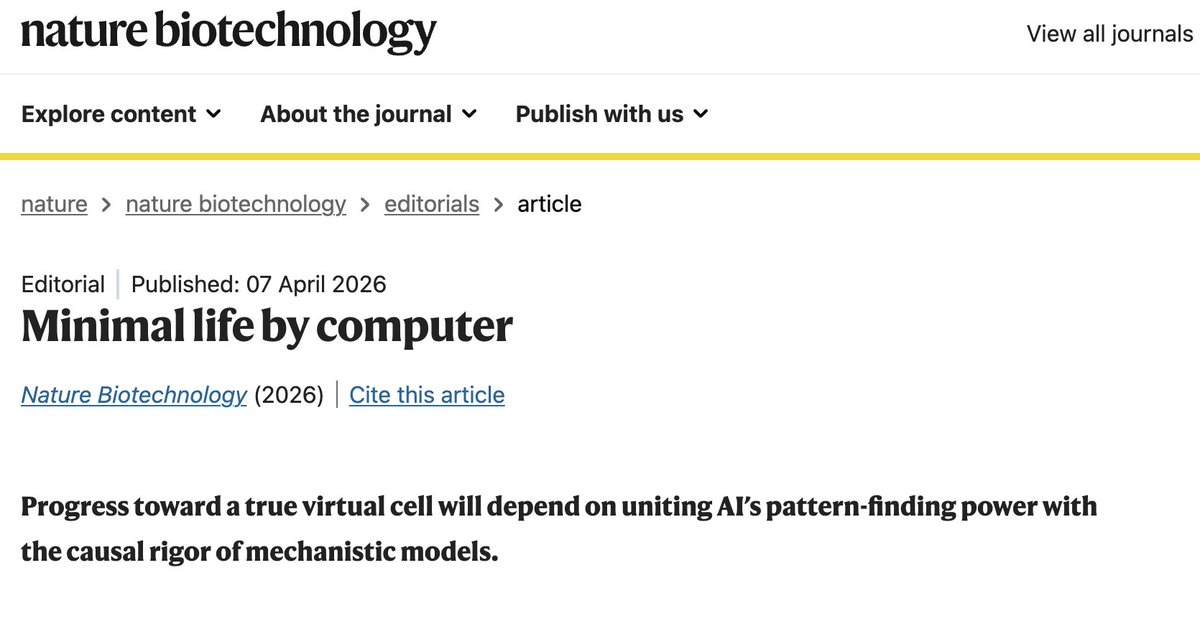
Really enjoyed @NatureBiotech's new commentary "Minimal life by computer": the road to a true virtual cell is not just bigger AI models. It’s AI + mechanistic biology. Pattern recognition can get you far. But if we want to simulate life, predict interventions, and actually
@OmicsOmicsBlog As a starting point, how about "95% of the coding regions in the cell have at least one defined functional/mechanistic annotation?" We could ramp up in complexity from there.
Seung Kim is one of my favorite people on campus, a brilliant scientist and outstanding mentor. Lots of inspiration, wisdom and humor here! 🧪🌲❤️

Walk With Me: Seung Kim studies pancreatic biology and insulin-producing cells to advance regenerative approaches for diabetes. Hear what still inspires him about science -- and why Elvis Presley is on his lab walls. stan.md/walkwithme
A terrific article -- this one takes it even further, applying neuroscientist wet-lab techniques to try and understand the microprocessor "brain" of an old Atari game console. (Spoiler: they fail) Fun to think about in the context of AI and simulation! journals.plos.org/ploscompbiol/a…
Re-read it every few years. This however now needs to substitute to „how AI will understand biology“
@annewoj23 I remember when you showed us your orange hands in bio class and we all freaked out 🥕🖐️🤣
Great take from @NikoMcCarty on a terrific cell modeling study that came out in Cell this week. I was asked to comment for a news piece about it in Nature; here's the full text of what I wrote (with thoughts on AI-driven models vs more mechanistic models) in case it sparks further discussion: Dear Ewen, thanks for reaching out and very exciting to see Zan and Zane's newest work! This work is a significant advance - the key part is including the kinetics, which most of the all-molecule simulations are not able to do. With regard to AI virtual cells, so far they are mostly promise and very little actual product, so it's hard to go into too much detail. That said, one way to think about Zan's accomplishment is in the context of artificial life, or AL. Her lab and mine, and others, are focused on actually trying to build detailed representations of a living cell in silico. They are dynamic, holistic, and mechanistic, all of which adds many distinct advantages in contrast to what is being considered with AI. For example, AL model simulations are explainable (that is, the simulated behaviors can be explained in terms of their mechanistic underpinnings), they actually require less data (but well-targeted, and of several different kinds), they are better suited to extrapolation, and interestingly, transfer learning is achieved through evolutionary theory (matching E. coli to a mycoplasma, for example), instead of (or in addition to) the traditional transfer learning methods that would be used for AI. I anticipate that in the future, some of the best things we learn from AI and this next generation AL (first generation would be Conway's Game of Life, and stuff like that - but these new models move far beyond that) will be integrated, and that is an interesting future to consider. As my lab is currently demonstrating (to appear soon), these models can lead us to scientific questions that were never considered before, and making an impact in basic as well as applied science. Very exciting times! * Note that several of these ideas came up in discussions with my lab members, they didn't all originate with me. Lucky to have a great team❤️

If you like this, then you may like my blog about biology: nikomc.com.
Count me in here - other seminal mathematical and statistical approaches have been invented while pursuing large-scale modeling goals (ie chaos theory and data assimilation in predicting weather) but biology has the most potential. What will we discover, and what will it enable?

Many physicists have come to believe that a mystery is unfolding in every microbe, animal, and human—one that could redefine the field for the next generation, @AdamFrank4 writes. theatlantic.com/science/2025/1…
So honored to receive this award, can't wait to visit @UniMelb! And thanks a million to my incredible lab, a brilliant and wonderful group of people who inspire me every day ❤️🦠💻

Markus Covert has been awarded the University of Melbourne’s 2025 Grimwade Medal! 🌟 The honor recognizes his pioneering work for constructing the first "whole-cell" computational model. @MarkusCovertLab @UniMelb biomedicalsciences.unimelb.edu.au/news-and-event…
Somehow the term "virtual cell" has been co-opted to mean only AI-driven or foundation models, but the OG "Virtual Cell Project" was an ambitious effort by @lesloew and @jcschaff to facilitate building mechanistic models of cells. 1/2 sciencedirect.com/science/articl…
@anshulkundaje We ran a virtual cell challenge 10 years ago, exciting idea and outstanding teams - but again, participants found a workaround. As they say in experimental biology, "you get what you screen for" 🙃 Agreed @anshulkundaje, we need to more focus on design! journals.plos.org/ploscompbiol/a…
@ElowitzLab @NikoMcCarty Wait... "intrinsically" more interesting? Or do you mean "extrinsically"? 🤣 but in all seriousness, an awesome paper - catalyzed lots of great follow-on work as well @ElowitzLab
@NikoMcCarty Great article @NikoMcCarty! Since it's apropos and Halloween is coming up, I'll share my lab's amazing jack o'lantern, carved in the shape of a potassium channel, or "PUMP K+ IN." Aren't they the best?!? 🧡🎃🧡

@srikosuri @eperlste Looking forward to it!
@UriAlonWeizmann so glad you are okay, and so sorry to hear about the lab - you are a priceless treasure! 🎶❤️

When we came to see our destroyed labs hit by an Iranian missile, we found that a piano had survived @WeizmannScience

Kyle Farh MD PhD - Il... @KyleFarh
392 Followers 1K Following Head of Illumina AI Lab. Deep Learning. Human Genetics. Perturb-seq.
Bio Man @BioMan14896
122 Followers 3K Following
Gloria Horrell @GloriaHorr6ycb
518 Followers 4K Following Graceful, confident, and unapologetically myself. ✨
Jerzy Szablowski @JerzySzablowski
2K Followers 1K Following Rice BioE Assoc Prof (07/26) | CEO, Imprint Bio. Developing noninvasive neurotech & mechanism-agnostic drugs, RMAs, ultrasound. DP2, Packard Fellow & DARPA YFA.
Annie @AnnieCostn60989
45 Followers 711 Following official account of Annie Costner daughter of Kevin Michael
Tina Hillary @HillaryTin40343
6 Followers 121 Following
Bashor Lab @BashorLab
993 Followers 790 Following Bashor Lab in Houston, Texas | Mammalian Synthetic Biology et al.
Harris Wang @harriswangnyc
3K Followers 560 Following Chair and Professor of Dept of Systems Biology | Columbia University | Synthetic Biology | Microbiome | Genome Engineering
Alicia @Azxx107
9 Followers 749 Following Operations Manager at BlackRock | Specializing in Market Analysis, Risk Management & M&A Support
Lara Weed @LaraWeed
2K Followers 1K Following BioE PhD @Stanford | NIH F31 Fellow | Zeitzer Circadian Research Lab | Studying sleep, circadian & menstrual cycle impacts on biomechanics with wearables
we1chan @we1chan
15 Followers 785 Following
Shlok Natarajan @Shlok_Natarajan
123 Followers 305 Following AI @StanfordDBDS @StanfordAILab Prev @Salesforce @Amazon @GeorgiaTech
Wafa Alhajjar, PhD @WAHPersonal
159 Followers 1K Following Translational Scientist | Vascular Engineering | iPSC & Regenerative Medicine | Founder, AxiomBio | Former Harvard Medical School & University of Toronto

Aviador @Avdor361
84 Followers 1K Following
Kevin Chen @kychen42
371 Followers 2K Following physician-scientist in-training @UCSF in Cyster Lab. biophysics, microscopy, immunology. he/him. 🇹🇼🏳️🌈
Jakub Tomek @JakubTomek13
1K Followers 672 Following Computational and experimental cardiology. Tea lover. Uilleann Piper. Sir Henry Wellcome Fellow at Oxford and UC Davis. Blog https://t.co/7vNqEgWp1d
Liu Xiaoping 刘小�... @Liuxiaoping_WHU
240 Followers 1K Following Interested in single cell and spatial omics, digital pathology, cancer Fitness enthusiast,guitar noise maker LOVE CHINA
Timon Merk @MerkTimon
562 Followers 494 Following PostDoc Baylor College of Medicine. Working on Machine Learning and adaptive Deep Brain Stimulation he/him
Viswesh Ananthakrishn... @VisweshAnanthK
0 Followers 87 Following
Jose Utrilla @joseutrilla
393 Followers 515 Following Scientist at CCG-UNAM @joseutrilla.bsky.social
HoangAnh @essenceezgame
10 Followers 352 Following

Little Stamp @stamp_little
16 Followers 363 Following
Clara H. Whyte @ClaraHWhyte
952 Followers 7K Following Founder @PaideiaMundi - Using #philosophy, #psychology, #neuroscience, #ecology and #arts to understand the roots of #biophilia. Ahimsa. Animal Welfare. Yoga.
Shiv Mangal Shukla @ShivMangal07
1 Followers 150 Following Doing BSMS at IISER Bhopal Interested in synthetic biology and Biophysics
Chris L @chrislong125
325 Followers 3K Following
Long Live Me @LongLiveMe2100
0 Followers 94 Following
Daniel @kerkomen
23 Followers 3K Following
Matthew Aguirre @aguirre404
594 Followers 2K Following One small analyst in a big data world. PhD student in Biomedical Informatics @ Stanford

Aneeqa Fatima @anfatima01
263 Followers 579 Following Prev: LLMs on MAIA @Microsoft | Math @UW and CS @UMich | All my intellectual musings and curiosities round up at biology | Selectively resigned

Chris Hayduk @ChrisHayduk
8K Followers 3K Following FDE, Life Sciences @OpenAI | Cross-disciplinary writing on AI & where we're going at https://t.co/gmBIh9hlZI | ex MLE @Meta, Drug Discovery Lead @Deloitte

Chris Mungall @chrismungall
1K Followers 1K Following https://t.co/64z6EJj8LT https://t.co/0dPY8W0e5W https://t.co/3Bw5ITI2QX https://t.co/0K7OeZkppP
Thomas H. Chapin IV @tomchapin
6K Followers 4K Following AI Engineer who advocates for healthy longevity and overall quality of life. Let’s use AI to help solve aging and other diseases!
Zack @ZattsuLame
49 Followers 2K Following
Helen O'Neill @DrHelenONeill
3K Followers 4K Following Associate Professor in Reproductive and Molecular Genetics @UCL working on #CRISPR genome editing. CEO and Founder @Hertilityhealth
The Guy @Guygies
3K Followers 3K Following Code Specifier since '78. Full stack Specifier. Champion of lowbies. Around us infinities abound.
Shae McLaughlin @shae_mcl
5K Followers 1K Following Bioengineering PhD @Stanford and @arcinstitute. I work on synthetic biology, gene regulation, and neuroscience. Writing at https://t.co/RGtaNVKdBU
imran ahammad @iamisunik
263 Followers 6K Following
User @user34023
161 Followers 2K Following
pranay soni @pranaysoft
65 Followers 2K Following
tariqdesai @tariqdesai
1 Followers 276 Following
Tyler Hulett @seromics
1K Followers 1K Following Decoding immunity. Autoimmunity is far more common than anyone today expects or understands. CSO @cdi_labs
lagunaseq @lagunaseq
44 Followers 866 Following
gen0m1cs @gen0m1cs
30K Followers 2K Following Genomics PhD student, @pennbgs @UPennGCB; genetic mapping, neurodegeneration, & related neuroimmune loops. Views are my own.
Rafael Irizarry @rafalab
29K Followers 490 Following Applied statistician. I tweet data-driven observations, data science educational materials, academic research updates, and the occasional joke.
Max Kozlov @maxdkozlov
5K Followers 610 Following science reporter covering biology @Nature | proudly Ukrainian 🇺🇦 | https://t.co/zQQfpzNIUc (views mine, not springer nature's) SIGNAL: mkozlov.01
Jeff Dean @JeffDean
443K Followers 6K Following Chief Scientist, Google DeepMind & Google Research. Gemini Lead. Opinions stated here are my own, not those of Google. TensorFlow, MapReduce, Bigtable, ...
Lara Weed @LaraWeed
2K Followers 1K Following BioE PhD @Stanford | NIH F31 Fellow | Zeitzer Circadian Research Lab | Studying sleep, circadian & menstrual cycle impacts on biomechanics with wearables
Kyle G Daniels @ScienceKyle
3K Followers 1K Following Assistant Professor @Stanford University Genetics. Synthetic Biologist // Real Human 🧬 🔬 💻 🏳️🌈 🏊🏾♂️
Jakub Tomek @JakubTomek13
1K Followers 672 Following Computational and experimental cardiology. Tea lover. Uilleann Piper. Sir Henry Wellcome Fellow at Oxford and UC Davis. Blog https://t.co/7vNqEgWp1d
RetroBayArea @RetroBayArea
6K Followers 98 Following An independent project featuring all original video edits that document culture and everyday life in the SF Bay Area. 1950s - mid-2000s. - DM for Business.
Stanford Children's @StanfordChild
23K Followers 2K Following Top ranked children's hospital exclusively dedicated to kids & expectant mothers. Dig. Policy: https://t.co/ImJ2ElR3ia Nondiscrim. Policy: https://t.co/oJM6V2DVNR
Keith Robison @OmicsOmicsBlog
10K Followers 2K Following Computational biologist in drug discovery since '96.
Nurcan Tuncbag @ntuncbag
1K Followers 885 Following Assoc. Prof. @kocuniversity College of Eng. and School of Medicine, Formerly @METU_ODTU @MIT @itu1773. PhD in Computational Sci&Eng, Member of @GlobalYAcademy
OmVenture @OmVenture
10K Followers 3K Following Peptides, proteomics, genomics, biotech, pharma for drugs, medical, prevention, diagnostics, healthcare & longevity using super intelligence automation ventures
Kyle Lacio @KyleLacio
16K Followers 429 Following Biomedical Engineer | BFS Line Technician at Nephron Pharmaceuticals Corporation | Former Naval Nuclear Reactor Operator | MBA Candidate | FINRA SIE & Series 6
Francesca Ceroni @ceronifranci
1K Followers 393 Following Reader (Associate Professor) @ Chemical Engineering Department, Imperial College London (views are my own)

Second Harvest of Sil... @2ndharvest
6K Followers 982 Following 1 in 6 people in Santa Clara and San Mateo counties is getting food from Second Harvest. Take action through the link below. 👇🧡
Review Commons @ReviewCommons
5K Followers 1K Following A platform by @EMBO and @ASAPbio_ that provides independent peer review before journal submission for Refereed Preprints
Dalai Lama @DalaiLama
16.7M Followers 0 Following Welcome to the official twitter page of the Office of His Holiness the 14th Dalai Lama®️.
Ash Jogalekar @curiouswavefn
31K Followers 420 Following Agentic AI for Science. Scientist in Residence at Oppenheimer Project. History of physics, biotechnology, U.S. history, nonproliferation. Opinions my own.
Abhishek Singharoy @abhisekhsingha1
994 Followers 190 Following Biophysicist, Integrative modeler, Prof @ASU, Program lead at NODES @DARPA, #nsfcareer awardee, Beckman Fellow, Top Performer @NSF Waterman Fellow
@BioAI_Neuro @BioAI_Pharma
12K Followers 7K Following @MIT trained Neuroscientist writing on ⚡Bioelectricity |⏳Longevity | 💊AI Drug Discovery 🎯 [email protected]
Shae McLaughlin @shae_mcl
5K Followers 1K Following Bioengineering PhD @Stanford and @arcinstitute. I work on synthetic biology, gene regulation, and neuroscience. Writing at https://t.co/RGtaNVKdBU
Prof. Nikolai Slavov @slavov_n
40K Followers 266 Following Mentor, scientist & engineer. Director of @ParallelSqTech. Having fun in @SlavovLab with single-cell proteomics & ribosomes. Organizer of @SCP_meeting
Alex Engel @lix_dunes
5 Followers 57 Following
NBC Olympics & Paraly... @NBCOlympics
1.1M Followers 3K Following The official home of NBC’s coverage of the Olympics and Paralympics.
Nish @nterminus
2K Followers 2K Following Now: biology investing @ https://t.co/Fmj3dMHPe7 Then: @Color | @SciFounders
Ken Ono @KenOno691
67K Followers 195 Following Founding Mathematician @axiommathai | Prof @UVA | AI, proof | Assoc. Producer, The Man Who Knew Infinity | Olympic swim performance 🏊♂️🏅
Richard Fuisz @richardfuisz
3K Followers 1K Following Asking biotechnology to do useful things. | @NonfictionBio, FutureHouse, Arcadia Science, Templa Nucleics. https://t.co/lXH4QygyMa
Abishai Ebenezer @AbishaiEbenezer
438 Followers 189 Following CS PhD Student @ucsd_cse | ML for Cancer Biology | Past life @UWproteindesign @ProseMsft @MSFTResearch | @Arsenal and @Seahawks fan | 🇺🇸🇮🇳
Martin Pacesa @MartinPacesa
5K Followers 1K Following Assistant Professor at the University of Zurich. 🖥️ protein design, machine learning🤖, crystallography💎, cryoEM🔬. Avid weirdness connoisseur 🎩
CELL @CellBioSF
642 Followers 260 Following CELL: Consortium for the Equations of Life and Living Systems. Fusing MathBio, BioPhysics, CompBio and DescriptiveBio around an aggressive mathematical core.
Saloni @salonium
36K Followers 2K Following Co-founder & editor @WorksInProgMag. Writer, Scientific Discovery. Podcaster, Hard Drugs. Advisor, @coeff_giving. // Prev @OurWorldInData. 🏳️🌈
Ron Alfa @Ronalfa
7K Followers 2K Following CEO & Co-founder @NOETIK_AI Using AI to actually solve cancer. Ex-@RecursionPharma | Stanford MD-PhD
Thomas Lau @ThomKLau
52 Followers 689 Following bioengineering @stanford @arcinstitute, prev @ emerald cloud lab
Soojung Yang @SoojungYang2
1K Followers 1K Following AI+simulation for biochemistry! | Postdoc @Stanford | Researcher @MSFTResearch | Previously @MIT PhD
Atul Gawande @Atul_Gawande
349K Followers 587 Following Surgeon, Writer ("Being Mortal," "Checklist Manifesto"), and formerly led Global Health @USAID. Threads: atul.gawande. Bsky: @agawande.
Ulkar @ulkar_aghayeva
3K Followers 828 Following writing about biology, science history and music | composer | https://t.co/PpuV1zhkrg | https://t.co/W6QDqE82Vv | Emergent Ventures '22
Eryney (NYC 7/1-8/31) @eryney_ok
2K Followers 606 Following pronounced like "aaron a" | bioengineering, ml and medicine | @geochurch @harvard, AAV @dyno_tx, proteins @Caltech, medicine @uvmvermont
Tim O'Reilly @timoreilly
2.6M Followers 2K Following Founder and CEO, O'Reilly Media. Watching the alpha geeks, sharing their stories, helping the future unfold. Didn't pay for a blue check, cannot make it go away
Jason Kelly @jrkelly
33K Followers 3K Following Co-founder and CEO at Ginkgo Bioworks ($DNA)🧬 Former Chair of US National Security Commission on Emerging Biotechnology 🇺🇸
Elisabeth Bik @MicrobiomDigest
144K Followers 44K Following Science integrity consultant, PhD. #ImageForensics @METRICStanford affiliate / https://t.co/2xH3WdXTFr / https://t.co/V4MR7WV9tl 🇳🇱🇺🇸
Harris Wang @harriswangnyc
3K Followers 560 Following Chair and Professor of Dept of Systems Biology | Columbia University | Synthetic Biology | Microbiome | Genome Engineering
ludo @ludovic_autin
402 Followers 283 Following
Nick Desnoyer @NickDesnoyer
9K Followers 414 Following SNF Postdoc fellow & @osventuresllc grantee @TheSainsburyLab 🌱🧬 Designing flowers for art and education 🌹✨ Info: https://t.co/L5C39riKg1
Reid Hoffman @reidhoffman
887K Followers 692 Following Co-Founder, LinkedIn. Investor. MSFT Board Member. Building an LLM to discover cures for cancer: @manas_co. Most importantly: Proud American.
Kaiyi Jiang @idmjky
947 Followers 497 Following Assistant Professor @Princeton Previously Inaugural @Amgen Science Fellow with @HowardYChang, PhD at @MIT in AbuGoot lab and undergraduate @Rice
Christina Curtis @cncurtis
3K Followers 2K Following Prof @ Stanford, Precision Oncology & Computational Biology
BridgeBio Pharma @BridgeBioPharma
2K Followers 165 Following We move at the speed of patient need. We exist to bring meaningful medicines to people living with genetic conditions. $BBIO
Pope Leo XIV @Pontifex
17.9M Followers 47 Following Welcome to the official account of His Holiness, Pope Leo XIV.
Regeneron @Regeneron
34K Followers 255 Following Official channel for Regeneron. We turn science into medicine for people with serious diseases. View our terms of engagement here: https://t.co/EuFDUdQQ5EYou might like