AppFactor.io @appfactorio
AppFactor is a native end-to-end agentic orchestration tool that automates software maintenance and modernization at scale. MCP Bridge is live soon. appfactor.io Joined October 2024-
Tweets54
-
Followers5
-
Following4
-
Likes30

👋 Friends! ⏰Just 12 hours left to vote for your favorite developer tool at DevHunt. 18 amazing devtools are competing for the "Tool of The Week" title 🥇 Finalists : → MCP Bridge by @appfactorio → @TryPricePush → Auriko.ai → @TinyHumansAi → Image DPI Converter by @miao8845 Your vote is important, so don't miss out! → devhunt.org
🎉🏆 Winners of the last week's DevHunt!🎉 Our top 3 champs are: 1⃣🥇MCP Bridge by @appfactorio – best Dev Tool of the week!!! ▶️ devhunt.org/tool/mcp-bridge 2⃣ @TryPricePush 🥈 ▶️ devhunt.org/tool/pricepush 3⃣ Auriko.ai 🥉 ▶️ devhunt.org/tool/auriko Keep up the great work, everyone! 👍
🚀 MCP Bridge is live on @ProductHunt today. Every team building production agents hits the same wall: a custom MCP server per API. We built MCP Bridge to remove that. REST, GraphQL, SOAP, gRPC → agent-ready tools. Self-hosted. Rust. Support us here ⬆️ producthunt.com/products/mcp-b…

Investment News: AppFactor secures £2.9 million Seed Investment led by Tensor Ventures! Congratulations to Keith Neilson, Gabriel Ciuloaica and the entire team on the investment. Full press release here: uktechnews.info/2026/02/05/app… #UKTechInvestmentNews #Investment #Deallite


Appfactor launches MCP Bridge: auto-generate MCP tool definitions for any REST/GraphQL/SOAP/gRPC API to connect enterprise APIs to AI agents
Steps to use MCP Bridge: ⇨ Connect existing APIs ⇨ Generate MCP definitions ⇨ Deploy bridge locally ⇨ Connect AI agents ⇨ Execute automated workflows
⇨ MCP Bridge supports: • AI agent integrations • Enterprise API connectivity • Automation workflows • Tool generation pipelines • Cross-platform AI systems
my friends at @appfactorio just launched MCP Bridge on @ProductHunt. congrats! support them with an upvote here: producthunt.com/products/mcp-b…
🚀 MCP Bridge is live on @ProductHunt today. Every team building production agents hits the same wall: a custom MCP server per API. We built MCP Bridge to remove that. REST, GraphQL, SOAP, gRPC → agent-ready tools. Self-hosted. Rust. Support us here ⬆️
⇨ MCP Bridge by @appfactorio automatically converts APIs into MCP-compatible tools for AI agents without manual integration work.
MCP Bridge by Appfactor: Connect any API to any AI agent by @appfactorio producthunt.com/products/mcp-b…

MCP Bridge by @appfactorio > Docker pull MCP Bridge > Point it to any REST/GraphQL API > Your MCP tools are ready! With auth, rate limiting, and response processing. Available - mcp-bridge.ai/?ref=microlaun… Your LLM agents can now consume any API.
Production-ready isn't a feature you add at the end. It's a shape you carry through every decision. appfactor.io/blog/mcp-bridg… PH launch tomorrow 🚀
Observability: @opentelemetry. Export to @datadoghq, @grafana, @honeycombio, your own collector. Per-call traces include token cost, so "which tool is costing me the most in inference" is answerable without instrumenting the agent.
Three production realities every agent stack hits: – LLMs retry the same call 8 times in 2 seconds when a response isn't what they expected – No enterprise API portfolio shares a single auth scheme – Retry logic is correct until it isn't. The cases that bite are the ones that look like success. How MCP Bridge handles all 3👇🏽

MCP Bridge: Connect any API to any AI agent betalist.com/startups/mcp-b…
18 competitors this week on DevHunt: → Image DPI Converter → Skywork Ai → Datadget → DevTutor → ToolRef → Ridiculousness → InfraPilot → Auriko → TinyHumans → Browser Cloud → BLAZED sh → DevHelper → Thumbs Ai → Wondershare Filmora → MCP Bridge → VibeBot → ONLYOFFICE Docs Developer → PricePush ↓↓↓
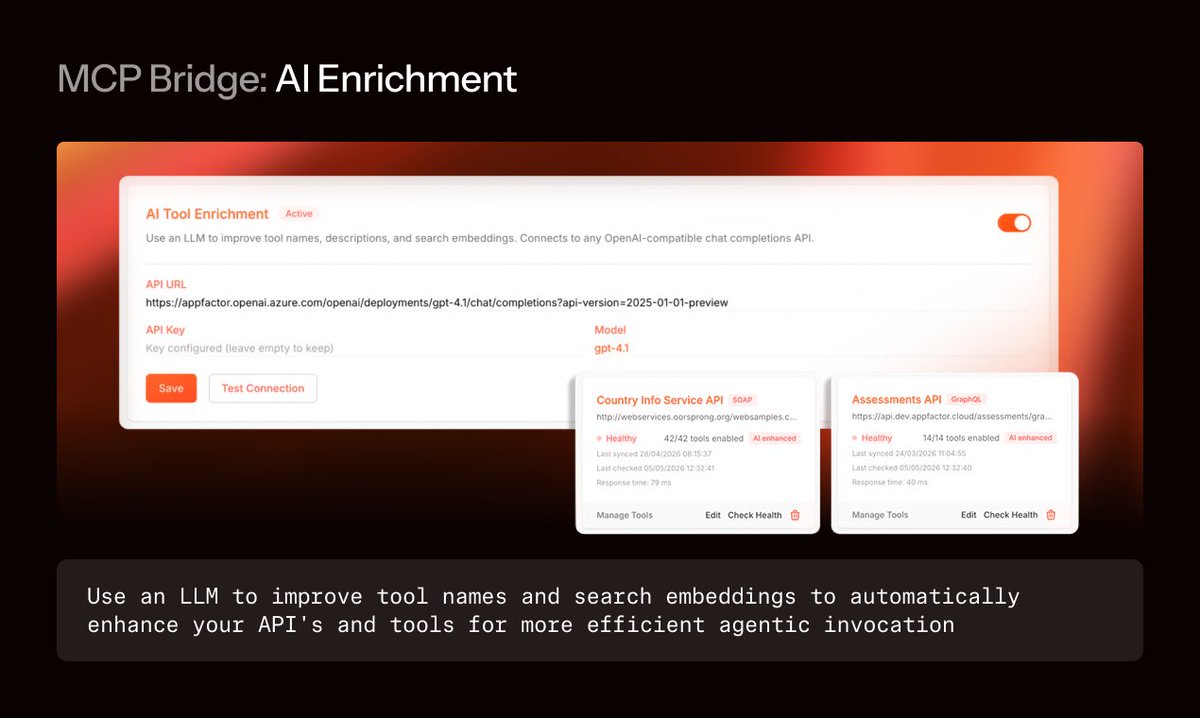
AI Enrichment in MCP Bridge: – Reads the response type (WSDL for SOAP, OpenAPI for REST, captured sample for opaque APIs) – LLM generates a name + description from the response fields – New version lives in the discovery layer only – Original schema preserved, agent still calls the real API appfactor.io/blog/how-we-ma…
Realization: the function name was never the signal. The response shape is. { "custId": "C-44218", "billingAddress": { ... }, "accountStatus": "active", "primaryContact": { ... }, "assignedManager": "..." }
getProcInfo3 → get_customer_account_details Same tool. The new name lives only in the discovery layer, the agent still calls the original API. The rename happened without anyone touching the source code. Here's how 👇🏽

Gabriel Ciuloaica @devsprint
91 Followers 271 Following
Ivan K. Nikkhoo @Ivan_Nikkhoo
734 Followers 3K Following Founder & Managing Partner at @NavigateVentur1 Managing Director at @N3_Capital #Tech, #Investing #Startups, #Travel
mail @mailgghk
26 Followers 271 Following

Dmitry Noranovich @javaeeeee1
2K Followers 2K Following Machine Learning Engineer. I learn by teaching. Opinions are my own. Building https://t.co/LDTxX1BwWC
Gabriel Ciuloaica @devsprint
91 Followers 271 Following
Ivan K. Nikkhoo @Ivan_Nikkhoo
734 Followers 3K Following Founder & Managing Partner at @NavigateVentur1 Managing Director at @N3_Capital #Tech, #Investing #Startups, #Travel
Trends for United States
You might like