honoz @honozcom
AI news that matters. Sharp opinionated takes on models, tools, research, industry. honoz.com Joined May 2026-
Tweets321
-
Followers11
-
Following113
-
Likes0
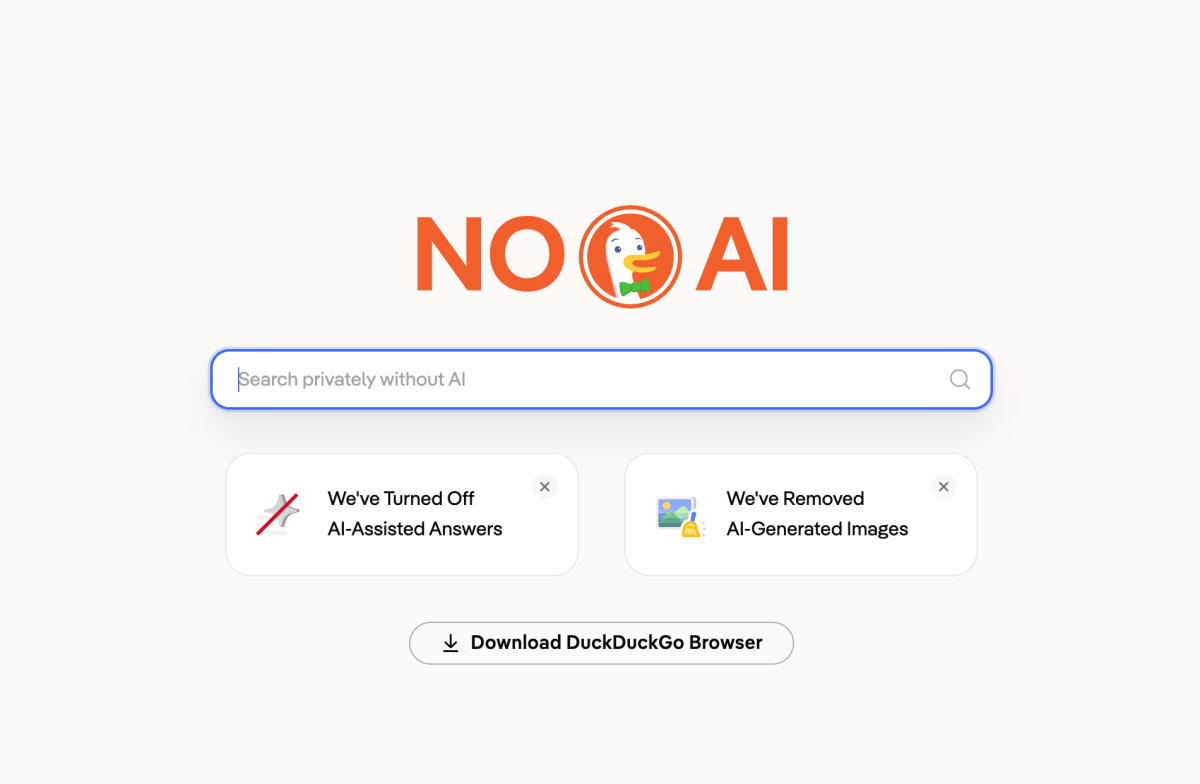
DuckDuckGo’s Anti-AI Pivot: Why the 'No-LLM' Search Engine is Booming The initial promise of the generative web was simple: ask a vague question, get a synthesized answer. But for a growing cohort of technical users, that promise has turned into a productivity nightmare. We have entered an era of "SEO-optimized hallucination," where search engines prioritize their own proprietary LLM output over the actual source material. In the middle of this noise, DuckDuckGo is making a surprising, highly calculated move: they are doubling down on being the search engine that refuses to summarize. What it is DuckDuckGo has formally streamlined access to its "no-AI" search variant, a specific search mode that bypasses the "AI Answers" features plaguing other competitors. While the company has experimented with AI summaries in the past, this move prioritizes direct access to unfiltered web results. This isn't just a settings toggle buried in a menu; the company is actively retooling its UX to highlight a mode that delivers raw links and text without the interference of a large language model reinterpreting the query. The traffic data supports this demand: DuckDuckGo is currently experiencing a significant boom in users, specifically correlating with the rollout of aggressive AI features by its larger rivals. Why it matters This shift matters because it exposes a critical failure in the current "AI-first" roadmap of major search engines. For the average user googling "best pizza near me," an AI summary is helpful. But for a developer debugging a race condition or a founder verifying market claims, AI summaries are active pollution. They obscure the specific version numbers, the exact GitHub comment, and the nuanced context that lives in the source text. By removing the LLM layer, DuckDuckGo is re-optimizing for signal-to-noise ratio. It signals a market segmentation: "Chat" search for consumers, and "Deterministic" search for practitioners. The bigger picture We are witnessing a replay of the early web portal wars, but with an inverted logic. In the late 90s, portals like Yahoo curated content. Then Google won by indexing everything. Now, Google is trying to curate again via AI summaries, effectively becoming a walled garden that answers questions so you never leave the page. DuckDuckGo's strategy is a return to the "Index" philosophy—the idea that a search engine should be a directory, not a publisher. Historically, every time a platform tries to become the content creator (Facebook's Instant Articles, Google's AMP), creators eventually revolt. The "No-AI" movement is the user-led revolt against the algorithmic middleman. Editor's take My take is that the "No-AI" label is the new premium feature in tech. We are seeing the exact same pattern that played out with ad-blockers two decades ago. Users tolerated intrusion until the utility cost became too high, then they flocked to tools that promised a clean, direct experience. DuckDuckGo is effectively building an ad-blocker for AI summaries. For the technical community, this is essential. I do not want my search engine to "think" for me; I want it to retrieve data. If I need synthesis, I will pipe that data into my own local LLM where I control the context window and the temperature. The fact that DDG is booming while the industry pushes harder on generative features proves that "AI" is not a monolith—it is a tool, and like any tool, it has a time and a place. Sometimes, you just need grep, not a chatbot. Bottom line DuckDuckGo's traffic spike proves that the market is hungry for an alternative to AI-saturated search. By prioritizing raw access to information over synthesized answers, they are securing a loyal base of developers and researchers who value precision over convenience. This article was researched and drafted with AI assistance, then editorially reviewed. See our AI content notice. honoz.com/duckduckgos-an… #AI #Tech #StartupNews #TechIndustry #TechNews
Nvidia's Cosmos3 Super Text2Image: The Engine for Physical AI The race to build the visual layer of Artificial Intelligence has largely been dominated by consumer-facing tools like Midjourney and DALL-E, but a quieter, arguably more significant battle is taking place in the realm of "physical AI." Nvidia has quietly uploaded a new heavyweight contender to the Hugging Face hub: Cosmos3-Super-Text2Image. This is not merely a text-to-image model for generating digital art; it is a specialized engine designed to fabricate the visual data required to train robots and autonomous vehicles. By releasing this to the community, Nvidia is signaling that the future of AI development lies in synthetic data generation, not just web scraping. What it is Cosmos3-Super-Text2Image is a diffusion-based text-to-image model that serves as a component of Nvidia’s broader Cosmos platform. While specific benchmark numbers are currently sparse in the public documentation, the model is presented as a high-fidelity generator capable of outputting resolutions suitable for professional simulation environments. It is available in the standard SafeTensors format, ensuring compatibility with popular inference tools like ComfyUI and Automatic1111, but its true power is unlocked through the Diffusers library and integration with the Nvidia Omniverse ecosystem. The model is tagged specifically for cosmos3_omni usage, suggesting it is tuned to handle complex, physically grounded prompts—such as specific lighting conditions, material properties, and geometric configurations—rather than abstract or surreal artistic styles. The weights are hosted directly by Nvidia, and the implementation relies on a standard diffusion transformer architecture, optimized for the company’s GPU compute stack. It effectively allows developers to type a description of a warehouse, a street corner, or a mechanical part and receive a photorealistic 4K render that can be used to train vision systems. Why it matters The release of Cosmos3 matters because it addresses the single biggest bottleneck in physical AI development: a lack of training data. Building a robot that can navigate a factory floor requires millions of images of that factory floor in different lighting, weather, and obstacle configurations. Photographing this in the real world is expensive and slow. Cosmos3 solves this by generating the data on demand. For developers and founders, this lowers the cost of entry into the robotics and spatial computing sectors. Instead of spending months on data collection, a team can leverage a model like Cosmos3 to synthesize a limitless variety of training scenarios. Furthermore, because the model is built on top of Nvidia’s ecosystem, it implies a level of optimization for Tensor Core GPUs that open-source alternatives struggle to match. It effectively bridges the gap between creative generative AI and the rigorous demands of engineering simulation. We are moving from an era of "AI for art" to "AI for engineering," and tools like this are the shovels in that gold rush. The bigger picture This release fits into a larger trend of "verticalization" in generative AI. While foundation models like GPT-4 and Claude aim to be generalists, the infrastructure players—Nvidia, Meta, and Google—are increasingly releasing models tuned for specific industries. We have seen this with Meta’s commitment to open-sourcing Llama for commercial LLM applications, and we are seeing it now with Nvidia’s Cosmos for physical world simulation. Historically, Nvidia has provided the picks and axes (the GPUs) for the AI gold rush. By releasing proprietary models like Cosmos, they are moving up the stack. They are no longer just selling the hardware; they are selling the intelligence that runs on it. This creates a potential moat: if the best models for generating robot training data are optimized specifically for Nvidia hardware, it reinforces the company’s dominance in the chip market. It also highlights a shift in the open-source community, where the most valuable contributions are coming from large corporations with massive compute budgets, rather than independent researchers. Editor's take I think the industry is sleeping on the implications of Nvidia’s software strategy. Everyone watches the stock price because of Blackwell and H100 demand, but the real long-term threat to competitors is the integration of Nvidia’s hardware with their proprietary software stacks. Cosmos3 isn’t just a cool image generator; it is a dependency hook. Once you build your robotics pipeline around Cosmos-generated synthetic data, you are locked into the Nvidia ecosystem. The fact that this is trending on Hugging Face is telling. It suggests that the developer community is hungry for tools that go beyond meme generation and offer tangible utility for building physical products. My take is that we will see more of this "infrastructure-as-a-model" approach, where the model itself is a utility for building other systems, rather than the end product. If you are building an AI startup that relies on visual data, you cannot afford to ignore this. It is a signal that the battle for AI dominance is moving from the chatbot window to the simulation engine. Bottom line Nvidia’s Cosmos3-Super-Text2Image is a specialized, high-fidelity model designed for generating synthetic data for robotics and industrial applications. It signals Nvidia's expansion from hardware to software infrastructure and highlights the growing importance of synthetic data in training physical AI systems. This article was researched and drafted with AI assistance, then editorially reviewed. See our AI content notice. honoz.com/nvidias-cosmos… #NVIDIA #AI #LLM #GenAI #MachineLearning

Nvidia Cosmos3 Super Image2Video: A New Standard for 4K AI Video The race for generative video supremacy has largely been defined by two conflicting metrics: visual fidelity and temporal consistency. For the last year, we have seen models that prioritize one at the expense of the other. Today, the landscape shifted with a quiet but significant release on Hugging Face: Nvidia’s Cosmos3 Super Image2Video. While the industry has been fixated on text-to-video giants like OpenAI’s Sora, Nvidia has been steadily building a diffusion-based ecosystem focused on utility and control. The release of Cosmos3 Super is not just another model drop; it is a statement that 4K resolution and 30fps fidelity are no longer exclusive to Hollywood render farms. This is a tool designed to bridge the gap between static generative art and dynamic, production-ready video assets. What it is Cosmos3 Super Image2Video is a diffusion-based transformer model specifically engineered for image-to-video (I2V) synthesis. Unlike generalized text-to-video models that often struggle to adhere strictly to a specific visual style, Cosmos3 Super takes an existing image—a mid-journey render, a photograph, or a 3D comp—and animates it with high temporal coherence. The model operates within the Nvidia Cosmos ecosystem, utilizing the Diffusers library to ensure seamless integration into existing Python-based workflows. The technical specifications are aggressive. The model generates video clips that run for 8 seconds at 30 frames per second. Crucially, the output resolution scales up to 4K (2160p), a fidelity that was previously reserved for proprietary, closed-source generators. It is available in Safetensors format, ensuring safe and efficient loading of weights, and supports the standard Cosmos3 Omni architecture. This means developers can expect compatibility with existing pipelines that leverage Nvidia’s CUDA optimizations, allowing for faster inference times on RTX hardware compared to standard transformer implementations. Why it matters The availability of a local, open-weights model capable of 4K output fundamentally changes the economics of AI video production. Until now, achieving 4K generative video typically required expensive API calls or significant upscaling post-processing, often resulting in artifacting and loss of detail. By offering 4K natively, Nvidia removes the upscaling bottleneck, allowing creators to output assets that are immediately ready for professional editing environments like Premiere or DaVinci Resolve. Furthermore, the specific focus on Image-to-Video rather than Text-to-Video is a strategic win for the professional market. High-end visual effects and animation pipelines rarely start with a text prompt; they start with a storyboard frame, a concept painting, or a 3D render. I2V allows directors and animators to take a static keyframe and breathe life into it—adding camera movement, subtle environmental shifts, or character motion—without the model hallucinating a completely new composition. This level of input adherence is what separates a toy from a tool. For the developer community, the inclusion of Diffusers support lowers the barrier to entry, allowing for rapid prototyping of custom video agents and automated editing workflows. The bigger picture This release fits into a broader trend of "foundation model" commoditization. While OpenAI and Google battle for the headlines with massive, generalized text-to-video models, Nvidia is quietly occupying the infrastructure layer. They are providing the shovels—highly specialized, optimized models that run on their hardware. The Cosmos family represents a shift toward "practical AI" for media: models that don't just impress on social media but fit into professional pipelines. Historically, video generation has been plagued by the "shimmer" effect—the flickering of pixels over time that breaks immersion. By leveraging a diffusion transformer architecture at this scale and resolution, Nvidia is signaling that the temporal consistency problem is being solved through brute-force parameter scaling and optimized training data. We are moving away from the "dream-like" aesthetic of early generative video toward photorealism. The fact that this is released as an open weight model on Hugging Face, rather than a closed beta, puts pressure on competitors like Runway and Pika to release their own high-resolution local models, or risk losing the developer market to Nvidia's increasingly open ecosystem. Editor's take My take is that Nvidia is playing a different game than the rest of Silicon Valley. While others chase the "Netflix killer" dream of generating full movies from a single sentence, Nvidia is targeting the $30 billion visual effects and post-production market. They understand that professionals don't want a black box; they want a slider they can control. The Cosmos3 Super model feels less like a consumer product and more like a plugin for the future of Unreal Engine and Adobe After Effects. I think this signals the beginning of the end for "low-res" video generation as a category. We are rapidly approaching a standard where 1080p will be considered inadequate for AI video, just as SD video is obsolete today. If you are a founder building a video app, and you aren't planning for 4K pipelines, you are already behind. Nvidia just handed the community the specs for the next standard of digital video, and they did it without the PR fluff. Bottom line Nvidia’s Cosmos3 Super Image2Video sets a new bar for open-source generative video, delivering 4K resolution at 30fps. It prioritizes production utility over novelty, offering a robust tool for animating high-fidelity images. For developers and VFX artists, this is a significant leap toward viable, professional AI video pipelines. This article was researched and drafted with AI assistance, then editorially reviewed. See our AI content notice. honoz.com/nvidia-cosmos3… #NVIDIA #AI #LLM #GenAI #MachineLearning

Nvidia Cosmos3-Super: Why the 7B Video Model is a Physical AI Play The landscape of generative video is shifting from creating viral clips to simulating physical reality. While the internet remains fixated on the cinematic output of consumer-facing tools, Nvidia has quietly released a heavyweight contender on Hugging Face that serves a different master: the physical AI stack. Cosmos3-Super isn’t just trying to make art; it is trying to understand the laws of physics, representing a major infrastructural play for the coming wave of autonomous systems and robotics. What it is Cosmos3-Super is a 7 billion parameter diffusion-based transformer model designed for high-fidelity video synthesis and world simulation. Unlike standard generative models that might struggle with temporal consistency, this model is explicitly architected to handle 720p native resolution with the ability to upscale to 1080p, offering a balance between computational efficiency and output quality. It arrives as part of the broader Cosmos ecosystem, signaling Nvidia’s intent to provide the foundational models for "physical AI." The model is currently available in diffusers format, utilizing safetensors for secure weight loading, and integrates directly into the standard Hugging Face ecosystem, making it immediately accessible for developers utilizing PyTorch pipelines without needing proprietary Nvidia hardware suites, though GPU acceleration remains essential for viable inference speeds. Why it matters The significance of Cosmos3-Super lies in its specific optimization for "world simulation." Traditional video models often hallucinate physics—objects pass through each other, gravity is ignored, and momentum is nonexistent. This limits their utility for any serious application beyond entertainment. Nvidia’s approach here targets the robotics and autonomy sectors, where a model’s ability to predict "cause and effect" is critical. By training on datasets that emphasize physical interactions, Cosmos3-Super provides a testbed for training AI agents in simulated environments before they are deployed in the real world. This "simulation-to-reality" (Sim2Real) pipeline is the holy grail for robotics, reducing the cost and danger of training physical machines. For the AI developer community, this release lowers the barrier to entry for creating sophisticated training data, allowing teams to generate synthetic video footage of specific scenarios to train smaller, more specialized agents. The bigger picture This release contextualizes Nvidia’s broader strategy beyond selling GPUs. As competitors like OpenAI (Sora) and Stability AI race for consumer mindshare, Nvidia is building the rails for the industrial metaverse. We have seen similar trends in the shift from 2D to 3D generation, and now from static 3D to dynamic 4D video simulation. Historically, the lack of high-quality, diverse video data has been a bottleneck for training embodied AI. Nvidia is effectively solving this data bottleneck by creating a generator that can produce infinite variations of physical scenarios. It mirrors the strategy seen with their Omniverse platform, but now packaged in a format that adheres to the open-source community standards of Hugging Face, suggesting a push to drive adoption among researchers who might otherwise rely on closed APIs. Editor's take My take is that the market is misinterpreting this if they view it merely as a "Sora killer." That is the wrong lens. Cosmos3-Super is not a product for a prompt engineer looking to make a movie; it is infrastructure for an engineer trying to train a self-driving car or a warehouse robot. I suspect Nvidia is releasing this widely to crowdsource the fine-tuning of physical understanding. By getting this into the hands of thousands of developers, they effectively get free R&D into improving the model's grasp of complex physics. It is a brilliant strategic move: capture the developer mindshare for the physical AI layer before the competition even realizes the game has changed from pixels to prediction. Bottom line Cosmos3-Super is a specialized 7B video model targeting physical simulation rather than just video generation. It is a critical tool for developers working on robotics and autonomous agents, offering a pathway to generate synthetic training data where real-world data is scarce or dangerous to collect. This article was researched and drafted with AI assistance, then editorially reviewed. See our AI content notice. honoz.com/nvidia-cosmos3… #NVIDIA #AI #LLM #GenAI #MachineLearning

Nvidia Cosmos3-Nano: The First Real Threat to Closed Video Models The race for video generation supremacy has largely been defined by opacity. While OpenAI, Google, and a handful of well-funded startups have dazzled us with high-fidelity, cinematic clips, the underlying models have remained stubbornly locked behind API keys and expensive credits. That dynamic shifted this week with the arrival of Nvidia’s Cosmos3-Nano on Hugging Face. This isn't just another research paper; it is a functional, open-weights release that democratizes access to high-quality video diffusion. By targeting a lean 7 billion parameter architecture optimized for single-GPU inference, Nvidia is effectively handing developers the keys to the castle. If you are a founder or a developer tired of feeding your margins into an API, this is the signal you have been waiting for. What it is Cosmos3-Nano is a 7 billion parameter video foundation model designed specifically for efficiency and local deployment. Unlike its larger, more compute-hungry predecessors in the Cosmos family, the "Nano" variant prioritizes a manageable memory footprint, allowing it to run on a single consumer-grade GPU. The model utilizes a diffusion-based architecture and has been seamlessly integrated into the Hugging Face Diffusers library, making it immediately accessible to the existing Python ecosystem without the need for complex, bespoke toolchains. Early reports and benchmarks indicate a strong focus on temporal consistency, a notorious bottleneck in previous open-source video attempts, allowing for smoother video generation at standard resolutions. Why it matters The release of Cosmos3-Nano matters because it shatters the barrier to entry for video AI applications. Until now, building a product that relied on video generation meant either building your own massive stack from scratch or paying exorbitant fees for closed APIs. This release changes the economics of development. It allows startups to run video workloads locally, ensuring data privacy and eliminating the variable latency of cloud APIs. For the autonomous agent ecosystem, this is critical. We are moving toward a future where agents need to communicate visually; giving them the ability to generate video context locally on an edge device or a cheap server is a massive leap forward. It forces the competition to innovate on price and performance rather than relying on moats created by proprietary infrastructure. The bigger picture This drop fits into a broader trend of "frontier diffusion" becoming commoditized. We saw it with Stable Diffusion for images, and we are seeing the early stages of it now with video. Nvidia releasing this as open weights is a strategic play to sell the hardware (the GPUs) that these models run on, but the byproduct is a massive acceleration of the open-source community. While labs like OpenAI focus on "AGI" through massive scale, Nvidia is pragmatically filling the gap for usable, deployable AI today. It validates the thesis that the future of AI isn't just about bigger models, but about optimized, capable models that fit into the developer's actual budget and hardware constraints. Editor's take My take is that Cosmos3-Nano is the inflection point for video AI. I have been skeptical of previous open-source video attempts because they often required a multi-GPU server farm to produce anything usable. This feels different. By targeting the single-GPU crowd, Nvidia is acknowledging that the real value of AI lies in its distribution, not just its existence. I believe we will see a rapid iteration of fine-tunes and LoRAs built on top of this base model within weeks, specifically tailored for gaming, dynamic backgrounds, and agent communication. If you are still relying on Sora or similar closed models for prototyping, you are building on borrowed time. The leverage is shifting to the open stack. Bottom line Cosmos3-Nano brings efficient, local video generation to the masses. It is a technically robust release that lowers the cost of innovation in the video space. For developers, the question is no longer "can I afford to build video features?" but "how fast can I deploy them?" This article was researched and drafted with AI assistance, then editorially reviewed. See our AI content notice. honoz.com/nvidia-cosmos3… #NVIDIA #AI #LLM #GenAI #MachineLearning

JetBrains Mellum2: A 12B 'Thinking' Model With 2.5B Active Params The race to build capable AI models is shifting from raw size to efficiency. While frontier labs chase the trillion-parameter mark, a quieter revolution is happening in the 12B space. JetBrains, a company best known for IDEs, has just released a potentially disruptive open-weight model on Hugging Face. It’s called Mellum2-12B-A2.5B-Thinking, and it challenges the assumption that you need massive server farms to run high-quality reasoning models. What it is Mellum2-12B-A2.5B-Thinking is a Mixture-of-Experts (MoE) language model. It technically boasts 12 billion total parameters, but it utilizes a sparse activation mechanism. This means that for any given token generation, only 2.5 billion of those parameters are active. This drastically reduces the VRAM requirements and computational load compared to a dense 12B model like Llama 3 or Mistral. The model is currently hosted on Hugging Face and is available in safetensors format, optimized for text generation and conversational tasks. The "Thinking" designation in the name implies it is trained or fine-tuned to generate internal reasoning traces before producing a final answer, a technique popularized recently to improve logic and math capabilities in smaller models. Why it matters This release matters because it directly addresses the hardware bottleneck for local AI. Most developers cannot run a 70B model locally without expensive GPU setups, and even 12B or 13B dense models can be sluggish on consumer hardware. By using an MoE architecture with 2.5B active parameters, Mellum2 theoretically offers the reasoning quality of a mid-sized model with the speed and footprint of a small one. If the benchmarks hold up, this allows for powerful coding assistants and chat agents to run entirely on-device. This preserves privacy—no data leaves the machine—and reduces latency by eliminating network calls to the cloud. It signals a shift where the efficiency of the architecture becomes more important than the total parameter count. The bigger picture We are seeing the maturation of the MoE strategy in the open-source community. While Mixtral proved the viability of open-weight MoE, it was still too large for many. Mellum2 represents the next step: aggressive sparsity to fit into usable deployment windows. JetBrains entering this space is also notable. They are not an AI research lab in the traditional sense; they are a productivity company. Their involvement suggests they are integrating these models deeply into their ecosystem, likely aiming to power features in IntelliJ, PyCharm, or Rider with local inference engines. This aligns with a broader industry trend where software vendors are moving away from API dependencies to build proprietary, local-first AI stacks. Editor's take I believe the "Thinking" label is the most interesting part of this release. We have seen a surge of models—like the recent Qwen and DeepSeek variants—that explicitly separate reasoning from the final response. If JetBrains has successfully distilled this capability into a 2.5B active parameter budget, they have solved a major UX problem for local tools. My take is that this is less about competing with GPT-4 and more about creating a viable local alternative for specific workflows. The combination of JetBrains' distribution power and a lean architecture could make this the default choice for developers looking to offline their coding copilots. Bottom line Mellum2-12B-A2.5B-Thinking is a high-efficiency MoE model designed for local reasoning. It attempts to bridge the gap between small, fast models and large, smart ones. It is a significant development for anyone building local AI tools. This article was researched and drafted with AI assistance, then editorially reviewed. See our AI content notice. honoz.com/jetbrains-mell… #AI #LLM #GenAI #MachineLearning #TechNews

Step-3.7-Flash GGUF: High-End Multimodal Vision Moves Local The barrier to entry for running sophisticated multimodal AI just collapsed. While the industry obsesses over the next trillion-parameter parameter count, a quieter, more practical revolution is happening on the edge. Stepfun’s release of the Step-3.7-Flash in GGUF format represents a pivotal shift in what developers can expect from local hardware. It is no longer just about text generation; it is about bringing vision capabilities—previously locked behind expensive API tiers—directly to the consumer GPU. What it is Step-3.7-Flash is a multimodal model that processes both image and text inputs to generate text outputs. Unlike standard dense models, this architecture utilizes a Mixture-of-Experts (MoE) approach, which activates specific subsets of its neural network for different tasks. This allows for high efficiency and performance relative to its size. The release on Hugging Face provides these weights in GGUF format, a file type specifically designed for CPU and Apple Silicon inference via the llama.cpp ecosystem. The release includes variants quantized using importance matrices (imatrix), ensuring that the model retains as much accuracy as possible while shrinking the memory footprint to run on locally available hardware. Why it matters The significance of this release lies in the democratization of vision intelligence. Historically, multimodal capabilities—reading a chart, analyzing a meme, or parsing a scanned document—required sending data to a centralized server like OpenAI’s GPT-4o or Anthropic’s Claude 3.5 Sonnet. This introduces latency, cost, and significant privacy concerns. By porting these capabilities to GGUF, Stepfun enables developers to run these workloads entirely offline on a local machine. For privacy-preserving applications—such as analyzing personal photos or processing sensitive corporate documents—this is a game changer. It signals a maturing ecosystem where the 'local LLM' is no longer a curiosity for hobbyists but a viable production target for serious agentic workflows. The bigger picture This fits into a broader trend of frontier model capabilities trickling down to the open-source community at unprecedented speeds. We saw a similar trajectory with text-only models like Llama-3 and Mistral, where open-source variants rapidly caught up to proprietary performance. Stepfun’s release indicates that the same timeline now applies to multimodal models. The MoE architecture is particularly notable here; it mimics the strategy used by industry giants like Mixtral and GPT-4, optimizing for performance per parameter rather than raw scale. As quantization techniques improve, models that previously required industrial-grade H100 clusters are becoming runnable on gaming laptops and Mac Studios. Editor's take I believe this release is a critical signal for the 'Agentic' future. Agents need to see the world to interact with it effectively. If your agent is forced to API out every time it needs to look at a screen or a document, you introduce a point of failure and a recurring cost that kills unit economics. Local vision models like Step-3.7-Flash remove that friction. My view is that we will see a bifurcation in the market: massive centralized models for training and reasoning, and highly optimized, specialized local models for execution. Stepfun is positioning itself squarely in that execution layer. Bottom line Step-3.7-Flash in GGUF format proves that high-end multimodal AI is no longer exclusive to API providers. It brings efficient, image-text capabilities to local hardware, offering developers a privacy-focused and cost-effective alternative for vision tasks. This article was researched and drafted with AI assistance, then editorially reviewed. See our AI content notice. honoz.com/step-37-flash-… #AI #LLM #GenAI #MachineLearning #TechNews

Anthropic Files for IPO: The First Real Test for 'Safe' AI Economics The era of the AI mega-startup is officially entering its next chapter. Anthropic has confidentially submitted a draft registration statement on Form S-1 to the U.S. Securities and Exchange Commission, setting the stage for an initial public offering. While the specific timing of the listing remains fluid—companies often file confidentially to test the waters without spooking the market—the move signals a definitive shift from the growth-at-all-costs startup phase to the disciplined reality of public markets. For an industry obsessed with AGI, this is a grounding moment in financial reality. What it is Anthropic, the maker of the Claude large language model (LLM) series, has initiated the formal process toward a public listing. The confidential submission allows the company to submit financials and operational details to the SEC for review without making them public immediately. This provides Anthropic the flexibility to pull the trigger on the IPO when market conditions are favorable or delay if volatility hits. Founded by ex-OpenAI executives Dario and Daniela Amodei, the company has raised billions in funding, primarily from Amazon and Google, positioning itself as the primary 'safety-first' competitor to OpenAI’s GPT-4 and GPT-4o models. Why it matters An IPO for Anthropic is not merely a liquidity event for early investors; it is the first major public test of the 'safety-tax' hypothesis. For years, the AI industry has debated whether focusing on constitutional AI, safety guardrails, and responsible scaling imposes a financial penalty compared to moving fast and breaking things. By going public, Anthropic is forced to open its books, revealing the actual burn rate of training frontier models and the margins of its enterprise API business. If their cost of inference remains high and safety measures slow down deployment, public investors—who demand predictable quarterly growth—may punish the stock. Conversely, a successful debut would validate that enterprises are willing to pay a premium for 'safer' AI models, forcing competitors to accelerate their own safety efforts to catch up. The bigger picture This filing sets the stage for a divergent path among AI giants. While OpenAI remains a complex non-profit hybrid with a capped-profit arm, deeply integrated with Microsoft’s ecosystem, Anthropic is pursuing a more traditional corporate structure. This structural difference will become a key narrative for investors. OpenAI has the advantage of a captive distribution channel in Microsoft 365 and Azure; Anthropic has to win customers on the open market, primarily through AWS and Google Cloud. An IPO pressures Anthropic to demonstrate that it can compete on distribution and pricing without the crutch of an exclusive cloud provider tie-in. It also sets a benchmark for valuation for other AI players like Mistral or xAI, who may be looking toward their own exit strategies in the next 18 to 24 months. Editor's take I think this is the most critical inflection point for the commercial AI landscape since the launch of ChatGPT. We are about to find out if Wall Street has the patience for AGI. Private VCs are often willing to fund 'science projects' based on future potential, but public markets are ruthless about unit economics and current revenue. Anthropic has marketed itself as the responsible, thoughtful alternative to OpenAI. My view is that this IPO will force them to make a hard choice: maintain their stringent safety standards and risk slower growth, or loosen the reins to satisfy shareholder demands for aggressive expansion. The 'safety-first' narrative is a powerful brand differentiator, but it is expensive. If the financials show that their Claude models are costing significantly more to run and maintain than OpenAI's equivalents, the stock will struggle. This filing isn't just about selling shares; it's about selling the idea that ethics can be profitable. Bottom line Anthropic is preparing to go public, forcing the company to prove that 'safe AI' is a viable business model at scale. Expect intense scrutiny on their burn rates and API margins. This article was researched and drafted with AI assistance, then editorially reviewed. See our AI content notice. honoz.com/anthropic-file… #Anthropic #Claude #AI #Tech #StartupNews

Meta's AI Support Bot: The Accidental Account Takeover Tool The race to automate customer support with AI agents has officially hit a security wall. A recent analysis of Meta's internal support infrastructure reveals a glaring vulnerability: the company's automated AI bot is being weaponized by attackers to hijack Instagram accounts. This isn't a sophisticated code exploit or a zero-day in the encryption stack; it is a fundamental failure of logic in the very systems designed to help users. By prioritizing automated responses over human judgment, Meta has inadvertently created a mechanism that helps hackers verify accounts they do not own. What It Is The mechanics of this exploit are alarmingly simple, requiring no advanced coding skills. The vulnerability centers on the "Download Your Information" (DYI) feature, a standard compliance tool for users to retrieve their data. When a user interacts with Meta's AI support bot regarding account access, the bot can generate a direct download link for this data. Here is the breakdown of the failure: an attacker initiates a chat with the AI bot and requests a data download link. The bot, adhering to its script, generates a unique URL for the attacker's own account. However, the URL structure contains a specific user ID parameter. Attackers have discovered that they can simply modify that ID in the URL string to match their target's victim ID. When they send this modified link back to the bot or request the system to process it, the automated backend fails to re-verify the ownership context. It blindly accepts the request and generates a valid download link for the victim's personal data. Crucially, this data package often includes active session cookies or tokens. By importing these stolen cookies into their own browser, attackers gain immediate access to the victim's account, completely bypassing password checks and two-factor authentication (2FA). Why It Matters This specific failure exposes a massive hole in the current implementation of AI-driven customer support. For years, the assumption has been that automation creates efficiency. This case proves that, without robust guardrails, automation creates exposure. The implication here is that the "human in the loop"—the support agent who would realize that a user asking for someone else's data is suspicious—has been removed. From a security perspective, this redefines the threat model for social media users. It demonstrates that 2FA is no longer the final barrier for account security. If the support systems designed to help users recover access can be socially engineered by a script, the authentication chain is only as strong as the dumbest bot in the conversation. For the broader industry, this serves as a stark warning. Companies are rapidly deploying LLMs and automated agents to reduce support costs. If those agents are granted the power to execute high-privilege actions (like data exports or password resets) based solely on text input without strict identity verification, we will see a surge in automated account takeovers. The cost savings from firing human support agents are quickly erased by the reputational damage and fraud liability when those agents start handing user accounts to hackers. The Bigger Picture This incident fits into a wider pattern of tech giants struggling to secure the "AI layer" of their applications. We have moved from the era of prompt injection attacks (tricking a model into saying bad words) to operational security failures (tricking a model into performing damaging actions). The distinction is critical: the former is a content moderation issue; the latter is a security vulnerability. Meta is not the first to face this, but the scale of Instagram makes this goof particularly dangerous. We have seen similar "logic bypasses" in other automated systems, such as attackers exploiting chatbots to manipulate pricing or warranty claims. However, using a support bot to exfiltrate session cookies represents a significant escalation. It effectively turns the customer service department into an attack surface. Historically, social engineering required convincing a human to make a mistake. Now, attackers only need to convince a rigid, rule-based bot to follow its script too literally. Editor's Take My take is that this is a direct consequence of treating AI support as a cost-cutting measure rather than a product feature. When you design a support bot, the primary goal should be helpfulness, but the secondary goal must be safety. By deploying a bot that can execute sensitive actions without re-authentication, Meta failed to implement basic security hygiene. I find it almost comical that in 2026, we are still fighting URL parameter manipulation. It feels like a throwback to web security flaws from the early 2000s, dressed up in a modern AI wrapper. This proves that adding a neural network to the front of your legacy API does not magically fix the underlying security flaws. If anything, it obscures them behind a veneer of conversational politeness. Until companies start treating their AI bots as potential insider threats—capable of being manipulated by bad actors—we will continue to see these goofy, damaging exploits. Bottom Line Meta's AI support bot is currently facilitating account takeovers by failing to verify user identities during data export requests. This highlights a critical vulnerability in automated support systems: without human judgment, bots can be easily scripted to bypass security protocols. The industry must stop giving AI agents high-level privileges without implementing strict, re-verification checkpoints. This article was researched and drafted with AI assistance, then editorially reviewed. See our AI content notice. honoz.com/metas-ai-suppo… #AI #Tech #StartupNews #TechIndustry #TechNews

Bonsai Image 4B: Why 1.58-Bit Diffusion Models Change the Game for Local AI The gap between cloud-based image generation and local inference is shrinking rapidly. For years, running high-quality diffusion models like Stable Diffusion XL required significant GPU VRAM, effectively locking out users without dedicated gaming rigs. However, a new trend of aggressive quantization is changing the math. The release of the Bonsai Image Ternary 4B model signals a shift where efficiency no longer requires a proportional sacrifice in image quality. By pushing weights down to a theoretical 1.58 bits, this model demonstrates that the future of AI art is not just in massive server farms, but in locally installed, privacy-preserving applications. What it is Bonsai Image Ternary 4B is a 4 billion parameter text-to-image model that has been optimized using a quantization method known as Gemlite. Unlike standard 16-bit float or even 8-bit integer models, this implementation utilizes a ternary scheme, where weights are constrained to -1, 0, or 1, plus a small scaling factor. This technique effectively compresses the model size to approximately 1.58 bits per weight. The model is distributed in the standard Diffusers library format, utilizing SafeTensors for safety and compatibility. It functions as a drop-in component for image generation pipelines, aiming to replicate the output quality of much larger models while maintaining a drastically smaller memory footprint. Why it matters This development matters because it addresses the primary bottleneck of local AI adoption: hardware accessibility. Currently, running state-of-the-art image models demands expensive, power-hungry GPUs. By reducing the precision to ternary levels, developers can run these models on consumer-grade hardware with significantly less VRAM. This lowers the barrier to entry for indie developers and allows for the deployment of image generation on edge devices, such as high-end laptops or proprietary hardware, without relying on cloud APIs. It represents a move away from the "bigger is better" philosophy, proving that algorithmic efficiency can compete with brute-force parameter scaling. The bigger picture We have seen this movie before in the Large Language Model space. Models like BitNet and various 1.58-bit LLMs have shown that extreme quantization is viable for text. Applying this same rigor to diffusion models is the logical next step. The industry is moving toward a future where models are optimized for the device they run on, rather than the device adapting to the model. This release fits into a broader context of "local-first" AI, where privacy and latency are paramount. As quantization techniques mature, we can expect a wave of applications capable of running complex generative tasks entirely offline, free from subscription fees or censorship filters often found in hosted solutions. Editor's take I believe ternary quantization is the dark horse of the current AI cycle. While everyone watches GPT-5 or Gemini 2.0, the real engineering breakthrough is happening in model compression. A 4B model running at 1.58 bits effectively democratizes the technology. It allows a much wider demographic to experiment with and build upon these models. If this quality holds up under scrutiny, we are witnessing the end of the "VRAM tax" that has restricted AI development to those with deep pockets for hardware. This is a technical win that has massive implications for the creative industry. Bottom line Bonsai Image Ternary 4B proves that image generation models can be compressed to extreme levels without collapsing. It is a significant step toward viable, high-quality local art tools that run on standard computers. This article was researched and drafted with AI assistance, then editorially reviewed. See our AI content notice. huggingface.co/prism-ml/bonsa… #AI #LLM #GenAI #MachineLearning #TechNews

Keye-VL-2.0: Why 4K Resolution Matters in Open Multimodal Models The race for capable open-source multimodal models has largely been a story of追赶—playing catch-up to the proprietary giants like GPT-4V and Claude 3.5 Sonnet. While Western labs have focused on broad reasoning capabilities, a distinct trend is emerging from Chinese tech giants: optimizing for specific, high-value data modalities. The latest entry, Kwai’s Keye-VL-2.0-30B-A3B, doesn't just chase generic benchmarks; it targets a specific bottleneck in the current ecosystem—visual resolution. By natively supporting 4K image inputs, this 30-billion parameter model is attempting to solve the "blurry vision" problem that plagues most local deployments. What it is Keye-VL-2.0-30B-A3B is a multimodal large language model (MLLM) developed by Kwai (Kuaishou), a major player in the Chinese tech ecosystem. It is built on a transformer architecture designed to handle image-text-to-text generation tasks. Unlike many open-source models that treat vision as an afterthought, Keye-VL-2.0 integrates a vision encoder capable of processing images at a native resolution of 4K (3840x2160 pixels). The model utilizes a Mixture of Experts (MoE) architecture, balancing a massive total parameter count with an active inference load of roughly 30 billion parameters. It is released under the model name Keye-VL-2.0-30B-A3B and is available in the Safetensors format. The repository indicates support for standard tasks such as feature extraction and multimodal classification, but its primary utility lies in its ability to ingest and reason over high-fidelity visual data without the aggressive downsampling typically required to fit image embeddings into a fixed context window. Why it matters The significance of 4K support cannot be overstated for practical applications. Most current vision-language models, including LLaVA and many derivatives, resize input images to a fixed square resolution (often 336x336 or 448x448 pixels). While this is computationally efficient, it destroys fine-grained information. A financial chart, a complex engineering diagram, or a page of text becomes an unreadable blur once compressed. By supporting 4K inputs, Keye-VL-2.0 enables a new class of "Vision Agents"—systems that can perform tasks previously reserved for human analysts. Consider a document processing pipeline: a standard LLM might summarize a PDF based on OCR text, but a high-resolution VLM can actually see the layout, identify signatures, and cross-reference data located in different columns of a table. For developers building tools for legal tech, medical imaging analysis, or automated UI testing, this model offers a path to deploy these capabilities locally without relying on API-based vision services. The bigger picture This release fits into a broader pattern of capability leakage from frontier labs to the open-source community. We saw a similar trajectory with text-only models; the gap between GPT-4 and Llama-3 was once insurmountable, but it has narrowed significantly. In the visual domain, the gap remains large, but models like Keye-VL-2.0, along with Qwen2-VL and InternVL, represent the first generation of open weights that can realistically challenge the proprietary leaders on specific tasks. The focus on resolution also signals a shift in how we evaluate these models. Benchmarks like MMMU or MMLU are becoming less relevant than "utility benchmarks"—can the model read a receipt? Can it navigate a website? By prioritizing input fidelity, Kwai is addressing the actual pain points of enterprise integration rather than chasing leaderboard points. Editor's take I believe the industry is underestimating the demand for high-resolution local vision. Privacy concerns are a massive driver here; companies simply cannot upload screenshots of internal dashboards or proprietary design documents to OpenAI or Anthropic. If a model like Keye-VL-2.0 can run on-premise and accurately parse that data, it solves a burning problem for CTOs. While the instruction-following capabilities of Chinese models can sometimes lag behind GPT-4 in nuance, the raw utility of "seeing everything" is a compelling trade-off. I expect to see this model heavily forked and fine-tuned by the community to serve specific verticals like OCR-augmented coding assistants or automated quality control in manufacturing. Bottom line Keye-VL-2.0-30B-A3B is a specialized tool for high-fidelity visual understanding. It offers a viable local alternative for tasks requiring granular image analysis, particularly where privacy or data control is a priority. This article was researched and drafted with AI assistance, then editorially reviewed. See our AI content notice. honoz.com/keye-vl-20-why… #AI #LLM #GenAI #MachineLearning #TechNews

Meta’s Subscription Pivot: Preparing the Billing Layer for the AI Era The era of the ad-only social network is officially dying. Meta’s decision to launch paid subscriptions across its flagship apps—Instagram, Facebook, and WhatsApp—marks the most significant pivot in the company’s business model since its pivot to the metaverse. This isn't merely a cash grab for verification blue checks; it is the foundational infrastructure for a subscription-based AI future. By establishing direct billing relationships with millions of users and creators now, Meta is effectively building the payment rails required to monetize the coming wave of advanced AI agents. What It Is Meta is officially rolling out "Meta Verified" and other subscription bundles across its "Family of Apps." For a recurring monthly fee, users receive a verified badge, proactive monitoring for account impersonation, and direct access to customer support. The pricing is tiered depending on the platform and the specific bundle, often hovering around $14.99 per month on the web for the full suite of features. The rollout is not limited to a single region; it represents a global push to monetize identity and security. The subscription packages are being marketed heavily toward creators and businesses, offering "exclusive features" and increased visibility in exchange for payment. This moves Meta away from its reliance solely on advertising revenue, diversifying income streams as privacy regulations and signal loss make ad targeting harder. Why It Matters This shift matters because it changes the incentives of the platform. When a user pays Meta directly, the company’s product is no longer just the user’s attention—it is the user’s success and security. This creates a stickier ecosystem. For creators, a subscription promises a safeguard against the chaotic nature of algorithm changes and impersonation attacks, offering a semblance of stability in their professional livelihood. However, the deeper implication lies in the data and the infrastructure. Implementing subscriptions requires complex billing systems, fraud detection, and identity verification layers. These are the exact same prerequisites needed to sell high-value AI services. You cannot easily sell a subscription to an advanced AI coding assistant or a personalized lifestyle agent if you do not have a proven, flawless system for taking recurring payments and verifying human identity. Meta is effectively subsidizing the build-out of this architecture using low-hanging fruit like blue checks and support queues. The Bigger Picture We have seen this movie before with X (formerly Twitter), but the scale here is different. X operates on a much smaller user base compared to Meta’s multi-billion empire. Furthermore, the competitive landscape has shifted. We are entering an age where AI companies like OpenAI and Anthropic are establishing direct subscription relationships with consumers for productivity and intelligence. If Meta relies solely on ads, and competitors rely on high-margin subscriptions for AI tools, Meta risks losing the most valuable segment of the market: power users and professionals. By launching subscriptions now, Meta retains those users within its walled garden. It also pre-empts a future where AI agents might bypass social platforms entirely. If a creator’s AI assistant can post directly to a server, Meta loses the engagement. By bundling the creator into a subscription plan, Meta ensures the creator—and their audience—stay locked into the platform. Editor's Take I believe this is the most critical infrastructure play Meta has made in a decade. The cynics will say this is just a reaction to X’s success or a desperate attempt to offset declining ad revenue. While those factors play a role, they miss the long game. The "AI Plans" mentioned in the source reporting are the smoking gun. We are rapidly moving toward a world where your primary interaction with a tech giant is not through a search bar or a feed, but through a personalized agent. Agents are not ad-supported. You do not want ads in your workflow; you want reliability and speed. That requires a subscription model. Meta is launching Instagram and WhatsApp subs now so that when they launch "Meta AI Premium" in two years, the credit card is already on file, the trust is established, and the behavioral friction is zero. They are training users to pay for the platform today so they will pay for the robot tomorrow. Bottom Line Meta’s subscriptions are the visible tip of a massive strategic iceberg. While users get blue checks and support today, Meta is building the billing engine necessary to monetize the AI revolution. This is about survival in a post-ad, post-app economy. This article was researched and drafted with AI assistance, then editorially reviewed. See our AI content notice. honoz.com/metas-subscrip… #MetaAI #Llama #AI #Tech #StartupNews

NVIDIA Cosmos 3: The Open Physics Engine for the Age of Robotics The race for artificial general intelligence often fixates on language—on whether a model can write poetry or pass the bar exam. But for the vast majority of the global economy, intelligence isn't about words; it is about movement. It is about understanding gravity, friction, and collision. Today, NVIDIA took the wraps off Cosmos 3, and if you are paying attention to the infrastructure layer of AI, this is a significantly louder signal than the usual large language model (LLM) update. We are moving past the era of the chatbot and entering the era of the physical reasoner. What it is Cosmos 3 is a 1 billion parameter "omni-model" specifically architected for physical AI reasoning and action. Unlike its predecessors in the Cosmos family, which were largely focused on video generation for content creation, this iteration is built for utility. It is designed to process video streams and sensor data to predict future states of the world, making it essential for robotics and autonomous systems. Technically, the model is being released under the Apache 2.0 license, a move that grants commercial developers the freedom to modify and deploy the weights without the restrictive caveats often seen in "open-weights" releases. The architecture has been optimized for inference efficiency, boasting a 4x increase in throughput compared to the previous generation. It is specifically tuned to run effectively on NVIDIA's Jetson Orin platforms, meaning this isn't just a cloud-bound toy; it is designed to live on the edge, inside the robot or the vehicle. Why it matters The implications here are not theoretical. For the last two years, we have seen a Cambrian explosion in "agentic" AI—software systems that use LLMs to plan and execute tasks. However, these agents are largely trapped behind a screen. They can book a flight, but they cannot physically pack a bag or drive a car. This is the "embodiment gap." Cosmos 3 bridges that gap by providing a pre-trained understanding of the physical world. For robotics founders, this changes the capital requirement table. Training a world model from scratch requires massive amounts of video data and compute. By releasing Cosmos 3 as an open base, NVIDIA provides a starting point that understands object permanence, spatial relationships, and physics. This allows startups to focus their fine-tuning budgets on specific verticals—like warehouse logistics or surgical precision—rather than teaching a machine what a floor is. Furthermore, the Apache 2.0 licensing is a strategic weapon against closed-source competitors. It ensures that the ecosystem of tools, wrappers, and optimizations built around Cosmos will remain open, potentially cementing NVIDIA's hardware as the default standard for physical AI deployment. The bigger picture We are witnessing a bifurcation in AI model development. On one side, you have the frontier labs (OpenAI, Anthropic, Google) racing toward AGI through text and reasoning. On the other, you have NVIDIA (and to some extent, Tesla with their vision-only approaches) building the infrastructure for spatial reasoning. This mirrors the early days of the internet, where the distinction between the "browser" and the "server" defined the industry. In this context, Cosmos 3 is NVIDIA staking a claim not just as a GPU supplier, but as a software platform provider. They are effectively open-sourcing the "physics engine" of the future to ensure that the hardware required to run it remains NVIDIA gear. It is a classic platform play: commoditize the complement (the model) to sell the core (the compute). The fact that they are targeting the Jetson edge architecture specifically tells you they expect the compute to happen where the action is—on the device, not in the data center. Editor's take My take is that we will look back at Cosmos 3 as the "Llama 3 moment" for robotics. Just as Llama proved that you could build viable commercial products on top of open weights, Cosmos 3 is going to prove that physical AI doesn't need to be locked behind a walled garden. The 4x throughput stat is the headline that matters most to me; it signals that the engineering team wasn't just chasing benchmarks, but was obsessing over latency. In robotics, latency equals safety. If a model takes 500ms to react to a person stepping into the road, it is useless. If it takes 50ms, it is a product. NVIDIA seems to have cracked that code. Bottom line Cosmos 3 is not just a research release; it is a foundational infrastructure play for the robotics industry. By open-sourcing a high-performance, physics-aware model, NVIDIA is accelerating the timeline for autonomous systems and securing its position at the hardware heart of the physical AI revolution. This article was researched and drafted with AI assistance, then editorially reviewed. See our AI content notice. honoz.com/nvidia-cosmos-… #NVIDIA #AI #LLM #GenAI #MachineLearning

United 767 Diverted Over Bluetooth Name: A Systemic Failure Imagine sitting on a United Airlines 767, waiting for takeoff, only to be told the flight is turning back to the gate. The reason isn't a mechanical failure or a medical emergency. It is because a passenger’s personal electronic device was broadcasting a name that the flight crew found suspicious. Specifically, a Bluetooth hotspot named something so mundane it is almost laughable, yet it triggered a chain of events that grounded a heavy jet. This incident is not just a logistical hiccup; it is a stark illustration of the friction between our hyper-connected digital lives and the analog, fear-based protocols governing critical infrastructure. What it is United Airlines flight UA35 from Newark (EWR) to San Francisco (SFO) was preparing for departure when the cabin crew detected a Bluetooth signal carrying a specific name. While the exact text string in this specific instance has been conflated with similar past incidents involving phrases like "Samsung Galaxy S21 Ultra 5G," the core issue remains identical: a standard, recognizable device name was flagged as anomalous. The flight attendants, adhering to security protocols, were unable to locate the device or verify its intent to their satisfaction. Consequently, the pilot made the decision to return the aircraft to the gate to deplane the passengers and conduct a thorough security sweep. The flight was delayed by hours, and the aircraft was potentially inspected for threats that existed only in the realm of text interpretation. Why it matters This matters because it exposes the fragility of human-in-the-loop security systems when faced with the ambiguity of modern technology. In the aviation industry, security protocols are rigid by design; they rely on binary threat assessments. However, the ecosystem of personal devices is fluid and noisy. When a default device name or a passenger's joke SSID is treated with the same gravity as a credible bomb threat, the system fails. It produces a catastrophic false positive that wastes massive resources. Furthermore, this creates a 'boy who cried wolf' scenario. If flight crews are trained to panic at the sight of a Samsung device name, what happens when a real, subtle threat presents itself? The desensitization to 'threats' that turn out to be nothing but consumer electronics erodes the sharpness required for actual security vigilance. We are trading operational efficiency for the illusion of safety. The bigger picture This diversion is a symptom of a larger lag in infrastructure adaptation. We are living in an era where the average person carries three or more devices capable of broadcasting radio signals, yet our aviation security paradigms are largely stuck in a pre-smartphone mindset. The regulatory bodies and airline policies have not kept pace with the ubiquity of Bluetooth Low Energy (BLE), Wi-Fi Direct, and personal hotspots. Historically, suspicious behavior was defined by actions—nervousness, fidgeting with bags. Today, it is defined by data—strings of text visible on a network scanner. If we cannot distinguish between a generic Samsung broadcast and a malicious signal, we have a classification problem, not a security problem. This is the same fundamental challenge facing AI moderation and content filtering: the inability of rigid systems to contextually parse benign data. Editor's take My take is that this is a humiliating failure of risk assessment. We are optimizing our security apparatus for the most paranoid interpretation of reality, resulting in a system that is easily defeated by a smartphone. The fact that a commercial pilot felt compelled to abort a flight because of a Bluetooth name suggests that the decision-making matrix in the cockpit is being overridden by a liability culture that demands zero tolerance for common sense. If we want to secure the skies, we need to empower crews with better tools to identify threats, not train them to treat every unrecognizable data packet as a potential explosive. This is security theater at its most expensive, and the ticket holders are the ones paying the price in wasted time and anxiety. Bottom line A generic Bluetooth name grounded a commercial flight, proving that our security protocols are ill-equipped for the modern digital age. The cost of false positives in aviation is becoming unsustainable, and we desperately need a smarter approach to signal detection. This article was researched and drafted with AI assistance, then editorially reviewed. See our AI content notice. honoz.com/united-767-div… #AI #Tech #StartupNews #TechIndustry #TechNews

Braintrust Case Study: How Codex and GPT-5.5 Automate the Dev Cycle The era of the human acting as a mere compiler for product requirements is effectively over. A new case study from Openai details how Braintrust, a data evaluation platform, has radically restructured its engineering workflow by treating Codex and GPT-5.5 not as assistants, but as primary drivers of code generation. By feeding natural language customer requests directly into an automated pipeline, they have achieved a development velocity that renders traditional manual coding obsolete for a vast category of tasks. This is not an incremental improvement in developer tools; it is a fundamental re-architecting of the software development lifecycle (SDLC) where the model writes, tests, and iterates on code faster than a human can read the documentation. What it is Braintrust has implemented a system where customer support tickets and feature requests are ingested directly by an AI agent powered by GPT-5.5 and Codex. Unlike standard autocomplete tools that merely suggest the next line of syntax, this workflow is agentic and complete. The model parses the natural language intent of the request, generates the necessary Python or SQL code to address it, and then—crucially—executes that code in a secure sandbox environment.This article was researched and drafted with AI assistance, then editorially reviewed. See our AI content notice. honoz.com/braintrust-cas… #OpenAI #ChatGPT #AI #AITools #DevTools

MOSS-TTS v1.5: A Secure, Open-Source Leap for Mandarin Speech Synthesis The race for artificial intelligence dominance is currently fixated on the reasoning capabilities of Large Language Models (LLMs), but a quieter, arguably more practical revolution is happening in the realm of voice. Text-to-Speech (TTS) technology is the critical bridge that converts the raw reasoning of an AI into human-like interaction. While English-language models have seen a surge in open-source innovation, high-quality solutions for languages with complex prosody—like Mandarin—have often remained locked behind proprietary APIs. The release of MOSS-TTS v1.5 by the OpenMOSS-Team on Hugging Face signals a shift in this dynamic, offering a secure, highly capable open-source alternative specifically tuned for Chinese speech synthesis. What it is MOSS-TTS v1.5 is a specialized text-to-speech model designed to convert written text into natural-sounding audio, with a primary focus on Mandarin Chinese. The repository identifies the model as a text-to-speech solution utilizing the `safetensors` format, a critical detail for developers concerned with production security. Unlike standard PyTorch `.bin` files, which use pickle and can execute arbitrary code during loading, safetensors are immutable and safe, making this model suitable for deployment in environments where security cannot be compromised. Technically, the model is tagged with `custom_code` and `moss_tts_delay`, suggesting that it includes specific inference logic to handle the timing and latency inherent in speech generation pipelines. The model is currently trending in the "Audio" category on Hugging Face, driven by its focus on the `zh` (Chinese) language tag. This update builds upon previous iterations of the MOSS project, refining the prosody—the patterns of stress and intonation—to address the specific challenges of tonal languages where pitch determines meaning. Why it matters The significance of this release extends beyond just adding another voice model to the Hugging Face hub; it addresses two major friction points in the current AI landscape: security and language parity. By adopting the `safetensors` format as the default distribution method, the OpenMOSS team is setting a standard for responsible open-source development. For enterprises and developers, this removes the risk of "model poisoning" or arbitrary code execution that has historically plagued the casual sharing of machine learning weights. Furthermore, this release levels the playing field for non-English AI applications. For too long, the gap between proprietary, closed-source TTS engines and open-source alternatives was widest in languages other than English. A high-quality, open-source Mandarin TTS model empowers a massive segment of the global developer community to build voice agents, accessibility tools, and automated customer service systems without being tethered to expensive API gateways. It facilitates data sovereignty, allowing organizations to run their speech synthesis entirely on-premise or in private clouds, a requirement for many industries dealing with sensitive data. The bigger picture We are witnessing a rapid commoditization of "human-like" voice. Just a year ago, generating speech that didn't sound robotic required significant investment in cloud infrastructure. Today, models like MOSS-TTS v1.5 are part of a broader ecosystem—including projects like Coqui TTS and VITS—that is pushing state-of-the-art capabilities into the hands of individual developers. This aligns with a historical trend in AI where modalities eventually follow the path of LLMs: starting closed and proprietary, then rapidly being replicated and improved upon by the open-source community. The focus on Mandarin is also strategically relevant. As the AI infrastructure war heats up between the US and China, having robust, independent open-source stacks for major languages is becoming a matter of technological independence. While models like Llama and Mistral dominate the discourse in the West, projects like MOSS (which previously made waves with an LLM of the same name) highlight a parallel ecosystem of high-performance models emerging from the East, optimized for different linguistic challenges. Editor's take My take is that the most important detail here is not the voice quality itself, but the packaging. The `safetensors` tag is the real signal. It shows that the team is thinking about deployment, not just research. Too many promising models fail to make the jump from the "trending" page to production servers because of security fears or complex dependencies. By prioritizing a safe loading format, MOSS-TTS v1.5 is inviting integration into serious stacks. I suspect we will see this model quickly forked and fine-tuned for specific dialects and emotional ranges, now that the safety barrier to entry has been lowered. This is a practical, developer-forward release that solves more problems than it creates. Bottom line MOSS-TTS v1.5 is a secure, safetensors-based update to the MOSS speech synthesis ecosystem, specifically targeting the complexities of Mandarin. It is a strong signal that open-source TTS is maturing into a production-ready, secure alternative to proprietary giants. This article was researched and drafted with AI assistance, then editorially reviewed. See our AI content notice. honoz.com/moss-tts-v15-a… #OpenSource #AI #GitHub #OSS #TechNews

Why Hormuz Disruption Threatens AI Hardware Margins The narrative that artificial intelligence is a purely digital realm is a convenient fiction. The reality of the current generative AI boom is brutally physical: it relies on the global movement of thousands of tons of semiconductor fabs, server racks, and networking gear. Consequently, when the physical arteries of global commerce constrict, the AI industry feels the pinch. The escalating crisis in the Strait of Hormuz and the resulting volatility in Red Sea shipping lanes have triggered a sharp, sudden rise in container shipping rates. This is not merely an inflationary statistic for economists; it is a direct variable in the cost structure of every major AI lab and hyperscaler planning the next generation of GPU clusters. What it is Recent data indicates a significant spike in container spot rates, driven primarily by the security situation in the Strait of Hormuz and attacks on commercial shipping in the Red Sea. Major freight operators—including Maersk and Hapag-Lloyd—have paused transits through the Suez Canal, diverting vessels around the Cape of Good Hope. This rerouting adds weeks to delivery times and consumes significantly more fuel. The market reaction has been swift: indices for spot shipping rates on key global routes have jumped. The immediate effect is a sharp increase in the cost to move a standard 40-foot container, regardless of whether it is filled with consumer electronics or high-value server components. The pricing mechanism is reacting to the risk premium and the scarcity of secure capacity, pushing rates up to levels not seen in over a year. Why it matters For the AI industry, this is a supply chain shock that hits at a critical moment. The race for artificial general intelligence (AGI) is currently a contest of who can procure, deploy, and operate the most massive compute clusters. This involves a complex, global logistics chain. High-performance GPUs, such as the NVIDIA H100 or the upcoming Blackwell series, are manufactured in Taiwan, assembled into systems often in Southeast Asia or China, and then shipped to data centers in the US, Europe, or the Middle East. When container rates double or triple, the landed cost of this hardware rises. More importantly, the reliability of "just-in-time" manufacturing evaporates. If an AI lab is waiting on a shipment of InfiniBand switches or custom server chassis to bring a new cluster online, a diversion around the Cape of Good Hope can delay a project launch by weeks. In a competitive environment where a week’s delay can mean ceding research leadership, logistics costs become secondary to time-to-market, but both are now under pressure. The bigger picture This disruption highlights a fragility in the modern tech stack that many founders preferred to ignore. For a decade, software ate the world, and logistics were a background utility. Now, as we transition into an era defined by heavy industry and energy-intensive compute, the bottlenecks are shifting back to the physical world. We are witnessing a reversal of globalization trends. The efficiency of the Suez Canal route was a cornerstone of the modern semiconductor supply chain. Its disruption forces a re-evaluation of where to physically locate compute. We may see a push towards "friend-shoring" hardware assembly or building more resilient, albeit more expensive, regional supply chains. The era of ultra-cheap, frictionless global shipping that enabled the leanest possible inventory management for hardware companies may be drawing to a close, replaced by a requirement for buffer stock and higher capital expenditure on logistics. Editor's take My view is that this is a "so what" moment for infrastructure investors. We spend so much time analyzing FLOPs and algorithmic efficiency that we forget the physical constraints. If you are running a frontier lab, you are now effectively also a shipping company. The smart money will start factoring geopolitical risk premiums into their hardware depreciation schedules. We might see a shift where data center construction prioritizes getting gear in the door earlier than optimal, simply to hedge against port closures. This crisis is a reminder that the cloud has a physical body, and right now, that body is stuck in traffic off the coast of South Africa. Bottom line Geopolitical instability in the Middle East is driving up shipping costs and delivery times. For AI labs dependent on complex hardware supply chains, this introduces new capex risks and potential deployment delays. The frictionless movement of gear is no longer guaranteed. This article was researched and drafted with AI assistance, then editorially reviewed. See our AI content notice. honoz.com/why-hormuz-dis… #AI #Tech #StartupNews #TechIndustry #TechNews

The Psychological Toll of AI: Why Tech Workers Are Grieving Their Careers There is a distinct, uncomfortable silence falling over engineering teams that has nothing to do with open-plan office acoustics. While the public discourse fixates on the existential threat of AGI or the sensationalized potential of AI displacing 50% of jobs, a quieter, more insidious crisis is already unfolding. We are witnessing the emergence of "AI Job Grief," a psychological phenomenon where high-performing technologists are not just anxious about the future, but are actively mourning the present irrelevance of their hard-earned expertise. This is not a hypothetical risk; it is a lived reality for developers who are realizing that the skills they spent a decade refining are being commoditized by a subscription service. What it is Coined in a recent analysis of the tech landscape, "AI Job Grief" describes the specific emotional response to the rapid devaluation of technical proficiency. It manifests not as a fear of the unknown, but as a recognition of the present. We are seeing a scenario where a junior engineer utilizing a large language model (LLM) wrapper can outpace a senior architect who relies solely on traditional methods. The grief stems from the dissonance between one's self-perception as a master of craft and the market reality that specific, granular knowledge—like memorizing API endpoints or writing optimized SQL joins—has a rapidly approaching expiration date. The Kübler-Ross model of grief (denial, anger, bargaining, depression, acceptance) is playing out in real-time on GitHub repos and Slack channels. Engineers are moving from denying AI's utility to feeling a deep sense of loss when a tool generates in seconds what took them hours to conceptualize. Why it matters This matters because it fundamentally alters the composition of the tech workforce and the definition of competence. For the last twenty years, the industry operated on a clear meritocracy: the more you knew, the more valuable you were. We are shifting toward an economy where "knowing how to ask" is more valuable than "knowing." This transition creates a massive psychological vacuum. If your professional identity is tied to being the person who "knows the answer," and the AI now provides the answer instantly, your role evaporates. This is causing senior talent to check out or become hostile, not out of laziness, but out of a defense mechanism against perceived obsolescence. The implications for hiring are stark; companies that prioritize raw coding speed via AI over architectural wisdom may build fragile systems, while companies that ignore AI efficiency will be priced out of the market. The human toll is a workforce navigating a profound loss of purpose. The bigger picture This is not the first time technology has rendered a skill set obsolete. The introduction of the compiler or the rise of Cloud Computing (DevOps) similarly displaced those who refused to adapt. However, the velocity of AI is unprecedented. When AWS launched, you still needed to know how to manage a server. With GPT-4 and Claude 3.5, you do not need to know how to write Python; you only need to know what Python is for. Historically, automation replaced manual, repetitive labor. AI is replacing cognitive, creative labor. We are moving from the Industrial Revolution to the "Cognitive Revolution." The grief we see today is the friction of that massive gear shift. It mirrors the anxiety of typesetters in the 1980s or the Luddites in the 19th century, but it is happening to the intellectual elite—a group unused to feeling dispensable. Editor's take My take is that this grief is a necessary growing pain, but it is being misdiagnosed as a technical problem rather than a human one. I have spoken to founders who are terrified of their senior engineers "wasting time" learning prompt engineering when they should be "shipping." This is a mistake. The role of the senior engineer is shifting from being the "builder" to being the "architect" and the "validator." The real danger is not that AI will take jobs, but that talented professionals will exit the industry because they feel their human capital has been zeroed out. We need to stop glorifying the "10x engineer" who codes alone and start valuing the "10x reviewer" who can steer an AI agent toward a secure, scalable solution. If we do not address this psychological crisis, we will lose the institutional wisdom required to prevent AI from hallucinating our infrastructure into oblivion. Bottom line The industry is facing a mental health crisis triggered by the rapid commoditization of coding skills. "AI Job Grief" is the realization that technical knowledge is no longer a scarce resource. To survive, tech workers must stop identifying as "coders" and start identifying as "architects" who leverage AI as a force multiplier. This article was researched and drafted with AI assistance, then editorially reviewed. See our AI content notice. honoz.com/the-psychologi… #AI #Tech #StartupNews #TechIndustry #TechNews

OpenRouter's $113M Bet: Why the 'Stripe for AI' Just Won the Market The race for artificial intelligence supremacy has largely been framed as a battle between giants. We watch OpenAI, Anthropic, and Google trade blows on leaderboards, chasing fractions of accuracy on benchmarks that most developers never touch. But while the cameras were pointed at the frontier, a massive infrastructure shift has been happening in the background. OpenRouter just raised $113 million in Series B funding, and it serves as the loudest signal yet that the future of AI development isn't about choosing one model—it is about routing through all of them. What it is OpenRouter is not a model developer. They do not train their own Llama, nor are they trying to build a competitor to Claude. Instead, they operate as a unified interface layer, often described as the 'Stripe for AI.' Their platform provides a single, standardized API endpoint that developers can use to access over 200 different models from various providers, including OpenAI, Anthropic, Meta, Mistral, and Google. The technical problem they solve is one of fragmentation. To integrate GPT-4, a developer needs an OpenAI SDK. To use Claude 3.5 Sonnet, they need the Anthropic SDK. Each has different pricing structures, different rate limits, and slightly different parameter naming. OpenRouter abstracts this entirely. You send a request to the OpenRouter API with the model name, and they handle the routing, billing, and authentication downstream. With this new $113 million cash injection, led by notable investors, the company plans to expand its infrastructure. This isn't just about keeping the servers running; it is about building a robust middleware layer. They are positioning themselves as the switchboard for the entire intelligence economy, handling billions of tokens per day for startups and enterprises alike. Why it matters The implications of this funding round extend far better than a simple cash infusion for a startup. It validates a fundamental shift in how AI is being consumed. For the last year, the 'default' for many founders was simply to build on OpenAI because it was the easiest path. However, as model quality has commoditized—where Llama 3.1 405B and GPT-4o are surprisingly close in capability—the cost and speed of inference have become the primary differentiators. OpenRouter matters because it enables 'model routing' as a core strategy. A developer can now configure their application to default to a cheaper, faster model like Llama 3 for simple tasks, and dynamically switch to an expensive, high-reasoning model like Opus or Claude for complex logic chains. This hybrid approach was previously a logistical nightmare to code and maintain. OpenRouter makes it a single configuration change. Furthermore, this creates a price discovery mechanism that the labs themselves often obscure. By displaying the cost per million tokens and the uptime statistics side-by-side for every provider, OpenRouter introduces much-needed transparency into the market. It forces providers to compete not just on hype, but on actual price-performance metrics. If Anthropic raises prices or OpenAI faces an outage, OpenRouter users can pivot in seconds rather than days. This redundancy is becoming essential for enterprise reliability. The bigger picture We can look at this through the lens of previous technological revolutions. In the early days of cloud computing, companies built their own data centers. Then, AWS came along and abstracted the hardware. But even then, you were still locked into Amazon's specific ecosystem. The real explosion in utility came with tools like Stripe or Twilio, which abstracted the complexity of payments and communications into a single API call that worked across multiple backend providers. OpenRouter is filling that specific gap in the AI stack. The 'Model Provider' layer is becoming the new 'Cloud Provider' layer—just as you wouldn't build an app that only runs on us-east-1 and has no backup, you shouldn't build an app that relies entirely on a single model provider's API key. Historically, middleware companies often face a 'squeeze' risk—where the platform providers (in this case, OpenAI or Google) might release similar features to crush them. However, OpenAI has shown little interest in being a neutral router, as their goal is to drive direct usage. This creates a permanent pocket of opportunity for a neutral third party. By owning the relationship with the developer and the billing information, OpenRouter is building a moat of data and convenience that will be difficult for the labs to disrupt without alienating their own developer base. Editor's take My view is that the $113M valuation isn't a bet on OpenRouter as a simple 'wrapper.' It is a bet on the disaggregation of the AI market. I have watched too many startups spend months optimizing their prompts for GPT-4, only to realize they are bleeding margins on tasks that a fine-tuned Llama 3 instance could handle for a tenth of the cost. OpenRouter fixes this economic inefficiency. I think this signals the end of the 'single-vendor' mindset. We are moving rapidly toward a multi-model world where applications will be composed of swarms of different agents using different models. The companies that win will be the ones that can dynamically route requests to the best tool for the job in real-time. OpenRouter is building the traffic control system for that chaos. If they execute well, they become the default tax on every AI transaction that doesn't happen directly inside a walled garden like ChatGPT. Bottom line OpenRouter's funding confirms that the infrastructure layer is the most valuable play in AI right now. By decoupling the application from the model, they give developers the leverage to choose the best tool for the job without rewriting code. The future is not one model to rule them all; it is a router connecting them all. This article was researched and drafted with AI assistance, then editorially reviewed. See our AI content notice. honoz.com/openrouters-11… #AI #Tech #StartupNews #TechIndustry #TechNews
Accenture Acquires Ookla: The $1.2B Bet on Infrastructure Data The consultancy giants are no longer just selling advice; they are buying the infrastructure of measurement itself. In a move that signals a dramatic shift in the data economy, Accenture has announced the acquisition of Ookla, the parent company behind Speedtest.net and Downdetector, for a staggering $1.2 billion. This is not a lateral hire of talent or a simple technology grab. It is a calculated purchase of the world’s most extensive repository of network performance telemetry. As the global economy pivots toward an AI-first reality, the ability to measure, predict, and optimize network latency has become a strategic asset on par with compute power itself. What it is Ookla is the de facto standard for internet health metrics. Best known for its consumer-facing Speedtest.net, the company processes tens of millions of connectivity tests daily, mapping the performance of ISPs and mobile carriers globally. However, the strategic crown jewel in this portfolio is Downdetector, the real-time outage tracking service that has become the canary in the coal mine for the digital age. When a major cloud provider has a hiccup or a banking API goes down, Downdetector is the first signal flare. By absorbing Ookla, Accenture is effectively placing a sensor on the pulse of the internet's nervous system. The deal values Ookla at roughly 10x its reported revenue, a premium that underscores the scarcity of this kind of proprietary data. Why it matters This acquisition matters because it exposes the hidden dependency of the AI boom: network reliability. The current narrative in Silicon Valley focuses heavily on GPU availability and model parameter counts, but for enterprises actually deploying these solutions, the bottleneck is often the 'last mile.' AI agents, particularly those operating at the edge or requiring real-time inference, are critically sensitive to latency and jitter. By owning the data that defines these network constraints, Accenture positions itself as the only entity capable of offering 'guaranteed' AI performance SLAs. They can now tell a Fortune 500 CEO not just where their network is failing, but exactly how those failures are degrading their AI ROI, using a dataset that no competitor can match. The bigger picture We are witnessing the vertical integration of the consulting stack. Historically, firms like Accenture, Deloitte, and McKinsey acted as neutral arbiters, hiring third-party data providers to inform their strategies. This deal signals the end of that era. The Big Four and their tech equivalents are becoming the owners of the infrastructure platforms they advise upon. This mirrors the consolidation seen in the cloud wars, where the lines between vendor, consultant, and platform have blurred. It also sets a precedent for the valuation of 'boring' utility data. If Ookla is worth $1.2 billion, what is the value of other specialized data layers that track logistics, energy consumption, or financial transactions? Editor's take My view is that this is a defensive play disguised as an expansion. Accenture is terrified of becoming irrelevant as AI commoditizes basic code generation and strategy formulation. By hoarding proprietary, non-synthetic data—specifically the kind of messy, real-world telemetry that LLMs struggle to hallucinate—they are building a moat that OpenAI or Anthropic cannot easily cross. You cannot train a model on Ookla's historical outage data without buying the company. I think this signals the start of a 'land grab' for reality-based datasets. While everyone chases the next model release, the smart money is buying the ground truth that validates whether any of this stuff actually works in production. Bottom line Accenture is buying the internet's thermometer. For the AI industry, this deal confirms that the next frontier of competitive advantage isn't just better algorithms, but better visibility into the physical networks that deliver them. This article was researched and drafted with AI assistance, then editorially reviewed. See our AI content notice. honoz.com/accenture-acqu… #AI #Tech #StartupNews #TechIndustry #TechNews


Esdebe: With you for ... @Esdebe_com
845 Followers 4K Following Esdebe Consultancy, a UK Veritas Specialist Partner, delivering solutions and services powered by Veritas
Daniel Wong @DanielW00321734
105 Followers 170 Following

Tsla Archive @tesla_archivers
85 Followers 3K Following 🚨 TESLA STOCKS, BREAKING NEWS & INSIGHTS 24/7 $TSLA
Bo Al @BoAl345
60 Followers 3K Following


Triava Labs @triavalabs
8 Followers 43 Following Sovereign AI infrastructure for independent operators. Your model. Your voice. Your business. Manifesto + technical writeup at https://t.co/bniQ4ok5bm.
javier ulloque soler @javierulloque45
1K Followers 8K Following raised and born American 🇺🇸 and half Italian 🇮🇹 I was raised to believe in god and to never break god rules my heart ❤️ is peace and love and helping
Pat Gelsinger @PGelsinger
2.0M Followers 159 Following Values are most enduring thing leaders create. Engineering pioneer, proud grandfather, philanthropist, Christian, farm boy at heart.
Jeff Bezos @JeffBezos
8.4M Followers 593 Following Six thousand years ago, someone invented the plow, and we all got wealthier. A gentle reminder that all civilizational wealth is driven by invention.
Bindu Reddy @bindureddy
260K Followers 319 Following CEO of @abacusai - the world’s first AI Super Assistant for professionals and enterprises - your AGI super computer, open-source AI zealot, ex-AWS & Google
AMD Ryzen @AMDRyzen
605K Followers 75 Following @AMD Ryzen processors enable digital creators, VR pioneers, game world explorers and tech thrill-seekers. Need support? Visit our forum: https://t.co/a10nee7eVt
The New York Times @nytimes
53.5M Followers 846 Following News tips? Share them here: https://t.co/ghL9OoYKMM

TechPowerUp @TechPowerUp
40K Followers 0 Following
n8n.io @n8n_io
82K Followers 1 Following Workflow automation for technical teams to build AI solutions that integrate with any app or API at no-code speed and code flexibility. Open and self-hostable
Weaviate AI Database @weaviate_io
19K Followers 3K Following The easiest way to build and scale AI applications. 🐙 https://t.co/1rZk8H0hpf 📰 https://t.co/OE3jP2OB87
Pinecone @pinecone
28K Followers 146 Following Pinecone is the knowledge infrastructure for AI at scale.
Oracle @Oracle
828K Followers 790 Following With industry-leading cloud and AI, we help people see data in new ways, discover insights, unlock endless possibilities.


Tim Cook @tim_cook
16.8M Followers 69 Following Apple CEO Auburn 🏀 🏈 Duke 🏀 National Parks 🏞️ “Life's most persistent and urgent question is, 'What are you doing for others?'” - MLK. he/him
Mark Zuckerberg @finkd
2.0M Followers 705 Following
Soumith Chintala @soumithchintala
307K Followers 1K Following Building new things @thinkymachines. Also dabble in robotics at NYU. Cofounded @PyTorch. AI is delicious when it is accessible and open-source.
Sebastian Raschka @rasbt
464K Followers 1K Following ML/AI research engineer. Ex stats professor. Author of "Build a Large Language Model From Scratch" (https://t.co/O8LAAMRzzW) & reasoning (https://t.co/5TueQKx2Fk)
Riley Goodside @goodside
213K Followers 3K Following Screenshots of chatbots since 2022. Formerly: Google DeepMind, Scale
Financial Times @FT
6.8M Followers 1K Following Big stories and breaking news as they are published on https://t.co/EYmAcRLBHv. Register here to access free articles: https://t.co/NRg2hritkA

swyx @swyx
166K Followers 4K Following achieve ambition with intentionality, intensity, integrity & insanity. affiliations: - @dxtipshq - @cognition - @temporalio - @aidotengineer - @latentspacepod
VentureBeat @VentureBeat
686K Followers 2K Following Obsessed with covering transformative technology.
Electrek.co @ElectrekCo
126K Followers 58 Following Leading source for all things electric vehicles and clean energy.
Tom's Hardware @tomshardware
144K Followers 320 Following Over two decades of articles, benchmarks, and community for PC enthusiasts worldwide. Part of @FuturePLC
TechSpot @TechSpot
22K Followers 105 Following Tech Enthusiasts - Power Users - IT Professionals - Gamers
Wccftech @wccftech
66K Followers 299 Following We bring you the latest from hardware, mobile tech, gaming and internet industries | Tip: [email protected]


Daxiong (Lin) @ComfyUIWiki
3K Followers 55 Following Currently maintaining the ComfyUI official documentation, template content, etc.
fal @fal
49K Followers 5 Following the generative media cloud. hiring https://t.co/JrbUk989MN. for support/discounts, e-mail us at [email protected].


Together AI @togethercompute
56K Followers 374 Following Accelerate inference, model shaping, and pre-training on a research-optimized platform.

LlamaIndex 🦙 @llama_index
116K Followers 32 Following The world's best AI Document OCR LlamaParse: https://t.co/yQGTiRSfFL Docs: https://t.co/us6GCS14vD
IBM @IBM
711K Followers 4K Following We're creating the future. With AI, hybrid cloud & quantum, we’re building a smarter world. Let’s create smarter business.
Salesforce @salesforce
580K Followers 148 Following We're the #1 AI CRM—where humans with agents drive customer success together with AI, data, and Customer 360 apps on one platform. Tweet @AskSalesforce for help
Decagon @DecagonAI
5K Followers 17 Following Powering concierge customer experiences for the most impactful companies in the world. Backed by @a16z, @accel, @baincapVC, @coatuemgmt, @indexventures
Sierra @SierraPlatform
10K Followers 247 Following We help companies build better, more human customer experiences with AI.
Harvey @harvey__ai
111 Followers 0 Following @harvey__ai was Harvey's old X handle, we're now at @harvey.
Glean @gleanwork
742 Followers 58 Following We're now @glean! Search across all your company’s apps to find exactly what you need and discover the things you should know.
Reka @RekaAILabs
19K Followers 21 Following An AI research and product company 🫠. We are a team of scientists and engineers building state-of-the-art multimodal models 😻
Inflection AI @inflectionAI
49K Followers 3 Following We are an AI studio creating a personal AI for everyone. Our first is @pi, a supportive and empathetic conversational AI.
Adept AI @adeptailabs
116 Followers 9 Following Adept’s advancements in agent development accelerate your roadmap with proven results. cofounder @jluan & @anmol01gulati
Ideogram @ideogram_ai
71K Followers 1 Following Think it. Make it. Own it. Research and product company building open frontier models for generative media and design.
Krea @krea_ai
115K Followers 18 Following delightful creative tools with AI inside – we're hiring! https://t.co/mWn3JiDT0n



Jim Fan @DrJimFan
455K Followers 3K Following NVIDIA Director of Robotics & Distinguished Scientist. Co-Lead of GEAR lab. Solving Physical AGI, one motor at a time. Stanford Ph.D. OpenAI's 1st intern.Trends for United States
You might like