QuantZen™ @quant_zen
Quantum-Proof Cryptographic layer to protect applications from today's Phishing attempts and future Quantum attacks without touching base-layer consensus. quantzen.live Abu Dhabi Joined July 2023-
Tweets345
-
Followers821
-
Following366
-
Likes413
The World’s First Dual-Core Quantum Computer China may have unveiled one of the most interesting quantum computing development. A Chinese company, CAS Cold Atom Technology (Wuhan) Co., Ltd., has introduced what it calls the world's first "dual-core" quantum computer, named Hanyuan-2. Instead of relying on a single quantum processor, Hanyuan-2 combines two independently controllable quantum arrays in one machine. Together, the system contains 200 qubits, split into: 🔹 100 Rubidium-87 atom qubits 🔹 100 Rubidium-85 atom qubits Why is this interesting? One of the biggest challenges in quantum computing is that qubits are incredibly fragile. Tiny disturbances such as temperature changes or electromagnetic interference can disrupt calculations. Hanyuan-2's dual-core design aims to address some of the biggest limitations of traditional single-core quantum systems, including: ✅ Limited scalability and expansion ✅ Interference between neighboring qubits ✅ Stability and error-management challenges The two cores can operate in parallel to improve efficiency or work in a "main core + auxiliary core" setup to help create more stable logical qubits. Another reason researchers are paying attention is the technology behind it. Unlike superconducting quantum computers used by companies such as IBM and Google, Hanyuan-2 uses neutral atoms. Because neutral atoms are electrically neutral, they interact less with their surroundings. In theory, this allows them to preserve quantum information for longer periods, reducing decoherence and potentially improving error rates. #quantumcomputing #PQCmigration #cyberrisk #NIST

Scientists Discovered Quantum System Do the Impossible: 1 + 1 = -1 One of the most mind-bending discoveries in quantum physics this year. Scientists have observed something that sounds impossible at first: "1 + 1 = -1." Not in mathematics, of course. But in the world of atomic motion inside a crystal, that's essentially what happened. Researchers fired ultra-powerful terahertz laser pulses into a bismuth selenide crystal, causing its atoms to move in tiny circular motions. Then, using a second ultrafast laser pulse, they captured the motion like an atomic-scale strobe camera. What they saw was completely unexpected. Normally, when two spinning motions combine, you would expect a stronger spin in the same direction. Instead, the combined motion suddenly flipped and rotated the opposite way. Why? The answer lies in the crystal's unique threefold rotational symmetry, which allows certain opposite rotational states to behave as if they are physically identical. As angular momentum moved between different vibration modes, the motion folded back on itself, creating a phenomenon that resembles a quantum version of "1 + 1 = -1." For the first time, researchers directly observed how angular momentum is transferred between crystal lattice vibrations, providing experimental evidence for a process that scientists have theorized about for decades. The work also helps address a long-standing question connected to the famous Einstein–de Haas effect, first explored more than a century ago. The discovery is so significant that it lays the foundation for an entirely new field called helical nonlinear phononics; the study of controlling rotational atomic vibrations using light. And the long-term possibilities are exciting: 🔹 Controlling magnetic states with unprecedented precision 🔹 Faster and more efficient spintronic devices 🔹 Ultra-fast data storage operating on sub-picosecond timescales 🔹 New ways to manipulate quantum materials using light Reference: Minakova et al., Nature Physics (2026) – Observation of angular momentum transfer among crystal lattice modes. #QuantZen #quantum #physics #science

Japan Built a Fully Homegrown Quantum Computer A fully homegrown quantum computer is now live and accessible through the cloud. What makes this so significant isn't just that Japan built a quantum computer. It's that the entire system was built in Japan; from the quantum hardware and control systems to the software stack that powers it. The system was developed at the Osaka University, Graduate School of Engineering for Quantum Information and Quantum Biology (QIQB) in collaboration with RIKEN and Fujitsu, bringing together some of Japan's leading quantum research and tech organizations. Even the refrigeration technology that keeps the quantum processor operating at temperatures close to absolute zero was developed domestically. That's a level of technological self-reliance achieved by only a handful of countries. Behind the system is OQTOPUS (Open Quantum Toolchain for Operators and Users), an open-source platform that allows users to connect remotely and run quantum programs. And this isn't a simulation or a showcase running on classical computers. It's real quantum hardware. Researchers, developers, students, and users can access the system remotely through the cloud, submit real quantum programs, and receive results from an actual superconducting quantum computer. The technology was also demonstrated at Expo 2025 in Osaka, where visitors were able to run basic quantum algorithms on the system themselves. For decades, quantum computing has largely been confined to research labs and specialist teams. Now, Japan is helping bring it into the hands of a much broader community. More importantly, Japan has become one of the few countries capable of building a fully operational superconducting quantum computing system using an entirely domestic hardware and software stack. The quantum race is no longer just about building more powerful machines. It's increasingly about who can build and control the entire ecosystem behind them. And Japan made a very strong statement. 🌐⚛️ #QuantZen #quantum #tech #science

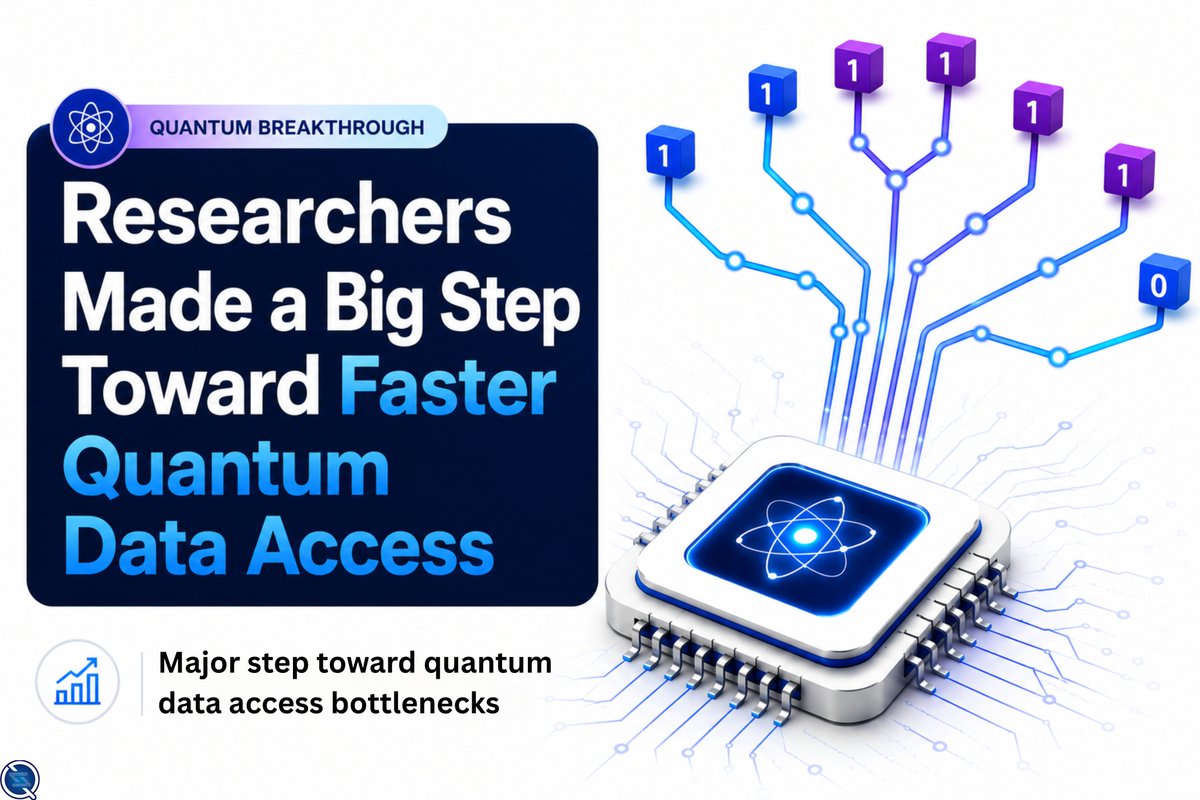
Researchers Made a Big Step Toward Faster Quantum Data Access For years, many quantum algorithms have looked incredibly powerful on paper. The problem? Getting huge amounts of classical data into a quantum computer quickly enough. Without that capability, many of quantum computing's biggest promises remain just promises. Now, researchers at Zhejiang University (China) have taken a meaningful step toward solving this. The team has successfully demonstrated a Quantum Random Access Memory (QRAM) architecture on a superconducting quantum processor, with the results published in Nature Physics. Here's what makes this interesting: 🔹 They built and tested 4-bit and 8-bit QRAM systems 🔹 The 4-bit system achieved about 81% query fidelity, while the 8-bit version reached around 60% 🔹 They used a "bucket-brigade" architecture; a tree-like network of quantum routers that helps direct data queries more efficiently 🔹 They also developed a new gate-decomposition method that reduced circuit complexity and made the QRAM system more practical to run 🔹 An error-mitigation technique was introduced to improve retrieval accuracy 🔹 The team found evidence that the architecture may be relatively resilient to noise, one of the biggest challenges in quantum computing One important distinction: QRAM is not the same as quantum memory. ➡️ Quantum memory stores quantum information (qubits). ➡️ QRAM is designed to help quantum computers efficiently access and retrieve classical data stored in conventional systems. That may sound like a small difference, but it could be a critical missing piece for many future quantum applications. Potential use cases often discussed include: ✔️ Drug discovery and molecular analysis ✔️ Fraud detection across massive financial datasets ✔️ Quantum-enhanced AI and machine learning Of course, this is still very early. A 4-bit and 8-bit demonstration is a long way from the millions or billions of data points needed for commercial systems. Scaling, error correction, hardware improvements, and higher accuracy remain major hurdles. This development also highlights the growing strategic importance of quantum technology, as both China and the United States continue investing billions into the field as part of a broader race for leadership in advanced computing. As one of the researchers put it: "Current quantum algorithms are theoretically impressive, but to run them on quantum computers, they must efficiently access vast amounts of conventional data. Without QRAM, many application fields will inevitably remain pure theory." And that is why this small experiment may represent a much bigger step for the future of quantum computing. #QuantZen #quantum #tech
Scientists Unlock Simple Way to Create Powerful Quantum States Scientists at the University of Chicago have discovered a simple way to create powerful quantum states that could help power the next generation of quantum sensors and technologies. And the best part? They didn't need complicated new hardware. Instead, the researchers made a small adjustment to a common quantum optics setup called a cavity QED system, where atoms interact with light trapped between mirrors. The twist is that atoms are arranged in pairs, with each pair receiving equal and opposite energy shifts. This reduces the system's symmetry and unlocks a much wider range of highly entangled quantum states. Why does that matter? 🔹 It can generate powerful entangled states using tools already found in many quantum labs 🔹 Researchers can access different quantum states simply by adjusting lasers rather than rebuilding the hardware 🔹 The approach could enable ultra-precise sensing of magnetic fields and gravitational fields 🔹 It combines two things that are usually difficult to achieve together: extreme sensitivity and strong resistance to noise 🔹 It can create exotic states such as the AKLT state, which has long fascinated physicists and may have applications in quantum computing 🔹 The resulting quantum information can be measured using standard Ramsey techniques, avoiding the need for specialized readout methods This work was supported by Q-NEXT, the U.S. Department of Energy's National Quantum Information Science Research Center led by Argonne National Laboratory. The research, published in Physical Review X, is still theoretical for now. However, the team is already discussing experimental demonstrations with other groups and exploring even more ways to arrange atoms and generate new quantum states. Sometimes the biggest breakthroughs don't come from adding more complexity. They come from finding a smarter way to use the tools we already have. #QuantZen #quantum #physics #science

Microsoft Introduces Majorana 2 Quantum Chip Majorana 2 is Microsoft’s newest quantum chip, and one of its biggest steps yet toward building a useful quantum computer. Here's why people are paying attention. The biggest challenge in quantum computing is that qubits are incredibly fragile. They can lose their quantum state in the blink of an eye, making reliable computation extremely difficult. Majorana 2 is the answer to that problem. Microsoft says its new qubits are 1,000 times more reliable than the previous generation, with a mean lifetime of 20 seconds and some lasting up to a full minute. That may not sound impressive at first. But Microsoft compares it to inventing a smartphone battery that, instead of dying after one day, lasts nearly three years on a single charge. That's the scale of improvement they're talking about. What's even more interesting is how Microsoft got here. The original chip used aluminum. Majorana 2 uses lead-based superconductors, which help shield fragile qubits from unwanted interference. Microsoft also didn't rely only on physicists and engineers. It used Microsoft Discovery, an agentic AI platform that helped automate measurements, optimize manufacturing processes, and identify hidden flaws across nearly 20 years of research data. Another reason this announcement stands out. While many companies are building quantum computers using conventional qubits, Microsoft is pursuing topological qubits, a different approach designed to be naturally more resistant to errors from the start. In other words, instead of constantly fixing fragile qubits, Microsoft is trying to build stronger ones in the first place. The result? Microsoft now believes it can achieve a scalable quantum computer by 2029, cutting its original timeline roughly in half. If successful, quantum computers at that scale could help tackle challenges in: • Medicine and drug discovery • Food production and agriculture • Energy optimization • Climate and materials science It's still early days for quantum computing. But Majorana 2 feels like the future seems a little closer. - A 1,000× reliability jump. - AI-assisted discovery. - A new qubit architecture. - And a 2029 target.

ASML: World’s Most Important Tech Monopoly The most important company in the AI revolution is ASML. It sits in a small Dutch town called Veldhoven, and it has built what may be the most important machine on Earth. Here's why. Every advanced AI chip, smartphone processor, and many of the most powerful computers depend on a technology that only ASML can supply. To make a chip, manufacturers use light to carve microscopic circuits onto silicon wafers. The shorter the wavelength of light, the more intricate the design. The more intricate the design, the more powerful the chip. For decades, the industry kept pushing from visible light to UV, then deep UV. But eventually, that wasn't enough. The next leap was Extreme Ultraviolet (EUV). And EUV is unbelievably difficult to create. ASML's machines fire a laser at tiny droplets of molten tin 50,000 times every second, generating temperatures estimated at around 40 times hotter than the surface of the Sun. All of that just to produce the light needed to manufacture the world's most advanced chips. Back in 1997, the semiconductor industry knew EUV would be essential. But when it came time to build it, most companies walked away. The challenge was too difficult and costs were high. The risks were enormous. A small Dutch company that started with just 47 employees decided to take the bet. For more than 15 years, ASML kept working on a technology that had no guarantee of success. By 2012, the project had become so expensive that something extraordinary happened. Intel, TSMC, and Samsung Semiconductor invested roughly $6 billion into ASML as shareholders, not customers. The biggest chipmakers needed this tech so badly that they helped fund its development. The result was one of the most complex machines ever built. Each EUV machine: • Weighs around 180 tons • Contains roughly 100,000 parts • Relies on 800+ suppliers • Costs around $200 million • Requires multiple Boeing cargo planes to ship ASML only produces a limited number of machines each year. And here's where things become geopolitical. Since 2019, China has not been allowed to buy ASML's EUV machines due to export restrictions. China saw this coming. In 2024, Chinese companies rushed to buy ASML's older deep ultraviolet (DUV) systems, helping drive China to roughly 49% of ASML's revenue during parts of that buying spree. And that wasn't even ASML's most advanced tech. Today, ASML holds what is arguably the closest thing the tech industry has to a monopoly. The company controls 100% of the commercial EUV lithography market. There is no direct competitor producing these machines at scale. None. The AI race isn't just about OpenAI, NVIDIA, Google, Microsoft, China, or the United States. It's also about a company in a Dutch town. Because without ASML's machines, the world's most advanced chips simply don't get made. And without those chips, the AI revolution looks very different. #QuantZen #AI #semiconductors #tech

Meta’s Big Vision for Solar Power at Night! Meta have just made two of the boldest energy bets we have seen in years. - One is about collecting solar power in space. - The other is about storing clean energy for more than 100 hours. And together, they offer a glimpse of what the energy grid for AI could look like around 2030. Here is why this matters. AI data centers do not sleep. They need electricity every hour of the day. But traditional solar only works when the sun shines, and most battery systems today are designed to store power for just a few hours. That is becoming one of AI’s biggest challenges. Not chips, not software but electricity. To tackle this, Meta partnered with Overview Energy on something that sounds almost like science fiction. The idea is simple to understand, even if the technology is incredibly ambitious. Satellites placed in geosynchronous orbit, around 22,000 miles above Earth where sunlight is nearly constant, collect solar energy in space and beam it down as near-infrared light to existing solar farms on the ground. In theory, a solar farm that normally goes dark after sunset could keep producing power long into the night. No new land. No completely new grid. Just a very different way of using solar. And Meta did not stop there. It also partnered with Noon Energy, whose long-duration storage system is designed to hold clean energy for more than 100 hours. That matters because even when renewable power is generated, storing it for long periods has remained one of the hardest problems to solve. Meta is not making a single bet. The company says it has already contracted more than 30 gigawatts of clean energy across nuclear, geothermal, wind and solar and now it is adding orbit to the list. This is not about choosing one miracle technology. It is about building an energy portfolio capable of powering AI around the clock. There is still a long road ahead. Space solar is not powering cities today, and many challenges remain before it becomes commercially viable. The first planned demonstration is expected in 2028. The broader vision is aimed closer to 2030. Still, the direction is hard to ignore. For years, the AI race was about who had the smartest models and the fastest chips. Now it may also be about who can secure enough clean power to keep those systems running. And that might be the most important AI story nobody saw coming. #QuantZen #AI #innovation #tech #energy

China’s Quantum Network That Could Change Security One of the most important quantum communication breakthroughs. If cybersecurity today feels like an endless race between hackers and defenders, China’s latest quantum networking milestone offers a glimpse of a very different future. Chinese researchers at Peking University have built the world’s first large-scale quantum key distribution (QKD) network based on integrated photonic quantum chips and the numbers are hard to ignore. The scale is serious: 20 users, 370 km per link, and an aggregate network reach of 3,700 km. Why does this matter? Because QKD is one of the most secure ways to share encryption keys. In simple words, if someone tries to listen in, the signal changes, and that interference can be detected by the laws of physics. That is the real appeal here, communication secured by physics, not by assumed trust. The big challenge has always been distance and scale. Most long-distance QKD systems depend on trusted relay nodes. Those relays extend the network, but they also create trust points that can become weak spots. But what makes this especially interesting is not just the distance. It is the fact that the system works without traditional trusted relay stations. This new setup aims to remove that problem. At the center of the network is a tiny chip called a super optical comb. It acts like a perfect timekeeper for the whole system, sending ultra-stable timing signals so every user stays in sync. The researchers say its frequency stability reaches a 40-hertz linewidth, which is extremely tight for this kind of system. That synchronization is what makes the whole network possible. In simple terms: If normal long-distance communication is like people shouting across a windy valley, this chip makes sure everyone speaks in exactly the same rhythm. That synchronization matters because quantum signals are extremely sensitive to noise and timing drift. On the client side, the team built 20 quantum transmitter chips. Each one encodes quantum keys onto light pulses and sends them through optical fiber to a central server. Each user pair communicates over 370 km of fiber, while the combined network demonstrates 3,700 km of total communication capability. An important distinction here, this is not one single uninterrupted 3,700 km fiber line. It is a relay-free network architecture where multiple long-distance quantum links work together under one synchronized framework. That shift from isolated point-to-point experiments to a scalable network model is a major step for quantum communication, from lab demo to network logic is the real breakthrough. This is the kind of technology that could matter for governments, businesses, financial transactions, AI, and cloud computing. #QuantZen #quantum #research #science

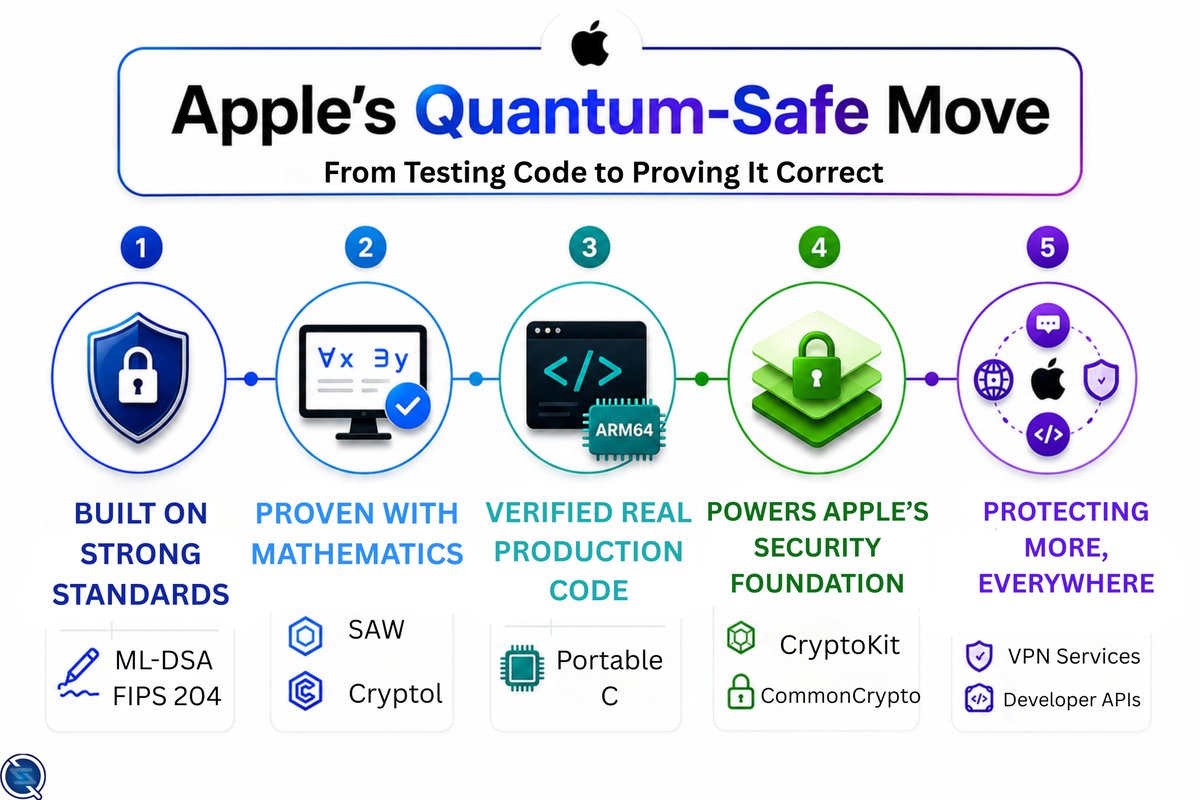
Apple’s Quantum-Safe Move: From Testing Code to Proving It Correct Apple’s post-quantum work is not built around a vague idea of “future security.” It is based on two specific next-generation encryption methods called ML-KEM and ML-DSA. Think of them as new kinds of digital locks and signatures designed for a future where quantum computers may be powerful enough to challenge today’s encryption. Apple did not create these standards alone. These systems follow official guidelines from National Institute of Standards and Technology (NIST), the U.S. standards body that helps shape global cybersecurity rules. ML-KEM aligns with FIPS 203, while ML-DSA follows FIPS 204, meaning Apple is building on security standards meant for worldwide adoption rather than inventing its own private rulebook. But what makes this story especially interesting is how Apple checked the code. Most software is tested by running it again and again and looking for failures. Apple still does that, but for post-quantum cryptography it decided testing alone was not enough. So the company turned to tools with unusual names like Isabelle, SAW, and Cryptol. You do not need to understand the software itself to understand the goal. Together, these tools help engineers translate code into mathematics and check whether the implementation truly behaves exactly as intended. And Apple did not stop at simplified lab versions. The company verified both its portable C code, which works across different devices, and its highly optimized ARM64 assembly, the performance-focused code written specifically for Apple silicon chips. In other words, Apple checked the real engine running under the hood, not just a prototype. That matters because corecrypto sits at the center of Apple’s security world. It powers the company’s Security framework, CryptoKit, and CommonCrypto; the systems responsible for encryption, digital signatures, passwords, hashing, and secure random number generation across Apple platforms and developer tools. If corecrypto is strong, the entire security foundation becomes stronger. Apple’s message feels increasingly clear: As security enters the post-quantum era, testing remains important, but proving that encryption works may become just as essential #QuantZen #cybersecurity #quantum #cryptography
AI Helps Reverse Aging In Cells OpenAI reportedly partnered with longevity startup Retro Biosciences to redesign the Yamanaka factors. What are Yamanaka factors? It is the four proteins whose discovery led to the 2012 Nobel Prize and that can reprogram adult cells back into youthful stem cells. The original discovery changed biology. But there was a catch. The process rarely worked at scale. Fewer than 0.1% of cells successfully converted, and the transformation could take weeks. So the team built GPT-4b micro: a custom AI model trained exclusively on biological data. And instead of following the traditional path of testing only a few mutations at a time, the model redesigned entire proteins with hundreds of changes simultaneously. That is where things become remarkable. More than 30% of the AI-designed protein variants reportedly outperformed the originals, compared with typical success rates below 10%. The strongest versions showed: • 50x higher stem cell marker activity • dramatically enhanced DNA damage repair • enhanced proteins that consistently reversed key signatures of cellular aging • results described as reversing aging in human cells According to the reported findings, independent laboratories confirmed these results across multiple cell types and testing methods. AI is simply not helping scientists study biology but specialized AI models beginning to redesign biology itself. If validated and expanded further, these enhanced proteins could become powerful tools for regenerative medicine. More broadly, this breakthrough suggests that specialized AI models could compress decades of biological discovery into weeks and could potentially revolutionize how we approach aging and disease research one day. Early science still deserves careful scrutiny. But moments like this remind us why AI and biology together may become one of the most important frontiers of our time. #QuantZen #AI #biotech #research

How Instagram Accounts Get Hacked? ⚠️Disclaimer - Educational purposes only. Ever wondered how Instagram accounts actually get hacked? It is usually not “movie hacking.” It is usually a mix of phishing, social engineering, and one small mistake made at the wrong time. The most common way this kind of attack happens, is deceptively simple: A hacker builds an exact replica of Instagram’s login page and connects it to a database, so every password entered goes straight to them. People do not usually trust a random link, so attackers buy a lookalike domain that feels familiar at a glance. Sometimes it is as subtle as a tiny lowercase “l” that looks like an uppercase “I.” That one visual trick is often enough to create the illusion that the site is genuine. Then they host it on a third-party VPS somewhere, perhaps in a region far from the target, and pair it with a tempting message like: “Get to know who has a crush on you among your followers.” The target clicks. The target enters the details. And then, almost theatrically, an error page appears: “504 bad gateway, try again later.” By the time the page is shut down, the credentials are already captured. This same pattern shows up everywhere, not just on Instagram, but in banking fraud, email theft, and other forms of online compromise. The real lesson is simple: strong passwords matter, but awareness matters more. A fake page only works when a real person is rushed, curious, or unguarded. If you use Instagram daily, this is worth knowing. #QuantZen #cybersecurity #digital #hacking

4 Signs Your Phone May Be Hacked Disclaimer - This is for educational purposes only Think your phone is safe? It probably feels that way. After all, it’s an iPhone or a flagship Android. Clean interface, locked screen. face ID, fingerprint unlock. Everything looks secure but modern phone compromises rarely look dramatic. No flashing warnings, no movie-style hacker screens, just tiny permissions quietly sitting in the background. And that’s what makes it dangerous. Here are a few things worth checking before it’s too late 1. Hidden control profiles This is one of the biggest red flags most people never look at. On iPhone: Settings → General → VPN & Device Management If you see a profile you never installed for work or school, someone could potentially have elevated control over your device. On Android: Settings → Security → Device Admin Apps If an unfamiliar app has admin access, that’s a serious issue. A lot of mobile compromises don’t begin with “hacking.” They begin with permissions users never noticed. 2. Data exfiltration Some apps quietly talk more than they should. Go to: Settings → Mobile Data Scroll through your apps. If an app you barely use is consuming huge amounts of data, it may be transmitting information in the background. On iPhone, there’s an even more interesting feature: Settings → Privacy & Security → App Privacy Report → Network Activity This shows which servers and domains your apps are communicating with. And sometimes, that tells a very different story than the app description in the App Store. 3. Camera & microphone access Most people grant permissions once and never revisit them. Go to: Settings → Privacy & Security Review which apps can access: • Camera • Microphone • Photos • Location If a random app can use your microphone, something’s wrong. Background access is often where privacy disappears quietly. 🔋 4. Battery behavior matters more than you think A compromised device often behaves strangely before users realize it. Watch for: • Battery draining unusually fast • Phone heating up while idle • High background activity with screen off Sometimes the biggest indicator isn’t visible on the screen at all. It’s the phone working overtime when you’re not using it. Cybersecurity today isn’t just about protecting servers and enterprises anymore. It’s personal. Your phone carries: • conversations • banking apps • authentication codes • business data • private photos • your digital identity And attackers know that. A secure device isn’t the one with the best marketing. It’s the one whose permissions, activity, and behavior you actually monitor. #QuantZen #cybersecurity #hacker #tech

AI Will Change Quantum Computing Forever April 2026 was the month, three separate headlines quietly revealed the same thing. A Caltech team, working with Google, published research showing AI was instrumental in designing a quantum computer capable of breaking modern encryption. NVIDIA launched Ising, a family of free AI models built specifically to calibrate quantum processors and run error correction three times more accurately than previous methods. And Sycamore Technologies raised $139 million to build quantum-accelerated AI servers. Most people saw three unrelated stories. But together, they point to something much bigger: - AI is helping design better quantum computers. - Better quantum computers will run better AI. - Better AI will design even better quantum systems. That is a feedback loop. And once a technological feedback loop turns on, progress stops moving linearly. It compounds. A lot of quantum timelines were built on one assumption: humans alone were driving the breakthroughs. Now AI is becoming part of the research engine itself. Which means the timelines people predicted even two years ago may already be outdated. The real challenge is no longer just keeping up with AI. It is understanding what happens when AI and quantum computing start accelerating each other at the same time. #QuantZen #AI #quantum #tech

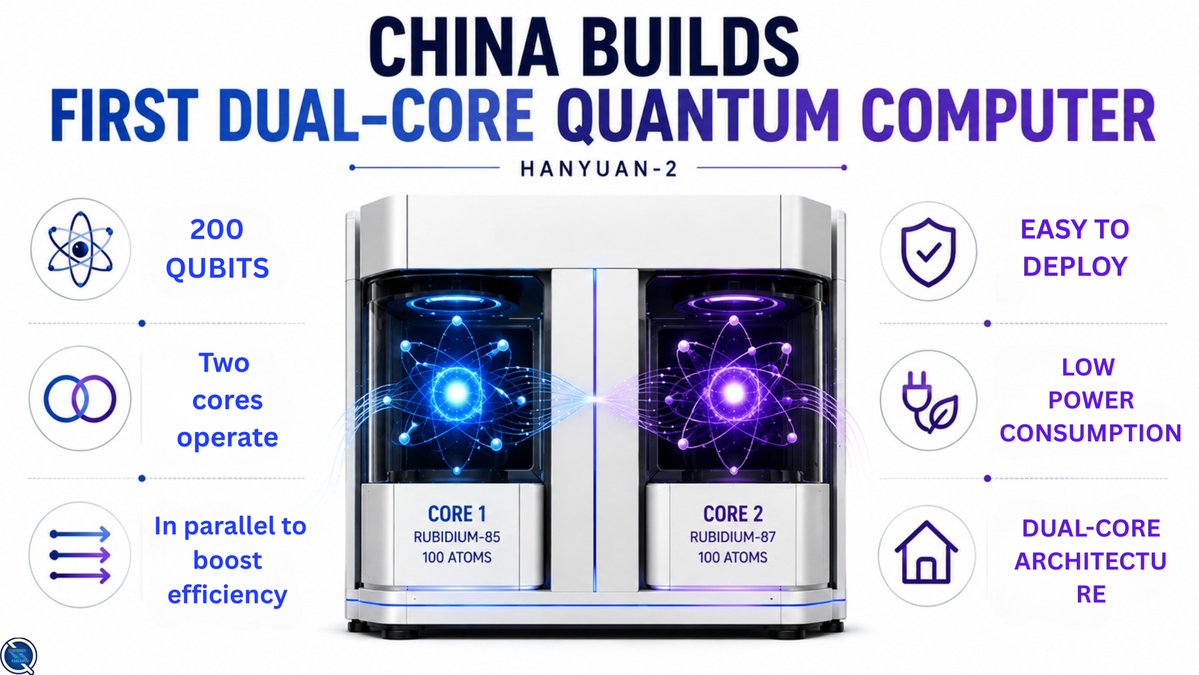
China Builds First Dual-Core Quantum Computer China may have just taken a big step forward in quantum computing. CAS Cold Atom Technology in Wuhan has unveiled the world’s first dual-core neutral atomic quantum computer, Hanyuan-2; a shift from the old single-core era to a dual-core collaboration model. And according to the company, this is not just another hardware upgrade. It marks a “major breakthrough in quantum computing design” and pushes China’s neutral atomic quantum computing technology into a “new stage”. Its design is interesting. Hanyuan-2 is built on China’s self-developed neutral atom array technology and combines 100 rubidium-85 atoms with 100 rubidium-87 atoms, creating a dual-core system with a total of 200 qubits. That matters because, in quantum computing, qubits are the heart of the machine. And this dual-core structure can do two powerful things at once: run in parallel to improve computing efficiency, or work in a “main core + auxiliary core” mode to build more stable logical qubits. In simple terms, it is trying to solve some of the biggest pain points in single-core systems; limited scalability and interference between nearby qubits. Even the hardware design is practical. Hanyuan-2 uses a standard cabinet-style integrated setup, needs only a small laser cooling system, and reportedly consumes less than 7 kilowatts of power. No ultra-low-temperature environment. No massive infrastructure. Just a system that can be deployed in ordinary indoor settings. Neutral atom quantum computing is already one of the most watched hardware paths in the field because of its scalability, long coherence time, and high control accuracy. If Hanyuan-2 performs as claimed, it could mark a meaningful move toward more usable, more stable, and more deployable quantum systems. Quantum computing is no longer just about reaching more qubits. It is about architecture, stability, and real-world practicality. #QuantZen #quantum #tech #science
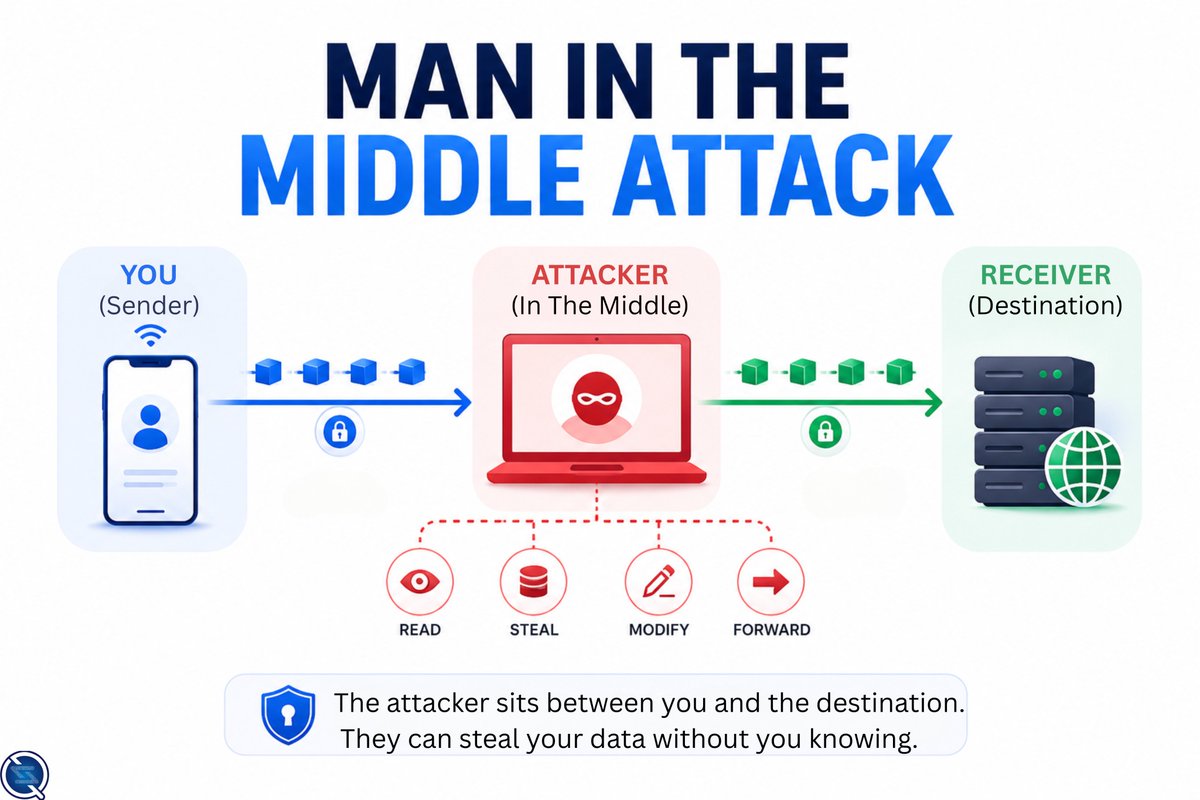
Man in the Middle Attack One of the most important ideas in networking and cybersecurity is also one of the easiest to underestimate: the man-in-the-middle attack. When you send a message from your mobile, whether it is WhatsApp, a website request, or any other online action, it does not simply fly straight to the destination. Your data travels as packets, and those packets pass through multiple devices on the internet: your mobile, your router, your ISP, several internet routers, and finally the destination server. That journey is where the risk begins. Because what happens if one of those intermediate devices gets compromised? If an attacker gains control of even one node in the middle, they can position themselves between you and the receiver. So instead of this: You → Receiver It becomes this: You → Attacker → Receiver And once the attacker is in that position, they can: read your data, capture sensitive information, modify the data, or forward it silently without you noticing. That is exactly what a man-in-the-middle attack, or MITM attack, is. It is not just an attack on data. It is an attack on trust. #QuantZen #data #cybersecurity #tech
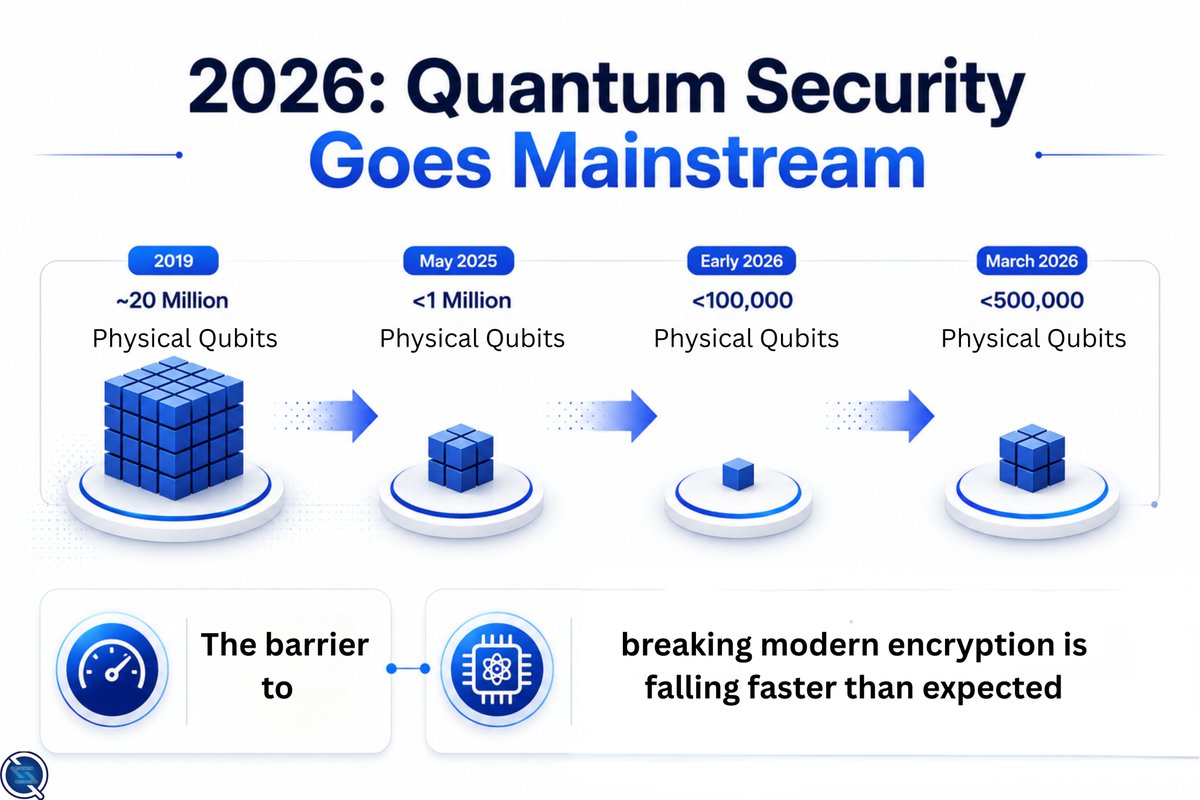
2026: Quantum Security Goes Mainstream Why 2026 Could Be the Year Quantum Security Becomes a Real-World Priority? For years, quantum computing felt distant. Important? Yes. Urgent? Not really. But over the last 18 months, something changed dramatically. The estimated resources required to break modern encryption have dropped far faster than most experts expected. Back in 2019, researchers estimated it would take roughly 20 million physical qubits to break RSA-2048: the encryption protecting internet banking, email, digital certificates, and much of today’s internet. That number became the industry benchmark. Then the estimates started collapsing: → May 2025: Updated research suggested RSA-2048 factoring could potentially require fewer than 1 million physical qubits. → Early 2026: Iceberg Quantum’s proposed Pinnacle architecture suggested the number could theoretically fall below 100,000 qubits under certain assumptions. → March 2026: Researchers from Google Quantum AI, the Ethereum Foundation, and Stanford explored attacks on elliptic curve cryptography and estimated fewer than 500,000 qubits for widely used curves like secp256k1. That is a massive shift. Not because quantum computers can do this today (they cannot). But because the gap between “impossible” and “possible” is shrinking much faster than expected. And that changes how organizations think about risk, migration timelines, and post-quantum readiness. The question is no longer if organizations will need post-quantum security, but whether they are preparing early enough. #QuantZen #quantum #security #tech
How ChatGPT Runs at Massive Scale? ChatGPT is serving hundreds of millions of weekly active users on a setup that sounds almost too simple to be real: a single primary PostgreSQL instance on Azure, with no sharding. Yes, one primary handles the writes. And yes, nearly 50 read replicas across multiple regions handle the reads. Most ChatGPT usage is read-heavy, so conversation fetching scales beautifully when queries are well-optimized. They also lean hard on connection pooling with pgBouncer, so instead of constantly opening new database connections, they keep a ready pool alive. That reportedly cut connection time from around 50 ms to 5 ms. Then comes the protection layer: multilayer rate limiting at the application, proxy, and query levels, so sudden spikes do not crush the primary. They are also extremely strict about query design. One ORM-generated query joining 12 tables was serious enough to cause outages, which is why they now aggressively simplify queries and kill long-running transactions. And even with all of that, there are still limits. With so many replicas, the primary has to stream every change outward, so it cannot scale reads forever. For the most write-heavy workloads, those were moved to Azure Cosmos DB. The result? Only one critical database incident in an entire year. One incident. At the scale of 800 million weekly users. It is a reminder that sometimes the winning architecture is not the flashiest one. Sometimes it is a 35-year-old open-source database, tuned relentlessly, protected carefully, and respected properly. Postgres is not just enough. In the right hands, it is extraordinary. #QuantZen #AI #data #tech

How to Spot a Hacked Computer? Disclaimer - Strictly for educational purposes only. How to know if your computer has been hacked? Not by waiting for antivirus alone. A proper manual security audit is like checking a place carefully; the real issues are usually hidden in small details that people often overlook. First, look for ghost users. On Windows, open Win + R and run netplwiz. On Mac, go to System Settings → Users & Groups. If you find an account you do not recognize; something like admin1 or a random string of letters. It can be a hidden backdoor meant to survive even after you change your password. Then check for background parasites. On Windows, open Task Manager with Ctrl + Shift + Esc and inspect the Startup tab. On Mac, review Activity Monitor and Login Items. Unknown apps launching at boot, strange process names, or unfamiliar publishers deserve attention. If you spot something like win_driver.exe sitting in an unusual AppData folder, that’s a serious red flag. Next, see who your system is quietly talking to. On Windows, open CMD as administrator and run netstat -ano. On Mac, use Terminal and lsof -i. If your browser is closed but connections are still active, something may be communicating in the background. You can paste suspicious IPs into VirusTotal to check if they’re flagged. Finally, check for invisible scheduled tasks. On Windows, inspect Task Scheduler. On Mac, review Launch Agents. Attackers often hide scripts under harmless names like “Chrome Cleanup” or fake update services running at 3 a.m. If a task points to a .bat, .vbs, or unknown script, research it carefully before deleting, removing the wrong file can break your system. Your antivirus won’t show you everything. #QuantZen #cybersecurity #hacking #data

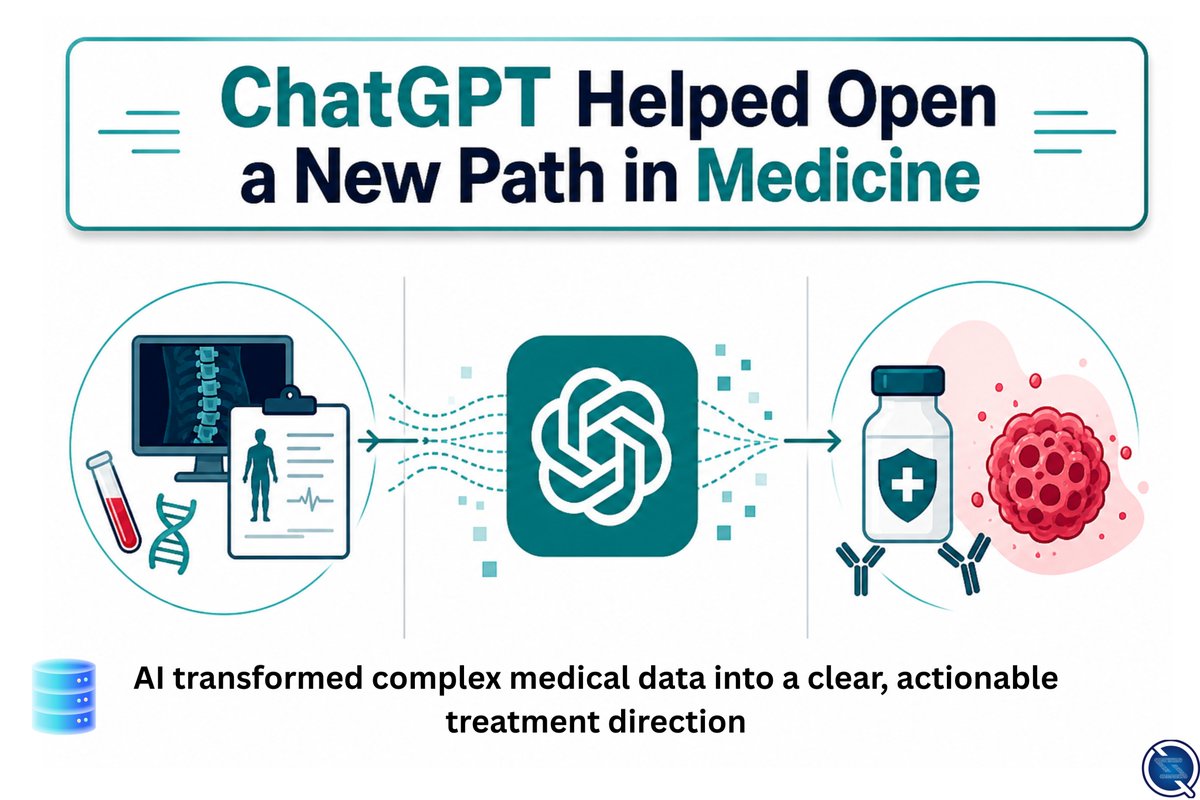
ChatGPT Helped Open a New Door in Medicine Possibly one of the most astonishing AI + medicine stories. Sid Sijbrandij, the founder of GitLab, a $14 billion company used by 30 million developers. He was diagnosed in 2022 with one of the most aggressive cancers: stage 4 spinal cancer. He went through chemo, surgery, and four blood transfusions. The cancer came back. Every doctor said he had no options. Every clinical trial rejected him. That is when he stopped being just a patient and started acting like a founder. He stepped back as CEO and built a full team around his case: oncologists, researchers, and scientists. Then he brought in AI. He fed 25TB of his own data into ChatGPT: scans, lab results, genetic data, everything. And the AI surfaced something his doctors had missed: a treatment approved for a completely different cancer that had never been tried on his type. That discovery opened the door. From there, his team created 19 custom vaccines from his own DNA, each designed to attack only his cancer cells. The result? Relapse-free since 2025. He later walked into OpenAI Forum with a talk titled: “From terminal to turnaround.” And then he did something almost no survivor ever does: He uploaded everything, all 25TB data for free, for researchers anywhere in the world to use. The founder who made code open source may have just made his own survival open source too. #QuantZen #AI #healthcare #biotech

Russell Sean @RussellQuantum
4K Followers 3K Following @QuanMed_AI- medical research system analysing by AI and Quantum not big Pharma on @Quan_Chain the only auto-migrating quantum blockchain. MSc Neuro/AI Dev

QuanChain @Quan_Chain
92K Followers 3K Following The only self migrating/adapting quantum proof blockchain that makes quantum security continuous. Join the telegram community: https://t.co/YQ6HVD8cYu
Tracy Harrison W @harrison_traciy
2K Followers 3K Following Belive me your kids gonna love these RC toys ↙️ https://t.co/FmikfkcY5u
Emre @emreweb3
4K Followers 5K Following
Victor Risco @VSp3cialist
93 Followers 597 Following Legal-Medical Interpreter. Enthusiast, politics, crypto+Ai. https://t.co/C2kMjwO70U https://t.co/NugHjNNzCl
PHAXY @TheHubKeeper
4K Followers 3K Following 🛡️ Lead Mod @soundnesslabs , AI | Robotics | Post Quantum Cryptography I cover what's coming.
Readone @Ridwanishaq83
2K Followers 777 Following A Content Writer | Decoding Web3 treasure map, one block at a time.
AndesVentures @AndesVenturesCA
645 Followers 7K Following The best and most beautiful things in the world cannot be seen or even touched, they must be felt with heart.
Marquivion (Marq) Orr @0xprimex0
37 Followers 1K Following ⚫️&⚪️ | Former foster youth→Founder/Engineer/Child Welfare Advocate: FosterEther, DSPQC, Qrown, GoQu, @aqurity_ai, Qugentic | @QSECDEF VIP Member | TRUTH
Ashish Janghel @AshishJanghel13
72 Followers 281 Following Founder & CEO @zenith__studio Flagship: QuantZen™ - Securing Web3 Applications from Quantum attacks @quant_zen

Jesús Jiménez Lozan... @JessJimnez79543
167 Followers 7K Following
Petra @6U0112JdqVw81
162 Followers 6K Following Sometimes the most productive thing you can do is relax.
animunie.bnb (💙,�... @Animunie_marie
1K Followers 3K Following Community Manager || Project Promoter || Social Media Strategist
DON27 @PSSA65639
101 Followers 1K Following
rema.base.eth @remaonbase
292 Followers 209 Following Building @base_arabic | Advocate Lead | Base Ambassador | Financial markets trader | Angel Investor
Daily Home Ideas @DecoredHomes
2K Followers 3K Following Decor ideas for your home. Daily Amazon links with over 4.5 ⭐ and 🆙
Quantum Shill Guy @QuantumShillGuy
2 Followers 94 Following Quantum Shill Guy - Latest quantum related crypto news & updates. PREPARE FOR Q-DAY WITH $QRL
It’s Me @not_real_no_one
491 Followers 1K Following
April C Wright @aprilwright
18K Followers 5K Following The Infosec Diplomat, Absurdist Polymath. AI philosopher. Reality-Auditor. Hacker, Author @oreilly. Privacy, ethics, chaotic good
Van Kennedy @MilaShanta43527
3 Followers 19 Following

MetaDogeUnity @metadogeunity
8K Followers 848 Following Kill to Earn Multiplayer Battle Royale Game Play Now ⬇️ https://t.co/sZbli3esVT
Towqeer Gilkar @towqeerdxb
3K Followers 2K Following Dubai Real Estate & Blockchain Veteran | Deal Architect for World-Class Athletes & Brand IPs in Real Estate | Turning handshakes into skylines.
Lillian @YsaLillian
234 Followers 2K Following How when your sitting in class and the teacher calls on you and asks what the answer is, and you just sit there with a blank look on your face in dead silence

Charles Lee @LoraleeMad28632
2 Followers 18 Following
Raman Agrawal @codewithraman
82 Followers 175 Following Love turning wild ideas into real apps. I help founders build products, automate with AI, and scale with clean code.
Fetch.ai Official Sup... @Fetch_____ai
82 Followers 1K Following Try ASI One: World's First Web3 LLM - https://t.co/dj7LFN1NYC Founding member of the @ASI_Alliance


Theodora @gggVf7UoHX09NPr
162 Followers 6K Following Sometimes the most productive thing you can do is relax.
Pathanjali Sharma @patsharma21
188 Followers 1K Following Web 3.0 | Venture Capital | Marketing and BD | Web 3 Infrastructure
✪ @girlgou_crypto
96 Followers 1K Following The Crypto Minute ⏰ | #Bitcoin | Never financial advice, just dad jokes | Featured in Bloomberg, The Times, Vice, Time Magazine, NY Post, ELLE, Vogue Business
Zenith Studio @zenith__studio
121 Followers 35 Following Abu - Dhabi innovation Lab building Quantum-Resilient Web3 infrastructure Flagship: QuantZen™ - Securing Web3 Dapps from Quantum attacks by @quant_zen
LinfordZola @supercryptopr
7K Followers 5K Following Global PR, marketing & investor relations for #blockchain & #digitalassets & #cryptocurrencies. Strategic approach, KPI-driven, super-connected.
Marina @35S9sqAk4c171
41 Followers 914 Following Stay strong. Make them wonder how you’re still smiling.
Zenia @Zenia_sol
21K Followers 8K Following Alpha girl in Web3 | Research, narrative spotting, community energy | Making good projects impossible to ignore | Partner :@OKX #NFA #DYOR

حمدان الخزا... @HK27O
354 Followers 554 Following
ambitious man .. طم... @Ambitiousman0
22K Followers 176 Following ⚡️Alpha Trader 🎯 Narrative Hunter Owner of @sourcebot01
Mary G @theonlymaryyyxx
58 Followers 234 Following Ecosystem Growth Manager | AI WEB3 | Layer 1 DM me on TG: @itsmary_web3
Nervos Pegged @peggeddneervos
6 Followers 401 Following Harnessing the power of blockchain to revolutionize traditional systems
Leo Kyc @kycleoo75
3 Followers 446 Following ⚔️let's make & play to nfts platform sky play⚔️ check out all the communities of 'skyplay 🌐 nfts platform' at a glance. 🔗
Tezos Seeker @teezosseeker
7 Followers 432 Following The original gateway 🛤️ to the nft ecosystem ⚡ discover, track & buy nfts with the best data & marketplace aggregator in the market ⚡ we ❤️ nfts 🦇🔊
Icx Pegged @iixcpeg_gedp
6 Followers 451 Following Creating nfts for the defichain community | weekly $dfi rewards (~20% apr) on your nft
Emre @emreweb3
4K Followers 5K Following
QuanChain @Quan_Chain
92K Followers 3K Following The only self migrating/adapting quantum proof blockchain that makes quantum security continuous. Join the telegram community: https://t.co/YQ6HVD8cYu
Victor Risco @VSp3cialist
93 Followers 597 Following Legal-Medical Interpreter. Enthusiast, politics, crypto+Ai. https://t.co/C2kMjwO70U https://t.co/NugHjNNzCl
ATC Investing @etc_facts
8K Followers 3K Following Inversor a Largo Plazo desde 2011 📊 Información Financiera Variada🔥Acciones y Fondos de Inversión.
Julian Inza @julianinza
4K Followers 6K Following Personal opinions. eIDAS eSignature eId EUDIWallet, Blockchain, PQC, Quantum, eGovernment, eCommerce, eBanking, eJustice, mPayments, eInvoice, PSD2, NIS2, DORA
PHAXY @TheHubKeeper
4K Followers 3K Following 🛡️ Lead Mod @soundnesslabs , AI | Robotics | Post Quantum Cryptography I cover what's coming.
Readone @Ridwanishaq83
2K Followers 777 Following A Content Writer | Decoding Web3 treasure map, one block at a time.
Marquivion (Marq) Orr @0xprimex0
37 Followers 1K Following ⚫️&⚪️ | Former foster youth→Founder/Engineer/Child Welfare Advocate: FosterEther, DSPQC, Qrown, GoQu, @aqurity_ai, Qugentic | @QSECDEF VIP Member | TRUTH
Russell Sean @RussellQuantum
4K Followers 3K Following @QuanMed_AI- medical research system analysing by AI and Quantum not big Pharma on @Quan_Chain the only auto-migrating quantum blockchain. MSc Neuro/AI Dev
The Quantum Insider @QuantumDaily
24K Followers 1K Following The leading provider of media and market intelligence on the quantum market. Part of Resonance.
Ashish Janghel @AshishJanghel13
72 Followers 281 Following Founder & CEO @zenith__studio Flagship: QuantZen™ - Securing Web3 Applications from Quantum attacks @quant_zen
idOS @idOS_network
102K Followers 92 Following Portable Identity for the Stablecoin Economy. Backed: @fabric_vc, @arbitrum, @Circle, @ripplexdev, @NEARProtocol, @Starknet Discl.: https://t.co/o2snmnznCD
animunie.bnb (💙,�... @Animunie_marie
1K Followers 3K Following Community Manager || Project Promoter || Social Media Strategist
rema.base.eth @remaonbase
292 Followers 209 Following Building @base_arabic | Advocate Lead | Base Ambassador | Financial markets trader | Angel Investor
Berachain Foundation ... @berachain
863K Followers 39 Following Accelerating applications and rewarding users through Proof of Liquidity. Backed by @bhdigitalassets, @hiFramework, @Polychain & @Hack_VC
cygaar @0xCygaar
134K Followers 840 Following sometimes a software engineer. contributing to @AbstractChain
Okratech Token (ORT) @Ortcoin1
168K Followers 162 Following Empowering the future of Web3 with real utility, real growth - powered by $ORT. https://t.co/4bpp8m2oxI
Abstract @AbstractChain
591K Followers 1K Following Bringing the world’s economy onchain by powering consumer apps, financial services, and digital assets for everyone, everywhere.
CoinDesk @CoinDesk
3.7M Followers 2K Following Leading the conversation on accelerating crypto’s future. Follow @CoinDeskPodcast @consensus2026 @Consensus_HK @CoinDeskES @CoinDeskMarkets @CoinDeskData
Jim Edwards @Jim_Edwards
19K Followers 4K Following https://t.co/gynu57LqKd. Formerly: EIC/News at Business Insider, author of Say Thank You for Everything.
Ray Xiao @_RayXiao
2K Followers 497 Following Investing @OKX_Ventures. Curiosity is the North Star. Technology diffusion is as vital as innovation. Prev @IOSGVC Opinions are my own.
Towqeer Gilkar @towqeerdxb
3K Followers 2K Following Dubai Real Estate & Blockchain Veteran | Deal Architect for World-Class Athletes & Brand IPs in Real Estate | Turning handshakes into skylines.
vx-underground @vxunderground
438K Followers 360 Following The largest collection of malware source code, samples, and papers on the internet. Password: infected

TrendAI Zero Day Init... @thezdi
89K Followers 16 Following TrendAI Zero Day Initiative™ (ZDI) is a program designed to reward security researchers for responsibly disclosing vulnerabilities.
ZachXBT @zachxbt
1.0M Followers 2K Following Scam survivor turned 2D investigator, Advisor @paradigm

Will Dormann is on Ma... @wdormann
27K Followers 1K Following I play with vulnerabilities and exploits. I used to be here on Twitter but now I'm here: @[email protected] https://t.co/hXggdAVkSQ
Wietse van der Werf @wietse
3K Followers 4K Following Entrepreneur working for #oceans and social #impact @searangersorg. European Young Leader 2020, @Ashoka fellow @EYL40
Wendy Nather @wendynather
31K Followers 374 Following
Volexity @Volexity
8K Followers 7 Following A security firm providing Incident Response, Proactive Threat Assessments, Trusted Advisory, and Threat Intelligence
Follow CISA's account... @USCERT_gov
536 Followers 0 Following This account is no longer active. Follow @CISAgov and @CISACyber.
Thomas H. Ptacek @tqbf
35K Followers 618 Following Don't look at me sideways. Don't even look me straight on. bsky:@sockpuppet.org
The Record From Recor... @TheRecord_Media
22K Followers 467 Following Covering the world of cyber and intelligence from every angle.
TEAM CYMRU @teamcymru
41K Followers 185 Following We provide digital business risk platforms and community services. Since 2005, our reputation has remained unchallenged Check out our research @teamcymru_S2!
Taiylor @0xTaylor_
4K Followers 1K Following Professional Security Threat 𝆹𝅥𝅮𝆹𝅥𝅮𝆹𝅥𝅮𝆹𝅥𝅮𝆹𝅥𝅮𝆹𝅥𝅮𝆹𝅥𝅮𝆹𝅥𝅮𝆹𝅥𝅮𝆹𝅥𝅮𝆹𝅥𝅮𝆹𝅥𝅮𝆹𝅥𝅮𝆹𝅥𝅮𝆹𝅥𝅮𝆹𝅥𝅮𝆹𝅥𝅮𝆹𝅥𝅮𝆹𝅥𝅮𝆹𝅥𝅮𝆹𝅥𝅮𝆹𝅥𝅮𝆹𝅥𝅮𝆹𝅥𝅮𝆹𝅥𝅮𝆹𝅥𝅮𝆹𝅥𝅮𝆹𝅥𝅮𝆹𝅥𝅮𝆹𝅥𝅮𝆹𝅥𝅮𝆹𝅥𝅮𝆹𝅥𝅮𝆹𝅥𝅮𝆹𝅥𝅮𝆹𝅥𝅮𝆹𝅥𝅮𝆹𝅥𝅮𝆹𝅥𝅮𝆹𝅥𝅮𝆹𝅥𝅮𝆹𝅥𝅮𝆹𝅥𝅮𝆹𝅥𝅮𝆹𝅥𝅮𝆹𝅥𝅮𝆹𝅥𝅮𝆹𝅥𝅮𝆹𝅥𝅮𝆹𝅥𝅮𝆹𝅥𝅮𝆹𝅥𝅮𝆹𝅥𝅮𝆹𝅥𝅮𝆹𝅥𝅮𝆹𝅥𝅮𝆹𝅥𝅮𝆹𝅥𝅮𝆹𝅥𝅮𝆹𝅥𝅮𝆹𝅥𝅮𝆹𝅥𝅮𝆹𝅥𝅮𝆹𝅥𝅮𝆹𝅥𝅮
TRM Labs @trmlabs
16K Followers 150 Following Preventing fraud and financial crime for digital currencies

SwiftOnSecurity @SwiftOnSecurity
410K Followers 9K Following computer security person. former helpdesk.
Space Rogue @spacerog
24K Followers 328 Following I fight for the user. | L0pht Heavy Industries - ATStake - Whacked Mac Archives - Hacker News Network - Cyber Squirrel 1 | IBM X-Force
Shira Rubinoff @Shirastweet
59K Followers 30K Following #Cybersecurity & #AI #Advisor, #ThoughtLeader #KeynoteSpeaker & #Author Top ranked #Influencer globally in cybersecurity #AI 🔴 YouTube/ShiraRubinoffTV
Shannon Morse @Snubs
74K Followers 1K Following Content Creator 📸 Owner @ Morse Code Creative Also @SailorSnubs 🔗 https://t.co/8H10rZ0vqO https://t.co/sf2HG0kaxl 🧵 https://t.co/ArXgfnP1eF 🦋
The Shadowserver Foun... @Shadowserver
22K Followers 0 Following Our mission is to make the Internet more secure by bringing to light vulnerabilities, malicious activity and emerging threats. Join our Alliance!
Semgrep @semgrep
4K Followers 204 Following A fast, open-source, static analysis tool for profoundly improving software security and reliability.
SANS DFIR @sansforensics
111K Followers 104 Following The world's leading Digital Forensics and Incident Response provider. This feed updates you on latest DFIR news, events, and training.
Sam Curry @samwcyo
101K Followers 1K Following
SANS Institute @SANSInstitute
193K Followers 412 Following SANS is the most trusted and by far the largest source for information & cyber security training, certification and research in the world.
You might like