Robert Müller @deepqlearning
Zurich, Switzerland Joined March 2025-
Tweets23
-
Followers49
-
Following405
-
Likes68
Excited to share that members of our lab co-authored 6 papers accepted at #ICML2026, including three Main Track and three Workshop papers 🔥🚀 📄 Accepted papers: ▪️ OpenTSLM: Time-Series Language Models for Reasoning over Multivariate Medical Text- and Time-Series Data [Main Track] ▪️ Auditing Emotion-Vector-Steered Political Bias in Open-Weight LLMs [AI4GOOD Workshop] ▪️ Reinforcement Learning of Karma Bidding Strategies [NExT-Game Workshop] ▪️ Cinematic Source Separation with Dialogue-Driven Sidechain Ducking [Workshop on Machine Learning for Audio] ▪️ Reinforcement Learning for Tool-Calling Agents in Fast Healthcare Interoperability Resources (FHIR) [Main Track] ▪️ Preserving Plasticity in Continual Learning via Dynamical Isometry [Main Track] @robertjakob @PatrickLanger20 @gaborhollbeck @f14wn @DerRiehl @atoof_sh @deepqlearning @kev_osull @cs06thegreat @nzuma0 @maxrosenblattl Huge congratulations to everyone involved. We are looking forward to presenting these works, reconnecting with colleagues, and meeting new friends in Seoul 🇰🇷 🔗 Full links in the comments.

@MavorParker Cool idea , congrats!
This is only the starting point. Obvious extensions:... -Frontier models at full reasoning budget -Memory and scratchpad ablations -Allow agents to chat -Comparison against humans Using the traces not just to rank agents, but to train them via self-play and RL
Static benchmarks measure what a model knows. Interactive benchmarks measure what a model keeps doing when its own actions change the state of the world. Cattle Trade is intended to be a first step in that direction. Paper: arxiv.org/abs/2605.14537 @ETH_agent_lab @robertjakob
The lesson learned is that agent evaluation needs environments where capabilities compose under pressure. Memory alone is not enough. Math alone is not enough. Tool use alone is not enough. The question is whether the policy remains coherent when the world pushes back.
Why this matters: Agents for procurement, negotiation, sales, portfolio management, auctions, scheduling, resource allocation. None of them solve one-shot questions. They act in interactive systems where opponents react, incentives conflict, and state-tracking errors compound.
LLMs had many of the basic pieces. They could bid, trade, bluff, follow rules, complete sets. They didn't reliably compose these abilities into a stable policy when other agents reacted and the game state changed after every move.
Different incentives for bidding spirals: NEED: price out the auctioneer to close your quartet EXTRACT: auctioneer pays you via buy-right BLOCK: win a card to stop a rival's quartet BID UP: make a rival pay the inflated price PUNT: speculatively win a card nobody collects yet

EXTRACT is the most cognitively demanding spiral. You're not trying to win the card. You're modeling the auctioneer's willingness to keep it, pushing past their threshold so they pay you to walk away. Gemini 3 Flash and Gemini 3.1 Flash Lite EXTRACT most and perform best.
Gemini 2.5 Flash Lite challenged for a goose with zero money cards. Opponent countered with 10 coins and won for free. Gemini 3 Flash paid far above face value for a fourth quartet. Multiplicative scoring made it worth +1,800 points.
Strong agents shift gears across the game. Gemini 3 Flash preserves cash early and ramps bid intensity nearly 10x by late game, timed to quartet-completion pressure. Gemini 2.5 Flash Lite bids aggressively from turn one and stays flat. It skips the accumulation phase entirely.

What separates winners from losers is strategic coherence: spending efficiency, resource discipline, phase-adapted bidding, composed together. Top agents end games broke with 4 quartets. Cash hoarders flatline at 2. Holding money isn't the goal. Converting it is.

The strongest result isn't "LLMs are bad at games." Broad reasoning scores don't measure strategic integration. Same 7 LLMs, three benchmarks, three orderings. Gemini 3.1 Flash Lite: 2nd on Cattle Trade, 3rd on Chatbot Arena, last on AAI Index. GPT-5.4 Nano runs opposite.

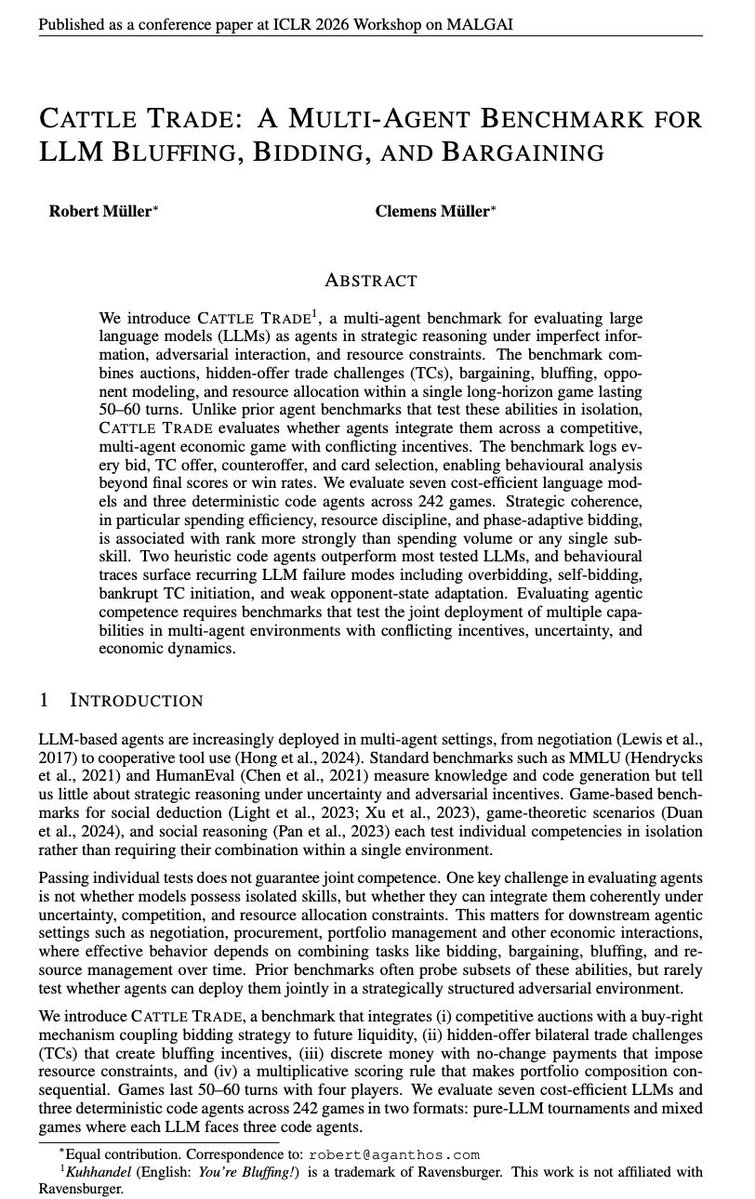
Most LLM benchmarks ask: can the model answer the question? We ask whether a model stays coherent across 60 turns of bidding, bluffing, bargaining, hidden offers, liquidity management, and adversarial play. Inspired by the German card game Kuhhandel. Strategy under imperfect info

A few hundred lines of code. No pretraining. No language. No "reasoning." Just structured state tracking, cash estimates, simple bidding rules. Across 242 games, it outranked 6 of 7 cost-efficient LLMs on TrueSkill. It doesn't forget who has money or what it's bidding against.
Public cards. Hidden money offers. Zero-value bluff cards. No change for overpayment. Buy-rights in auctions. Multiplicative scoring. You need memory, arithmetic, opponent modeling, and timing. All at once.
Why do models that score well on standard benchmarks still make bad strategic decisions? In Cattle Trade, accepted at @MALGAI_ICLR2026 , LLMs play a 4-player 50+ turn game of auctions, hidden offers, bluffing, and limited cash. Some LLMs lose to simple Python agents. 🧵

@JustinLin610 Thank you for your amazing contributions, all the best for what is next
@corbtt Crucial to move beyond the bandit setting you mention to proper multi-step RL
Strong read.

🤯 We cracked RLVR with... Random Rewards?! Training Qwen2.5-Math-7B with our Spurious Rewards improved MATH-500 by: - Random rewards: +21% - Incorrect rewards: +25% - (FYI) Ground-truth rewards: + 28.8% How could this even work⁉️ Here's why: 🧵 Blogpost: tinyurl.com/spurious-rewar…


Agentic Systems Lab |... @ETH_agent_lab
342 Followers 58 Following We design, develop, and evaluate AI systems that run the real world, and shape the researchers and founders who will define its future. Based at ETH Zurich.
Ning Wang @cs06thegreat
5 Followers 13 Following
Edward Heretsch (Syke... @edsykes
357 Followers 908 Following AI / Psychology / Software / Data / People / web3
📗 @__the__human__
26 Followers 3K Following

Sameer @sameer_username
46 Followers 1K Following AI @ AWS (all opinions are my own) #hookem ’21 he/him


J◎RGΞ🧋 @HipHipHipJorge
694 Followers 2K Following Product @GoogleCloud 🤖 Working on #AgenticAI & API Platform Infrastructure. Formerly @Stripe. Artificial Intelligence MS & MBA @Stanford @StanfordHAI 🌲

Timothy Kassis @TimothyKassis
3K Followers 524 Following Co-Founder & CTO @k_dense_ai | Ph.D. in Bioengineering. Previously @biostateai, @matterworks_bio, @MIT, @GeorgiaTech.
Massimiliano Viola �... @massiviola01
845 Followers 150 Following ML @ Bedrock Robotics | Ex Stanford, ETH Zurich | Computer Vision • 3D • Generative Models

Victor Rong @victor__rong
242 Followers 123 Following ML @cursor_ai | CS PhD Student @UofT | MIT '23
Cooper Price @cooperprice0
72 Followers 49 Following Antigravity @ Google Deepmind - MIT Heavyweight Crew
John Sabath @jcsabath
672 Followers 573 Following building https://t.co/V3hBnMM0mA | ex @stabilityai
Todd Elvers @toddelvers
226 Followers 342 Following Developer | Diffuser | Gamer | CoFounder @ https://t.co/TsxUwyQpLl | Formerly @ https://t.co/yVzA1TC8BF
Conner Ruhl @connerruhl
2K Followers 703 Following open-source AI · protocols · programming · paragliding · building https://t.co/Cdhh8ECQnL · previously https://t.co/2fw43SSQGD · 🇺🇸🏳️🌈
Grigory Sapunov @che_shr_cat
3K Followers 1K Following PhD in AI | GDE in AI/ML | CTO Intento | Author "Deep Learning with JAX" 📝 ML insights: https://t.co/ySSOXJKL7H 🤖 Daily AI paper reviews: https://t.co/yQNYyqTbBR
Anaïs Howland @AnaisHowland18
146 Followers 1K Following Building the AI analyst for fixed income (stealth) | ex-MBS PM | ex-GenAI @Google | ex-Founder @ParadigmShiftAI | CFA Charterholder | 🇺🇸 🇫🇷
arjun chintapalli �... @rjchint
376 Followers 670 Following Building the SOTA AI Web Agent @rtrvrai Trained planet scale models serving $BB traffic @google


Shlok Khemani @shloked
3K Followers 2K Following playing with llms and dreaming about the future / into long walks, hiking, photography, lfc
Dillon Uzar @DillonUzar
860 Followers 106 Following Building https://t.co/6ZEBsohKP9 | Compare LLMs across long context tests. Managing Member @ DeX Group LLC President @ Alkimi AI Corp Plus others.
Richie @Richie40316057
0 Followers 17 Following
Timur Garipov @tim_garipov
3K Followers 1K Following AI research @ https://t.co/zZqBi7JZSW PhD @MIT_CSAIL; ex-OpenAI
Davit @DBuniatyan
1K Followers 399 Following Continually learning at @activeloop (YC S18), previously doing PhD at @princeton
Anton Borzov @tyggy
1K Followers 1K Following Partner @StratMindsVC. Prev @WhatsApp design. Consciousness-UX — https://t.co/cUGNVAdS8J. Bicycle for the soul.
Baran @f14wn
89 Followers 477 Following 👨💻 CS @ETHZ, @CodeUniversity, @stanford | https://t.co/67Qy9lDNSr 🥷🚀
Florent Delgrange @f_delgrange
91 Followers 363 Following postdoc @aibrussels; working on providing reliable and verifiable ai mechanisms, with a strong focus on reinforcement learning


Behsad Riemer @BehsadRiemer
30 Followers 355 Following forward passing through class, backpropagating on emotion atm @google
Andries Rosseau @andries_rosseau
15 Followers 153 Following PhD student in AI (AI Lab Brussels). Topics: plasticity in neural networks, dynamical systems, AI safety, RL, evolution of cooperation.
Rayan Saleh @_balsam0
106 Followers 218 Following ex @elevenlabsio @recraftai building https://t.co/FmpsYvsObT

Gabor Hollbeck @gaborhollbeck
466 Followers 1K Following Ai multi-agent research / Physics @ETHZurich / prev. https://t.co/Wcy0B3zxyv / https://t.co/H2ndRwfbEp
Vaibhav Tulsyan @xennygrimmato_
4K Followers 6K Following Gemini Post-training @GoogleDeepMind. Formal verification. Competitive Programmer. Views are my own.

David Han @David_Han66
112 Followers 698 Following AI PhD @ UC Berkeley Toward agents that produce in the real economy. The Eval comes first. Building Agents' Last Exam
orange juice @ojuice_1024
3 Followers 4 Following

Joachim Baumann @ ICL... @joabaum
798 Followers 1K Following Postdoc @StanfordNLP @StanfordAILab / Prev: @MilaNLProc @UZH_en @MPI_IS @CarnegieMellon. CompSocSci, LLMs, algorithmic fairness.
cammy behaving badly @FeatherReed
227 Followers 2K Following hugs & overthinking sessions 🤗 follow back
Dr. Michelle Oppong @Jen73411473969
1 Followers 369 Following


Narin @Narin5578039
16 Followers 495 Following
J Rosser @jrosseruk
1K Followers 2K Following Research Associate with @NeelNanda5 @ Adecco supporting @GoogleDeepMind | ex-@cohere | DPhil @UniofOxford @j_foerst
Liam Fedus @LiamFedus
35K Followers 1K Following Building industrial-scale science at @periodiclabs Past: VP of Post-Training @OpenAI; Google Brain
Ning Wang @cs06thegreat
5 Followers 13 Following
Kevin O'Sullivan @kev_osull
23 Followers 27 Following
Edward Heretsch (Syke... @edsykes
357 Followers 908 Following AI / Psychology / Software / Data / People / web3
Auriel @aurielws
2K Followers 742 Following @googledeepmind Gemini, making tea, and burning thru chips Prev: Harvard CS, YCW20 ~Thoughts and Lurking r my own~
Jerry Tworek @MillionInt
37K Followers 1K Following CEO and co-founder of Core Automation former VP of RL @ OpenAI : reasoning models, o3, o1, GPT4, ChatGPT, Codex, RL for robots cautious AI optimist
Luke Bailey @LukeBailey181
1K Followers 360 Following CS PhD student @Stanford advised by @tengyuma & @tatsu_hashimoto. Former CS and Math undergraduate @Harvard. Website: https://t.co/zDpmBGVhkR
Mark Chen @markchen90
72K Followers 352 Following Chief Research Officer at @OpenAI. Coach for the USA IOI Team.
📗 @__the__human__
26 Followers 3K Following
J◎RGΞ🧋 @HipHipHipJorge
694 Followers 2K Following Product @GoogleCloud 🤖 Working on #AgenticAI & API Platform Infrastructure. Formerly @Stripe. Artificial Intelligence MS & MBA @Stanford @StanfordHAI 🌲
Div Garg @divgarg
22K Followers 99 Following Founder & CEO @AGI_Inc Prev. Stanford PhD (dropout), founder @ MultiOn (pioneered first browser / computer-use agents), worked @ Nvidia, Google AI, Apple
clem 🤗 @ClementDelangue
375K Followers 5K Following Co-founder & CEO @HuggingFace 🤗, the open and collaborative platform for AI builders
Sander Schulhoff @SanderSchulhoff
3K Followers 471 Following Founder & CEO of InventoryQuant (W26) https://t.co/CAAltYOO3p Built @HackAPrompt @LearnPrompting
Jeff Dean @JeffDean
443K Followers 6K Following Chief Scientist, Google DeepMind & Google Research. Gemini Lead. Opinions stated here are my own, not those of Google. TensorFlow, MapReduce, Bigtable, ...
Timothy Kassis @TimothyKassis
3K Followers 524 Following Co-Founder & CTO @k_dense_ai | Ph.D. in Bioengineering. Previously @biostateai, @matterworks_bio, @MIT, @GeorgiaTech.
Massimiliano Viola �... @massiviola01
845 Followers 150 Following ML @ Bedrock Robotics | Ex Stanford, ETH Zurich | Computer Vision • 3D • Generative Models
Binfeng Xu @billxbf
965 Followers 220 Following AI @nvidia | agent RL for computer-use. Retiring myself with continual learning. Opinions are mine.
Victor Rong @victor__rong
242 Followers 123 Following ML @cursor_ai | CS PhD Student @UofT | MIT '23
Sagnak Tasirlar @sagnaks
28 Followers 0 Following
Cooper Price @cooperprice0
72 Followers 49 Following Antigravity @ Google Deepmind - MIT Heavyweight Crew
Anaïs Howland @AnaisHowland18
146 Followers 1K Following Building the AI analyst for fixed income (stealth) | ex-MBS PM | ex-GenAI @Google | ex-Founder @ParadigmShiftAI | CFA Charterholder | 🇺🇸 🇫🇷
Conner Ruhl @connerruhl
2K Followers 703 Following open-source AI · protocols · programming · paragliding · building https://t.co/Cdhh8ECQnL · previously https://t.co/2fw43SSQGD · 🇺🇸🏳️🌈
John Sabath @jcsabath
672 Followers 573 Following building https://t.co/V3hBnMM0mA | ex @stabilityai
Todd Elvers @toddelvers
226 Followers 342 Following Developer | Diffuser | Gamer | CoFounder @ https://t.co/TsxUwyQpLl | Formerly @ https://t.co/yVzA1TC8BF
Grigory Sapunov @che_shr_cat
3K Followers 1K Following PhD in AI | GDE in AI/ML | CTO Intento | Author "Deep Learning with JAX" 📝 ML insights: https://t.co/ySSOXJKL7H 🤖 Daily AI paper reviews: https://t.co/yQNYyqTbBR
Nicolay Gerold @nicolaygerold
3K Followers 922 Following member of technical staff @AmpCode xsourcegraph podcast @howaiisbuilt ventures @aisbach
Jiayi Weng @Trinkle23897
12K Followers 184 Following MTS @openai, author of the entire post-training RL infra, core contributor of ChatGPT/GPT4/GPT4o etc. 30U30
Sophia Xiao Pu @XiaoSophiaPu
782 Followers 322 Following PhD student @ucsbNLP | Prev: intern @AWS undergrad @pku1898
arjun chintapalli �... @rjchint
376 Followers 670 Following Building the SOTA AI Web Agent @rtrvrai Trained planet scale models serving $BB traffic @google
Ryan Bahlous-Boldi @RyanBoldi
3K Followers 742 Following PhD @MIT_CSAIL | Continual RL, Open-Endedness, Evolution
Dillon Uzar @DillonUzar
860 Followers 106 Following Building https://t.co/6ZEBsohKP9 | Compare LLMs across long context tests. Managing Member @ DeX Group LLC President @ Alkimi AI Corp Plus others.
Luis Fernando De Pomb... @lfdepombo
154 Followers 259 Following probably exercising, in nature or salsa dancing love building dev tools. currently @anycloud_ prev @ycombinator, early @uber dev, @ucberkeley eecs.
Tina Manghnani @tina_manghnani
1 Followers 10 Following
Shlok Khemani @shloked
3K Followers 2K Following playing with llms and dreaming about the future / into long walks, hiking, photography, lfc
Francois Chaubard @FrancoisChauba1
1K Followers 262 Following Visiting Partner YC | PhD AI Stanford | Founder/CEO Focal Systems
Davit @DBuniatyan
1K Followers 399 Following Continually learning at @activeloop (YC S18), previously doing PhD at @princeton
Timur Garipov @tim_garipov
3K Followers 1K Following AI research @ https://t.co/zZqBi7JZSW PhD @MIT_CSAIL; ex-OpenAI
Guangyao (Stannis) Zh... @zhouguangyao
131 Followers 97 Following Staff Research Scientist and World Models for Robotics co-lead at @GoogleDeepMind. 🤖🧠 Prev @VicariousAI @BrownUniversity
Behsad Riemer @BehsadRiemer
30 Followers 355 Following forward passing through class, backpropagating on emotion atm @google
Anton Borzov @tyggy
1K Followers 1K Following Partner @StratMindsVC. Prev @WhatsApp design. Consciousness-UX — https://t.co/cUGNVAdS8J. Bicycle for the soul.Trends for United States
You might like